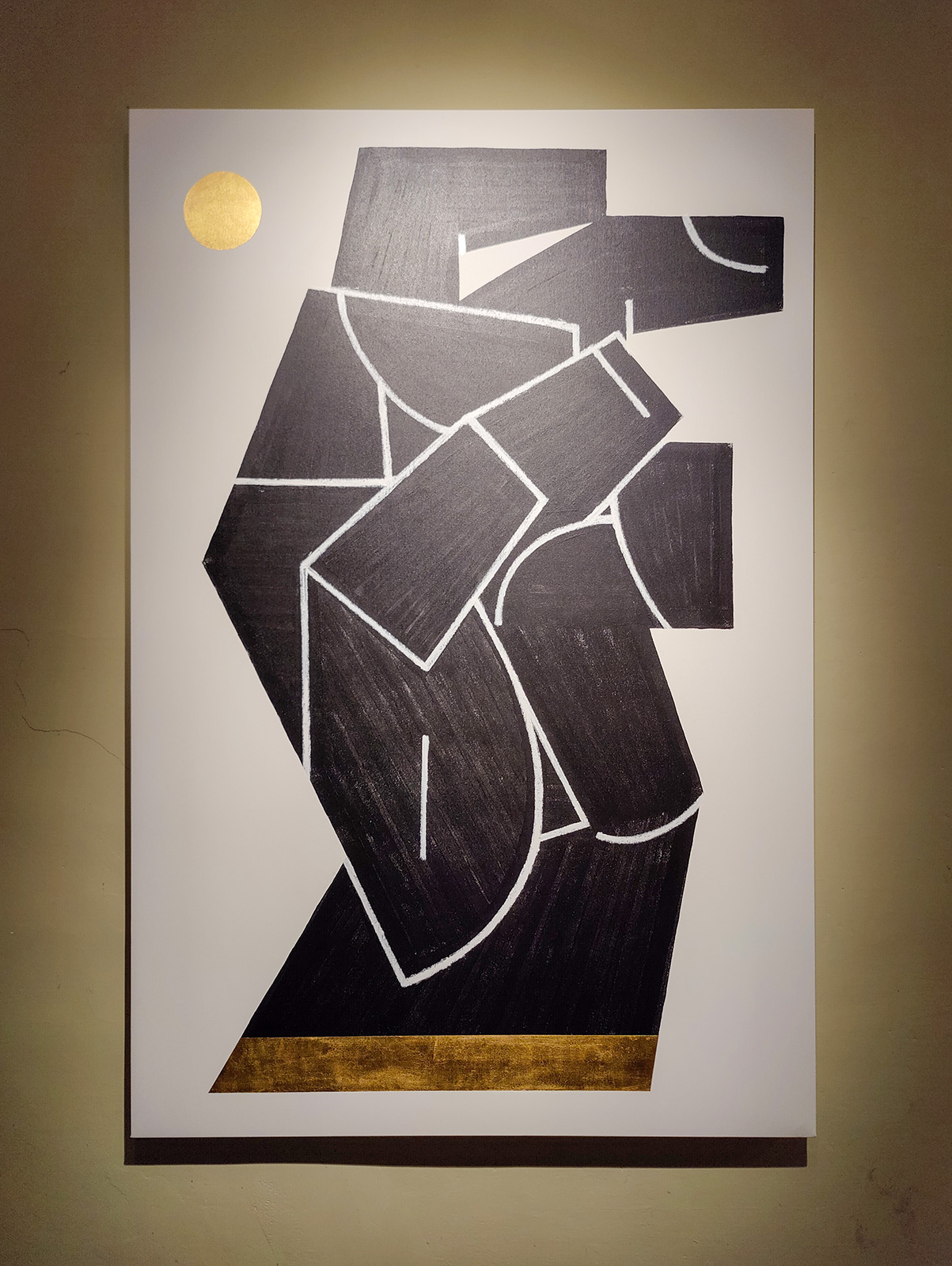
No Title
2023
2023
Acrylic and 22k gold leaf on canvas
100x150 cm
100x150 cm
Ouroboros is a body of work aiming to push the boundaries between figurative and abstraction.
A free and peculiar approach to the essentialization and idealization of lines and shapes that constitute a human hand as a whole.

No Title
2026
2026
Fluorescent spray paint, pastel and acrylic on canvas
70x100 cm
70x100 cm
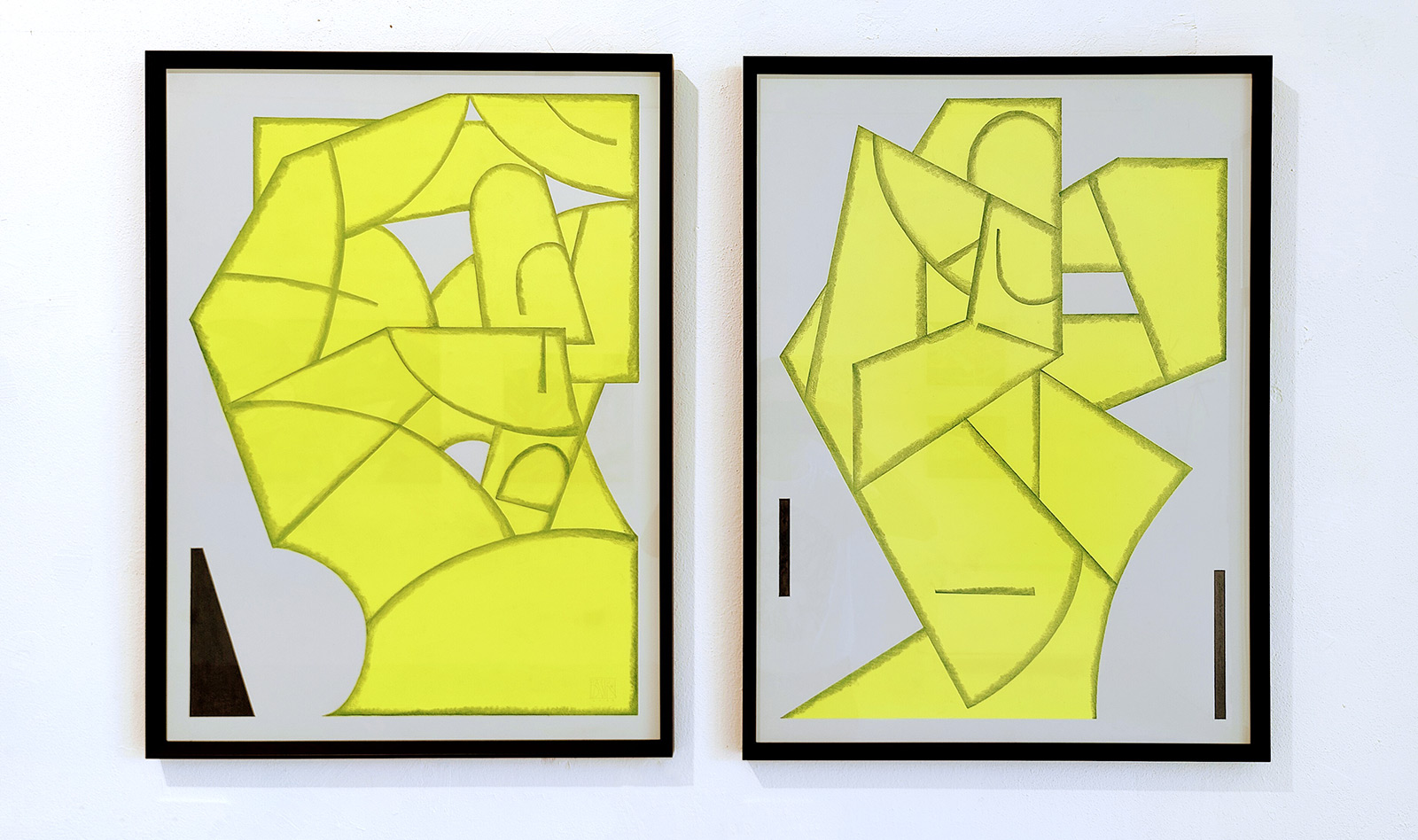
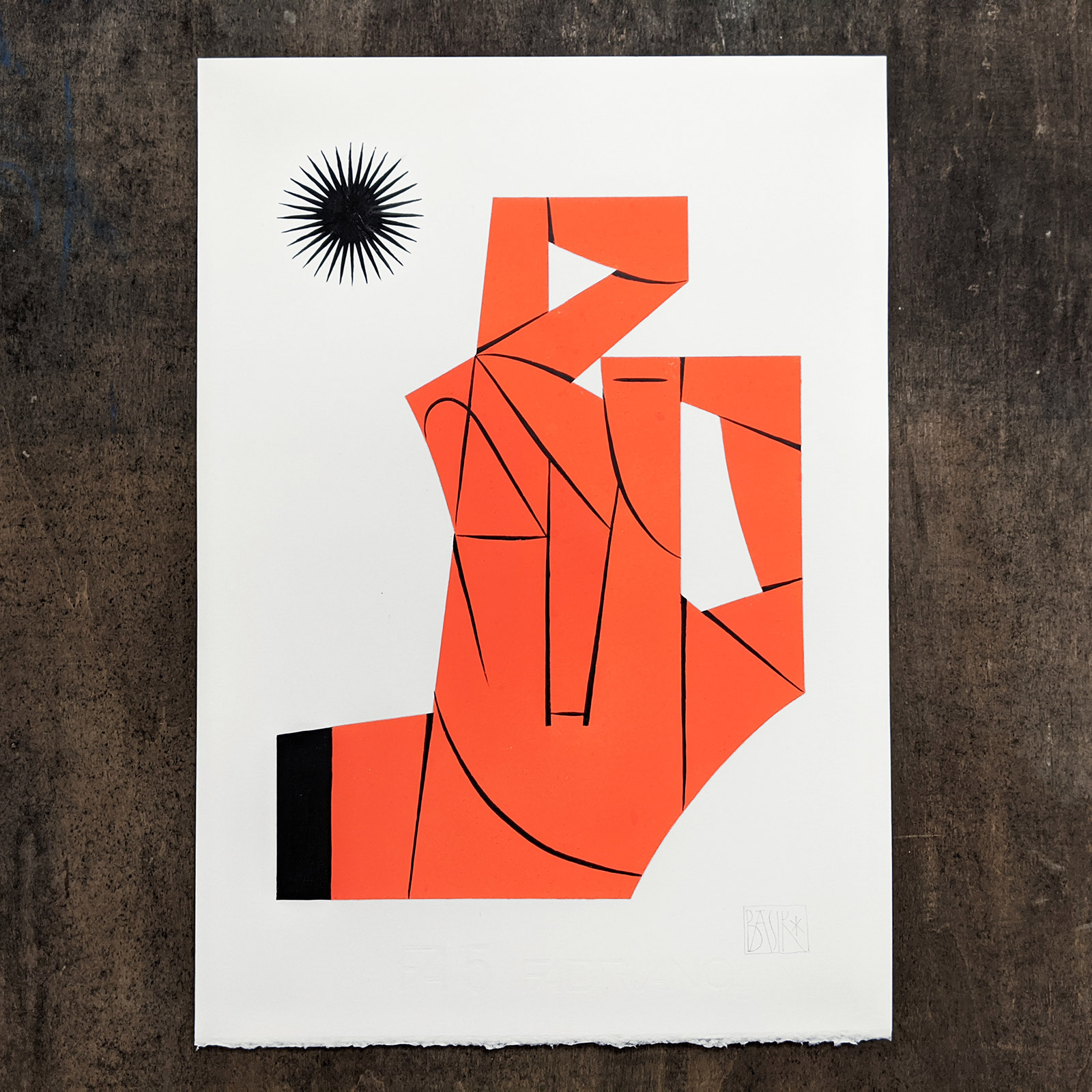
Fluorescent Torment VI, VII
2020
2020
Spray paint, graphite and acrylic on paper.
50x70 cm
50x70 cm


Ouroboros Mannu
Ussana, Italy 2019
Ussana, Italy 2019
Mural for Campidarte art residency program based in a rural area in southern Sardinia’s inland, surrounded by nature, agricultural landscapes and sheep herds.

Ouroboros V: Semi Brutal
Mar del Plata, Argentina 2019
Mar del Plata, Argentina 2019
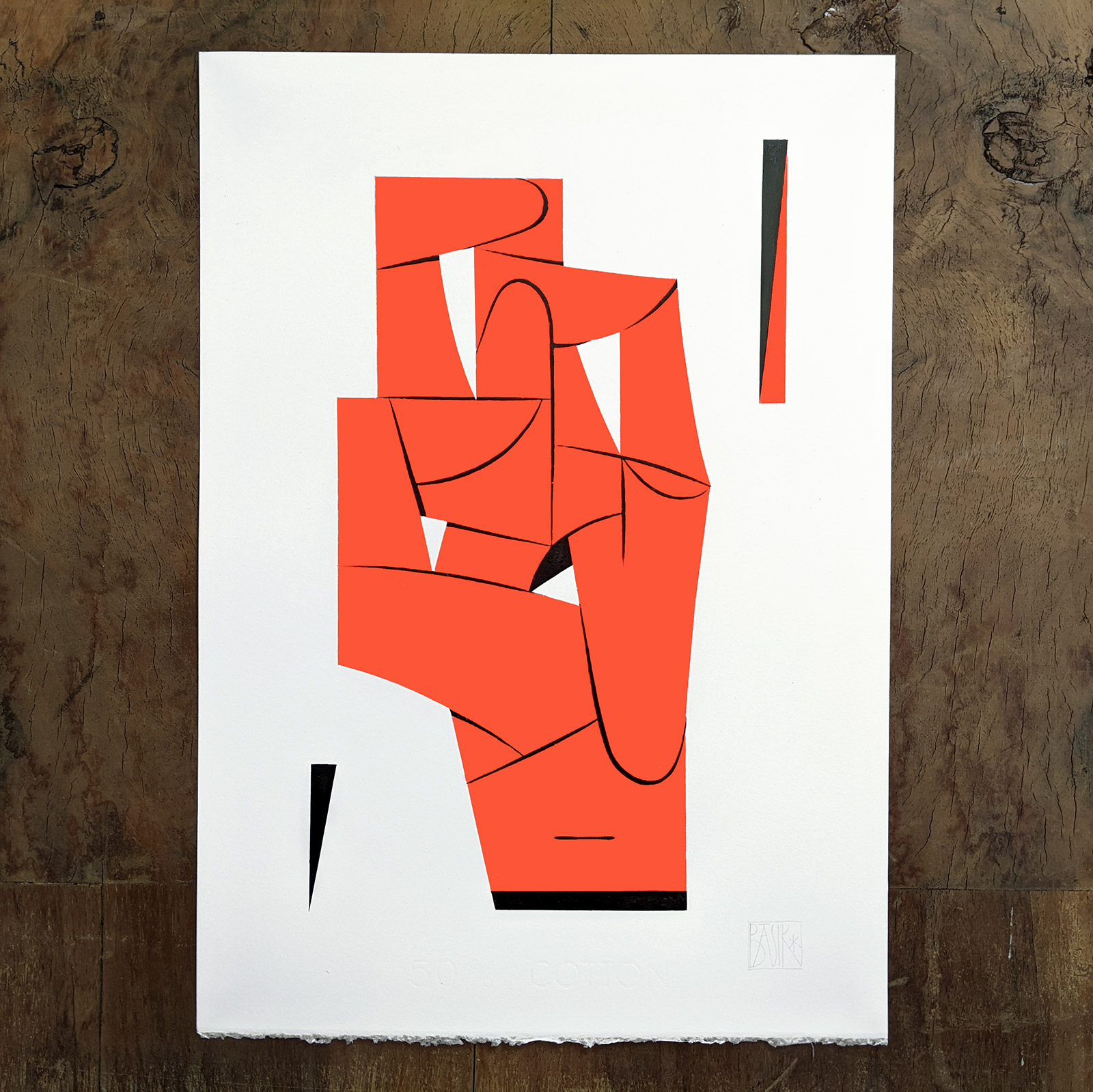

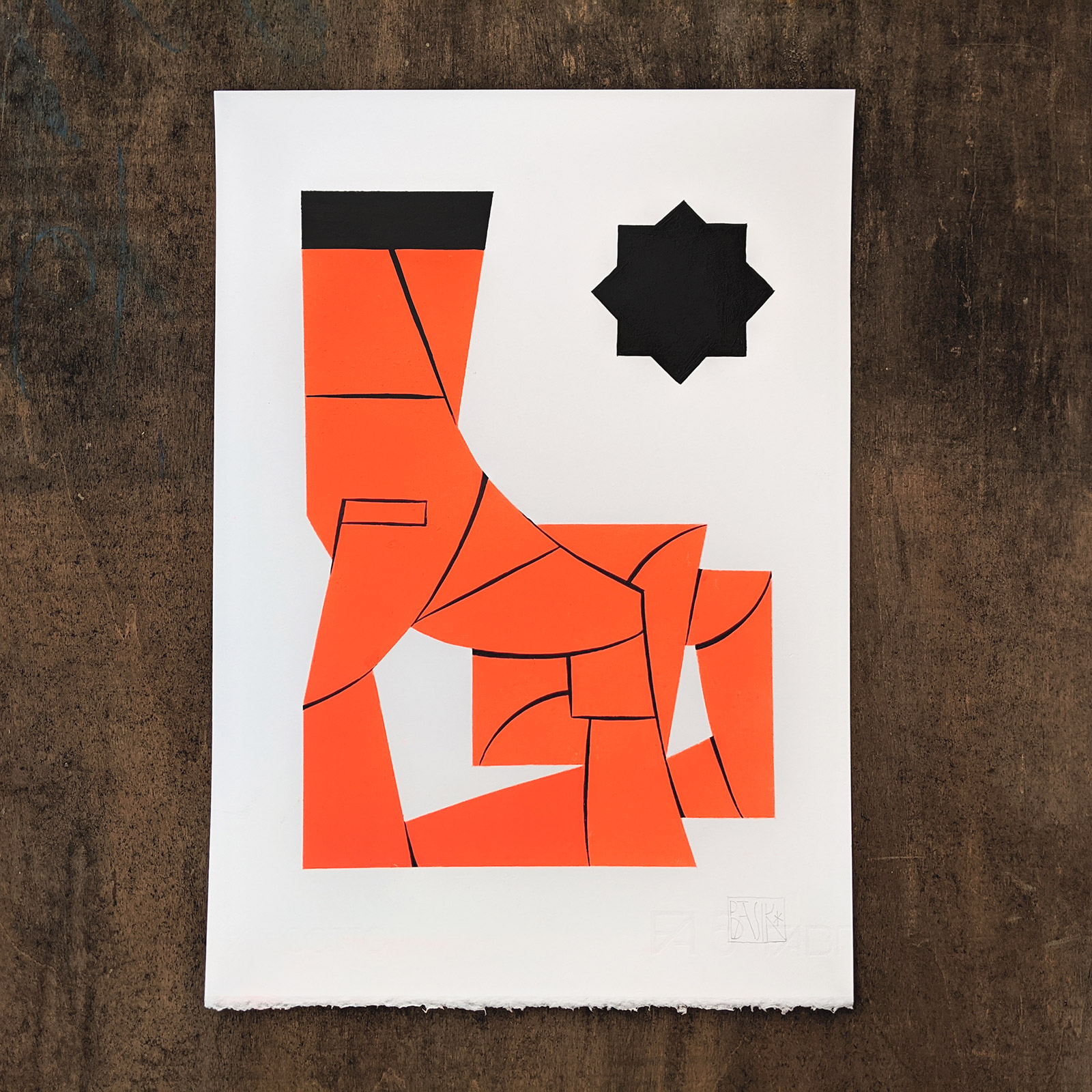
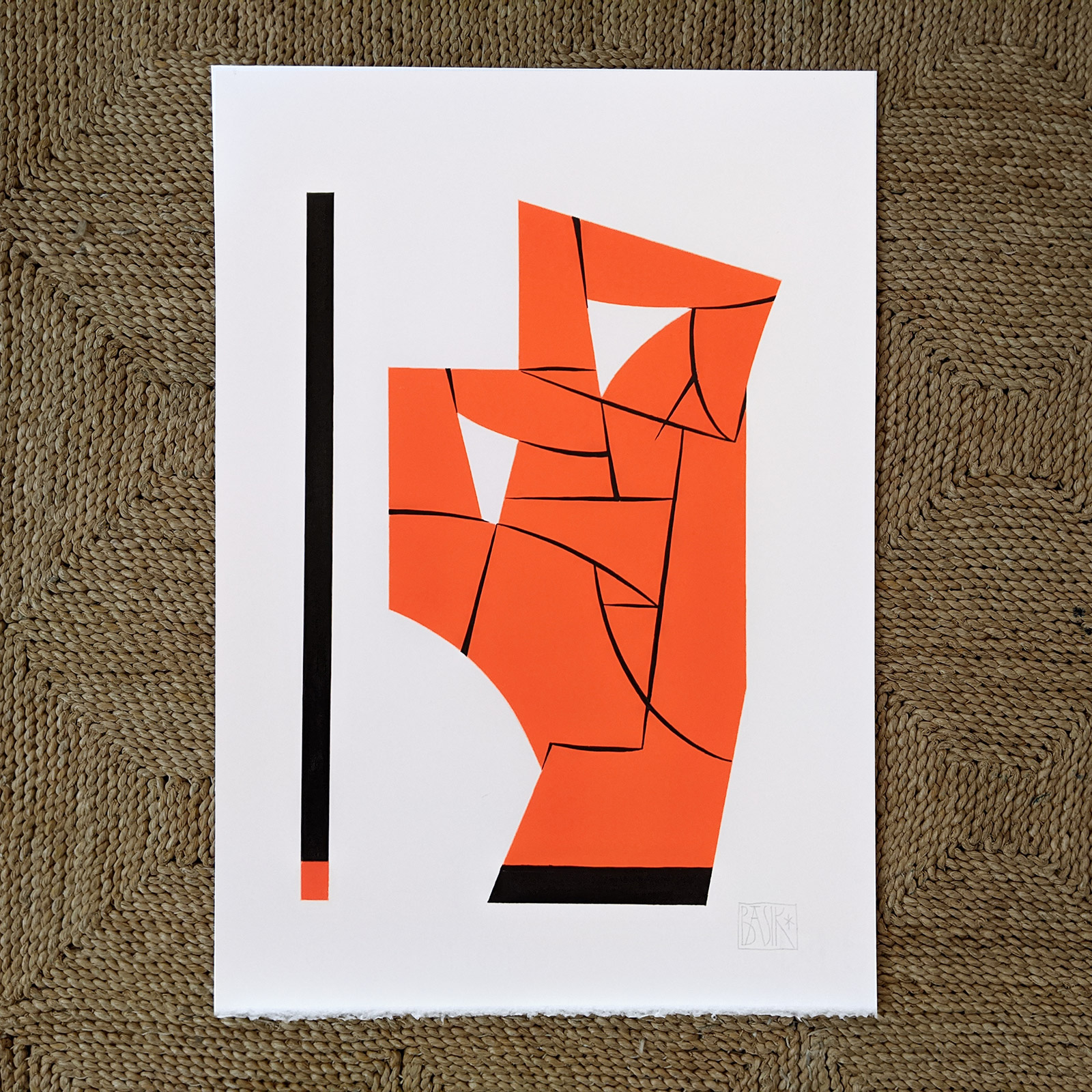
Naranja Fluor I-V
2020
2020
Fluorescent spray paint and acrylic on paper.
A4 size
A4 size

No Title
2021
2021
Indoor painting on abandoned building.

No Title (How I Ended up Finishing this Painting in Between Birth and Death)
2020-2022
2020-2022
Acrylic on canvas.
120x90 cm
120x90 cm
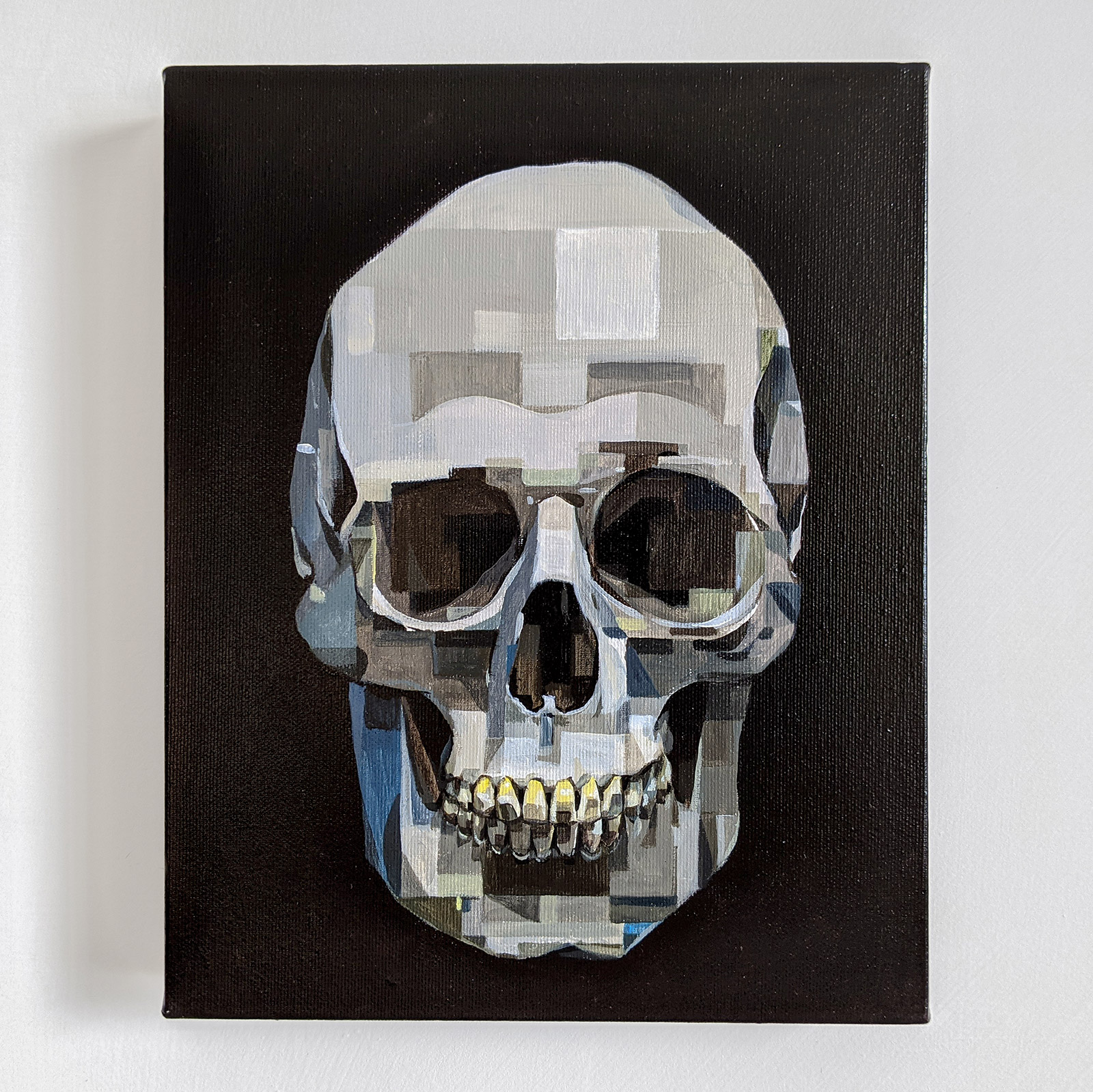

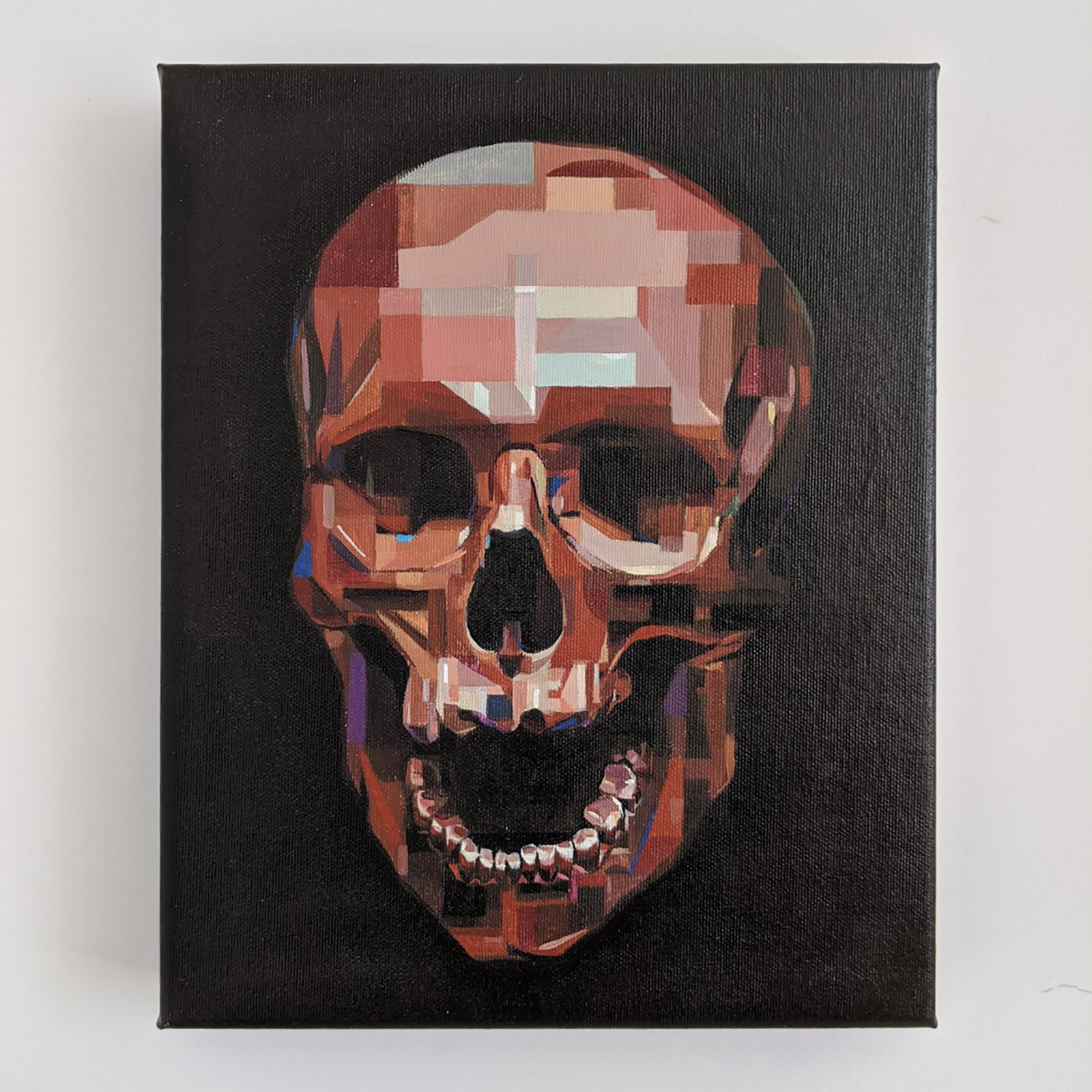
Natura Morta I, II, III
2020-2021
2020-2021
Acrylic and on canvas.
24x30 cm each
24x30 cm each


Vanitas Loquelae
2016
2016
Acrylic on found object.
A tribute to Dante Alighieri, featured in the collective exhibition idDante hosted in Ravenna (Italy), the city in which the poet spent his last years.
Based on the exact facial reconstruction made by the Bologna University by using the poet’s skull remnants.
This work focuses on the skull, rather than a romantic interpretation of Dante’s face as seen in many paintings throughout centuries. Here, the theme of death and the path from its lowest to the highest spiritual edge have been crucial to the completion of the piece, as well as taking into account philosophical concepts related to the caducity of life and earthly glory.
A tribute to Dante Alighieri, featured in the collective exhibition idDante hosted in Ravenna (Italy), the city in which the poet spent his last years.
Based on the exact facial reconstruction made by the Bologna University by using the poet’s skull remnants.
This work focuses on the skull, rather than a romantic interpretation of Dante’s face as seen in many paintings throughout centuries. Here, the theme of death and the path from its lowest to the highest spiritual edge have been crucial to the completion of the piece, as well as taking into account philosophical concepts related to the caducity of life and earthly glory.
More coming.

Our Lady of Sorrows and St. John (Mater Dolorosa, Spes Sublimis)
2025
2025
Acrylic and gold leaf on canvas.
200x270 cm
Commission for the 850th Anniversary of the foundation of the Diocese of Alessandria, Italy.
200x270 cm
Commission for the 850th Anniversary of the foundation of the Diocese of Alessandria, Italy.
Saints: popular figures in classic western imagery, traditional subjects as well as pop(ular) icons, capable of being modern through times thanks to a long lasting appeal in mass culture, often transcending their mere depictional religious value and purpose.
The whole body of work carries more in depth personal reflections and thoughts about the process of making art, the aesthetics beneath the framing of a subject, the bond between artist and his art and the relation between art (and/or the artist) and the viewer.


The Martyrdom of St. Bartholomew’s canvas
2017
2017
Acrylic and gold leaf on canvas.
60x60 cm
60x60 cm
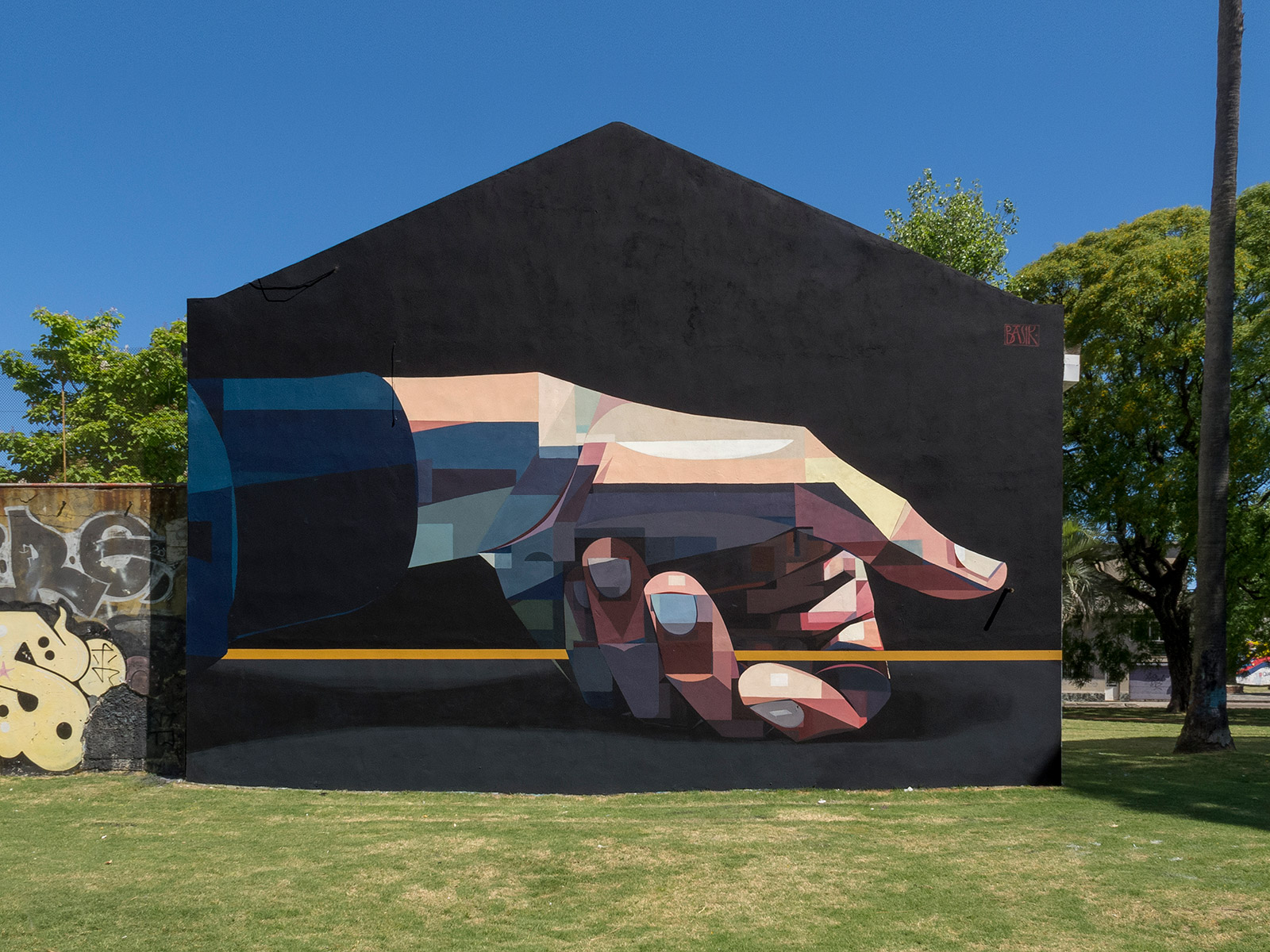
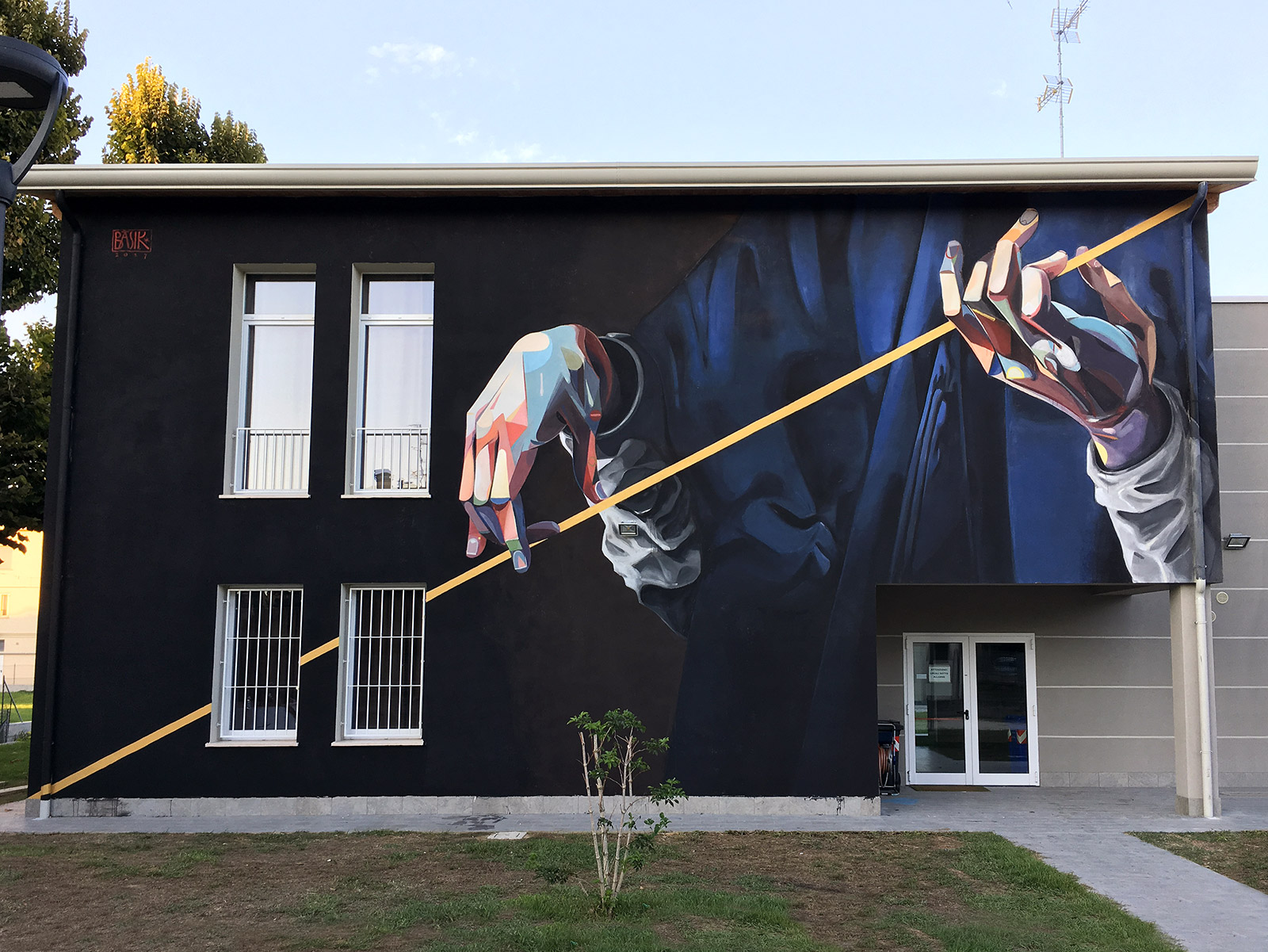
Division of a painting’s space according to the local symbology
Montevideo, Uruguay 2019
Montevideo, Uruguay 2019
Based on the patronage of St. Philip, a defining element of the city of Montevideo (and, more generally, of Uruguay).
The straight line passing through the hand is in fact a subtle reference to the horizontality of St. Philip's cross, which is traditionally depicted sideways, contrary to the common vertical representation of the cross symbol.
As if the patron would lay a marking element into the composition, separating foreground and background of the very same picture of which he is part, such pure graphic element, a line, is set to cover the horizon point between the frontal plain surface below the hand and the background, generating a duality of feelings: on one hand acting as a neat spacial division of a picture; on the other hand, seeming to somehow disrupt the boundaries between front and back as known in figurative painting, resulting in a declaration of "art as art" (or better "painting as art"), embracing the mural's bidimensional defining trait despite the attempt of capturing real life that lies beneath the traditional ideals of figuration.
The straight line passing through the hand is in fact a subtle reference to the horizontality of St. Philip's cross, which is traditionally depicted sideways, contrary to the common vertical representation of the cross symbol.
As if the patron would lay a marking element into the composition, separating foreground and background of the very same picture of which he is part, such pure graphic element, a line, is set to cover the horizon point between the frontal plain surface below the hand and the background, generating a duality of feelings: on one hand acting as a neat spacial division of a picture; on the other hand, seeming to somehow disrupt the boundaries between front and back as known in figurative painting, resulting in a declaration of "art as art" (or better "painting as art"), embracing the mural's bidimensional defining trait despite the attempt of capturing real life that lies beneath the traditional ideals of figuration.
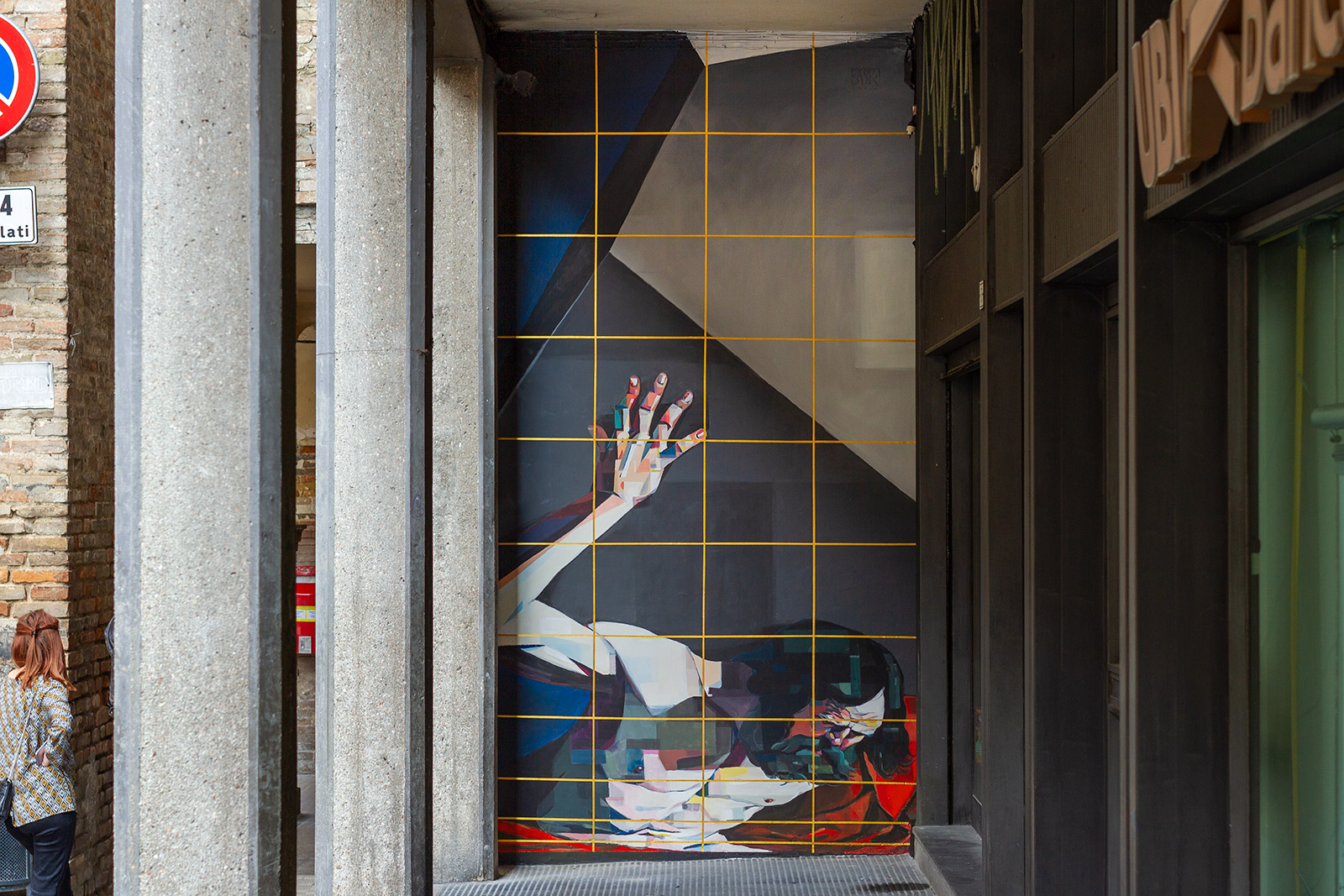
St. Christopher carrying the weight of proportions
Urbania, Italy 2019
Urbania, Italy 2019
St. Christopher carrying the infant Christ theme metaphorically relating to the place on which it is painted, an old building severely damaged by aerial bombings during WWII.
The sense of heavyness is here represented by Dührer's Melencolia I geometrical shape weighing on the shoulders of the figure, while his anatomical deformation is caused by the progressive contraction of a process element, such as the grid, now turned into art element.
The sense of heavyness is here represented by Dührer's Melencolia I geometrical shape weighing on the shoulders of the figure, while his anatomical deformation is caused by the progressive contraction of a process element, such as the grid, now turned into art element.

St. Rosalia aligns to center the image of Palermo
Palermo, Italy 2018
Palermo, Italy 2018
The piece features a main subject intentionally standing outside the wall framing, instead presenting the viewer a collection of items related to the symbolism of the city's main patrons from both the Christian and pre-Christian eras. The golden pot at the center carries the symbols of Saint Rosalia, St. Christina of Bolsena, St. Ninfa, St. Olivia, and St. Agatha, as seen in traditional depictions, while the crown and vase reference the Genius of Palermo, an ancient patron likely originating in the pre-Roman era.
This symbolic, tightly composed still life is set within a long vertical black space, creating a void along the edges. On a primary level, this compositional choice, together with the variety of objects depicted, evokes the “baroque” abundance at the heart of a fertile land where, over centuries, many cultures intertwined and enriched one another, making Palermo a unique example of integration and inclusiveness.
On a deeper level, the discrepancy between the subject and the steep proportions of the frame creates a tension that raises questions about art within a pre-defined space—a play, or even a struggle, with the spatial limits inherent to works created in public environments, especially on the wall of an existing building.
This symbolic, tightly composed still life is set within a long vertical black space, creating a void along the edges. On a primary level, this compositional choice, together with the variety of objects depicted, evokes the “baroque” abundance at the heart of a fertile land where, over centuries, many cultures intertwined and enriched one another, making Palermo a unique example of integration and inclusiveness.
On a deeper level, the discrepancy between the subject and the steep proportions of the frame creates a tension that raises questions about art within a pre-defined space—a play, or even a struggle, with the spatial limits inherent to works created in public environments, especially on the wall of an existing building.
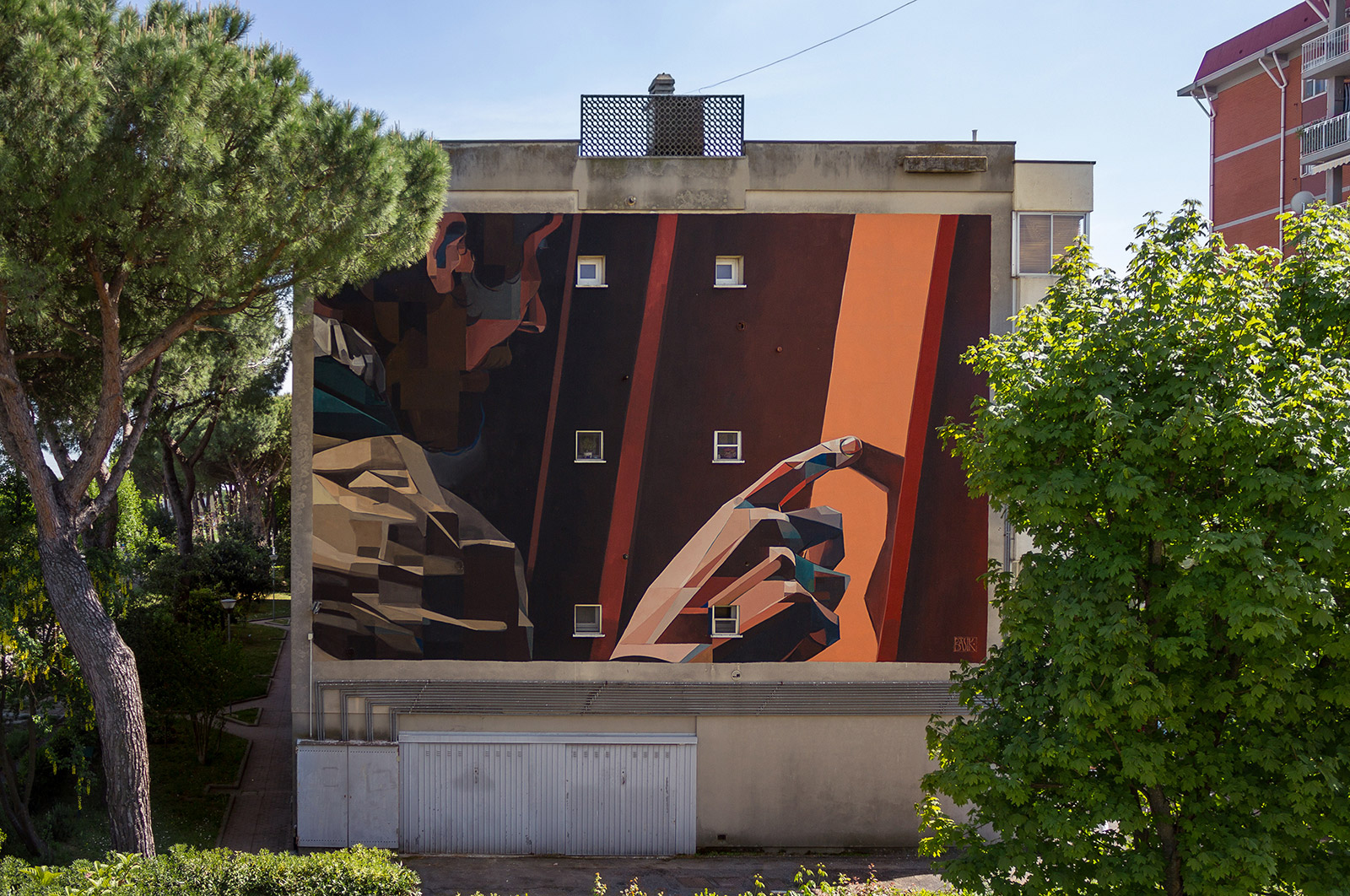
The Incredulity of Saint Thomas towards Modern Art
Ravenna, Italy 2019
Ravenna, Italy 2019
Tribute to Alberto Burri’s “Grande Ferro R”, a site-specific steel sculpture made in 1990 in the city of Ravenna, Italy.
Closely located to Burri’s work, the mural consists in an adaptation of the “doubting Thomas” theme, a criticism towards the current bad state of preservation and development of the Grande Ferro and therefore criticism on how it is perceived by the local administrations, as well as among common citizens.
When it comes to modern and contemporary art in general, where the horizons of the “immediately recognizable” of figurative and still nature heavily blur, making space to conceptuality and abstraction, the aim is to arise questions regarding the definition and perception of a piece of art as such (through people’s eyes), the loss of importance of a creative act in collectivity through nullifying behaviours, which then leads to questions about weighing the responsibilities of institutions, users, viewers and citizens towards (public) art.
Closely located to Burri’s work, the mural consists in an adaptation of the “doubting Thomas” theme, a criticism towards the current bad state of preservation and development of the Grande Ferro and therefore criticism on how it is perceived by the local administrations, as well as among common citizens.
When it comes to modern and contemporary art in general, where the horizons of the “immediately recognizable” of figurative and still nature heavily blur, making space to conceptuality and abstraction, the aim is to arise questions regarding the definition and perception of a piece of art as such (through people’s eyes), the loss of importance of a creative act in collectivity through nullifying behaviours, which then leads to questions about weighing the responsibilities of institutions, users, viewers and citizens towards (public) art.

St.George slaying the Dragon
2015-2016
2015-2016
Acrylic and gold leaf on canvas.
80x120 cm
80x120 cm

The Martyrdom of Saint Lucy according to the Fifteen Minutes of Fame theory
Forlì, Italy 2019
Forlì, Italy 2019
Contrary to the traditional representation of the martyrdom of Saint Lucy, in which she is usually portrayed stabbed to death, this work focuses on a central female figure “martyred” by the strong light of an out of frame unsolicited photo flash, a metaphor of the overwhelming abundance of portraits and selfies throughout the majority of new media.
The figure covers her eyes (and face), resulting in the iconoclast nullification of Saint Lucy’s sight feature and, moreover, of her depicted image, as traditionally intended.
Additionally, the wall itself (and the environment surrounding it), when receiving a façade lift, could be considered as another metaphor of such concept.
The figure covers her eyes (and face), resulting in the iconoclast nullification of Saint Lucy’s sight feature and, moreover, of her depicted image, as traditionally intended.
Additionally, the wall itself (and the environment surrounding it), when receiving a façade lift, could be considered as another metaphor of such concept.
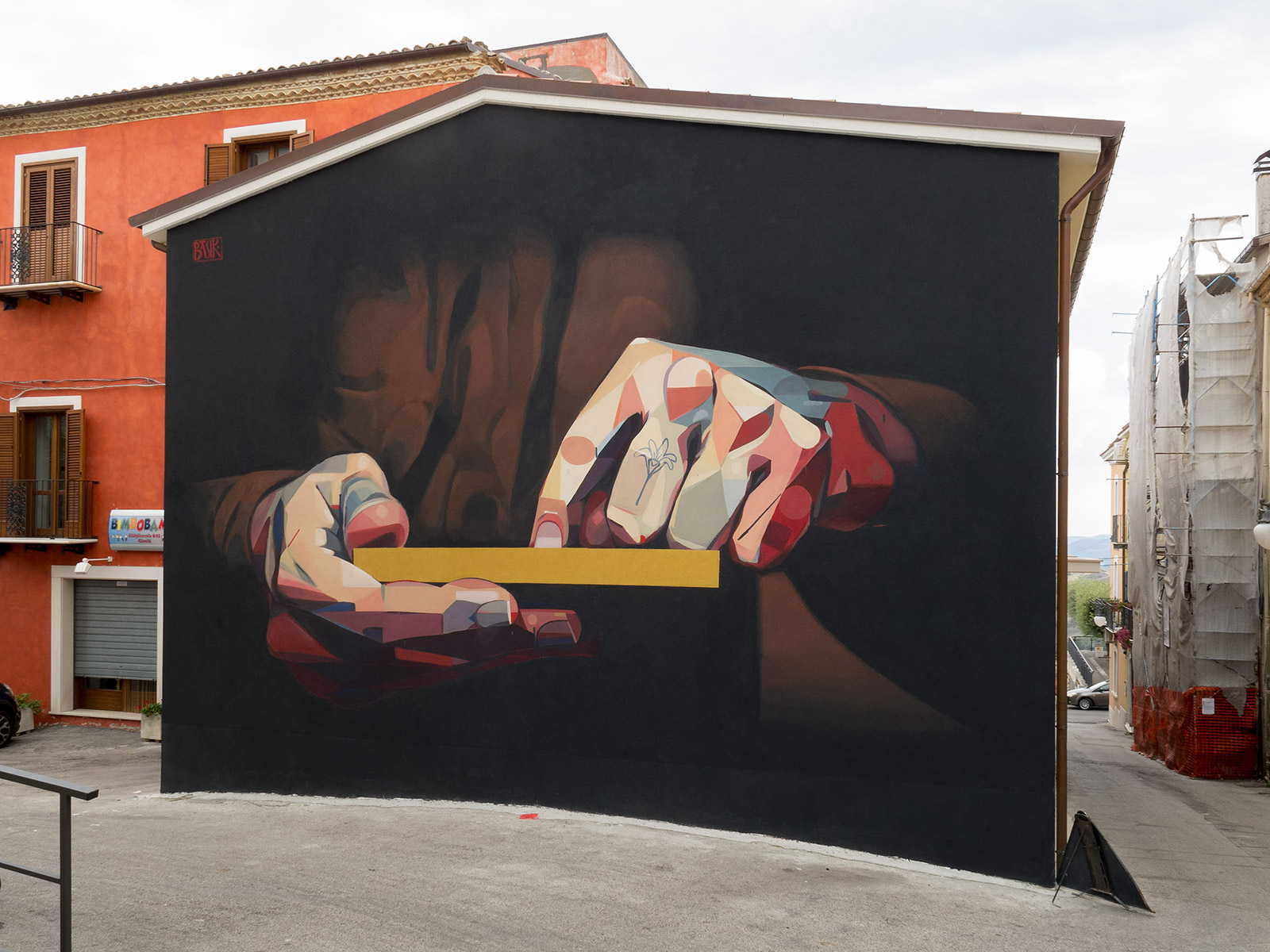
St. Anthony of Padua preaching to his followers
Santa Croce di Magliano, Italy 2018
Santa Croce di Magliano, Italy 2018
The work is based on a conceptual parallelism between the legend of the Saint (patron of the town) preaching to the fishes and new dynamics in the connection between art, artist and the viewer in the age of social media.
While such networks supposedly allow a more direct and quicker relationship between the abovementioned counterparts they also let new topics about the current state of art arise:
How much the perception of a work of art and the ideas beneath it can shift when filtered through the “perfectify” lenses of social media? Does this invisible filter also affect the words, the questions & answers and any type of comment occuring, eventually leading to a lack in authenticity? Do both art and viewers truly experience benefits, given the concept of ‘fast consumption’ that seems to be at the core of contemporary connecting environments?
While such networks supposedly allow a more direct and quicker relationship between the abovementioned counterparts they also let new topics about the current state of art arise:
How much the perception of a work of art and the ideas beneath it can shift when filtered through the “perfectify” lenses of social media? Does this invisible filter also affect the words, the questions & answers and any type of comment occuring, eventually leading to a lack in authenticity? Do both art and viewers truly experience benefits, given the concept of ‘fast consumption’ that seems to be at the core of contemporary connecting environments?

St. Luke drawing with his own rib
2015
2015
Acrylic, enamel and gold leaf on wood panel.
70x99 cm
70x99 cm
St. Luke drawing with his own rib
2015
2015
Acrylic, enamel and gold leaf on wood panel.
70x99 cm
70x99 cm
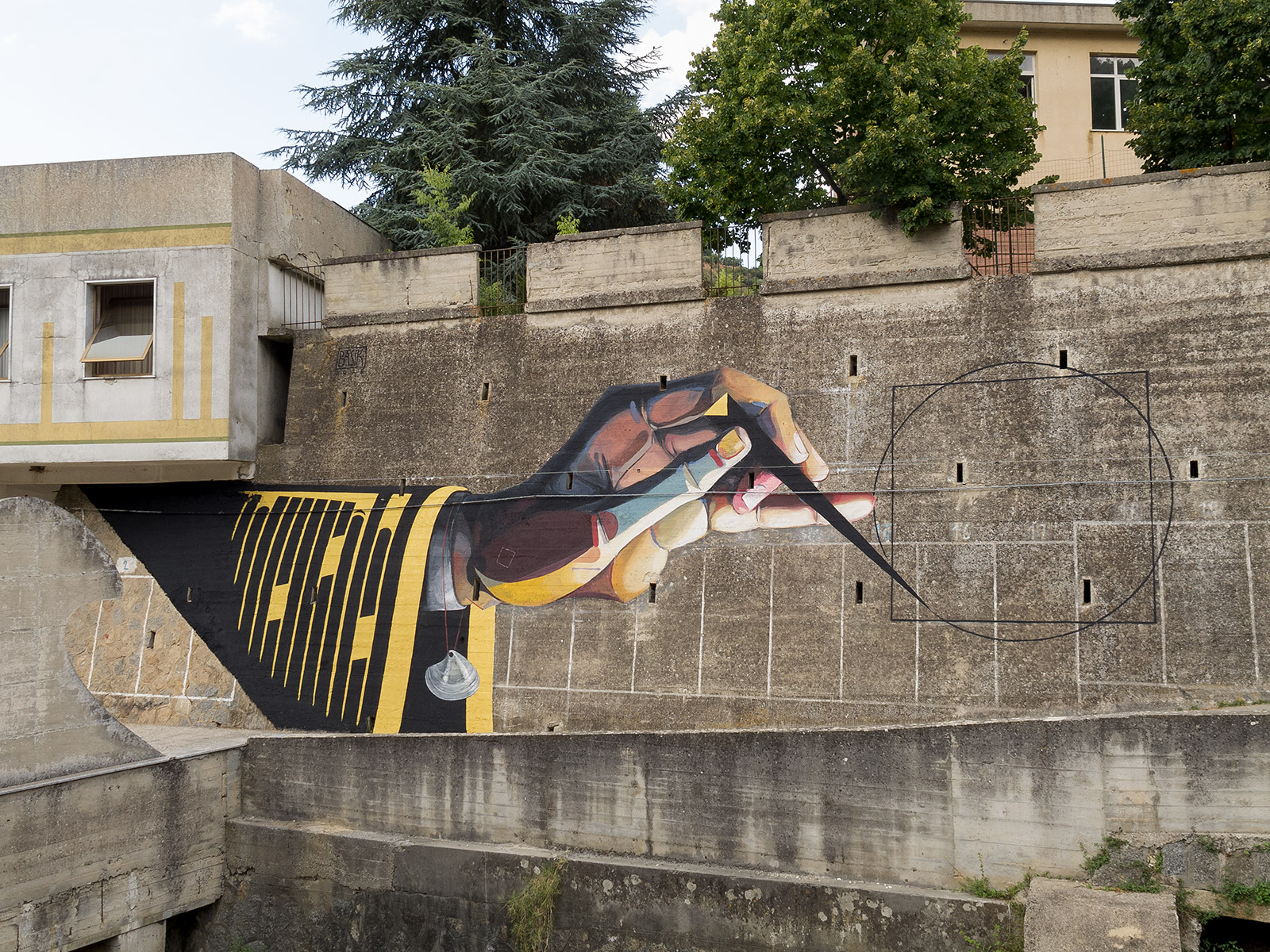
The Artist as Saint Roch squaring the circle on a wall in Gerocarne
Gerocarne, Italy 2016
Gerocarne, Italy 2016
Nostoi, a greek word literally meaning “(it) returns”, is the title of a poem part of the Trojan Cycle about the return home of the greek soldiers after the end of the Trojan War.
The south of Italy has always been a land conquered by different civilizations, filled with several cultures coming from distant places that blended together over the centurie so, more than any other area in my country, it has experienced the immigration/emigration phenomenon, from the soldiers living in Magna Graecia, who had to go to war in places far away from their home, to the millions of Italian citizens emigrated abroad to find better living conditions, some of which now use to come back to their native place during holidays.
My personal reflection on such land has been to conceptually link and unify two distant things, represented by the geometric task of squaring the circle, an impossible problem that philosophically aims to join earth and sky (respectively represented by a square and a circle since ancient times). The Saint Roch’s imagery works as a reminder of the place in which the painting now lies. The inhabitants of Gerocarne are in fact strictly devoted to the saint, who has always traditionally depicted with a seashell on his coat.
Nonetheless, the choice of painting a clam bound to the wrist is intentional: a common food for the fishermen and poor people of my homeland throughout the centuries, it is in fact also meant to be a symbol of my birthplace. A detail that comes with a double value, a metaphorical item linking two locations so distant by a thin, ideal line.
The south of Italy has always been a land conquered by different civilizations, filled with several cultures coming from distant places that blended together over the centurie so, more than any other area in my country, it has experienced the immigration/emigration phenomenon, from the soldiers living in Magna Graecia, who had to go to war in places far away from their home, to the millions of Italian citizens emigrated abroad to find better living conditions, some of which now use to come back to their native place during holidays.
My personal reflection on such land has been to conceptually link and unify two distant things, represented by the geometric task of squaring the circle, an impossible problem that philosophically aims to join earth and sky (respectively represented by a square and a circle since ancient times). The Saint Roch’s imagery works as a reminder of the place in which the painting now lies. The inhabitants of Gerocarne are in fact strictly devoted to the saint, who has always traditionally depicted with a seashell on his coat.
Nonetheless, the choice of painting a clam bound to the wrist is intentional: a common food for the fishermen and poor people of my homeland throughout the centuries, it is in fact also meant to be a symbol of my birthplace. A detail that comes with a double value, a metaphorical item linking two locations so distant by a thin, ideal line.
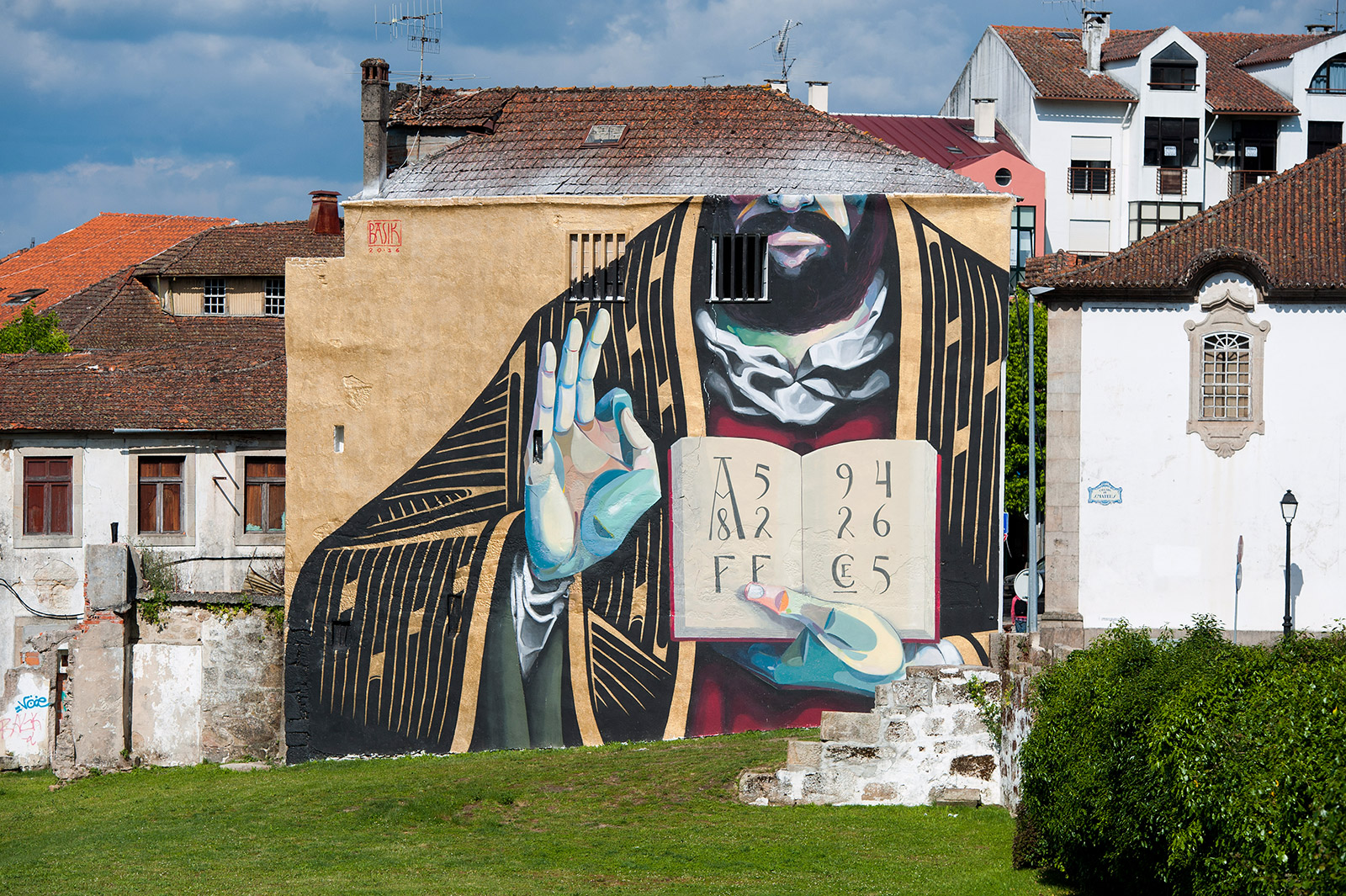
St. Peter holds the book of encryption
Viseu, Portugal 2016
Viseu, Portugal 2016
Reinterpretation of “St. Peter in his throne”, a painting by portuguese Renaissance master Grão Vasco, who was born in Viseu.
The figure casts a three gesture as chinese people do, while holding a book showing a randomly generated 128-bit WEP key password. both details are meant to be metaphors of a personal reflection on our current times and the related recent changes in geo-political and economic world balances, as well as everyday habits heavily influenced by consumer technology.
The figure casts a three gesture as chinese people do, while holding a book showing a randomly generated 128-bit WEP key password. both details are meant to be metaphors of a personal reflection on our current times and the related recent changes in geo-political and economic world balances, as well as everyday habits heavily influenced by consumer technology.
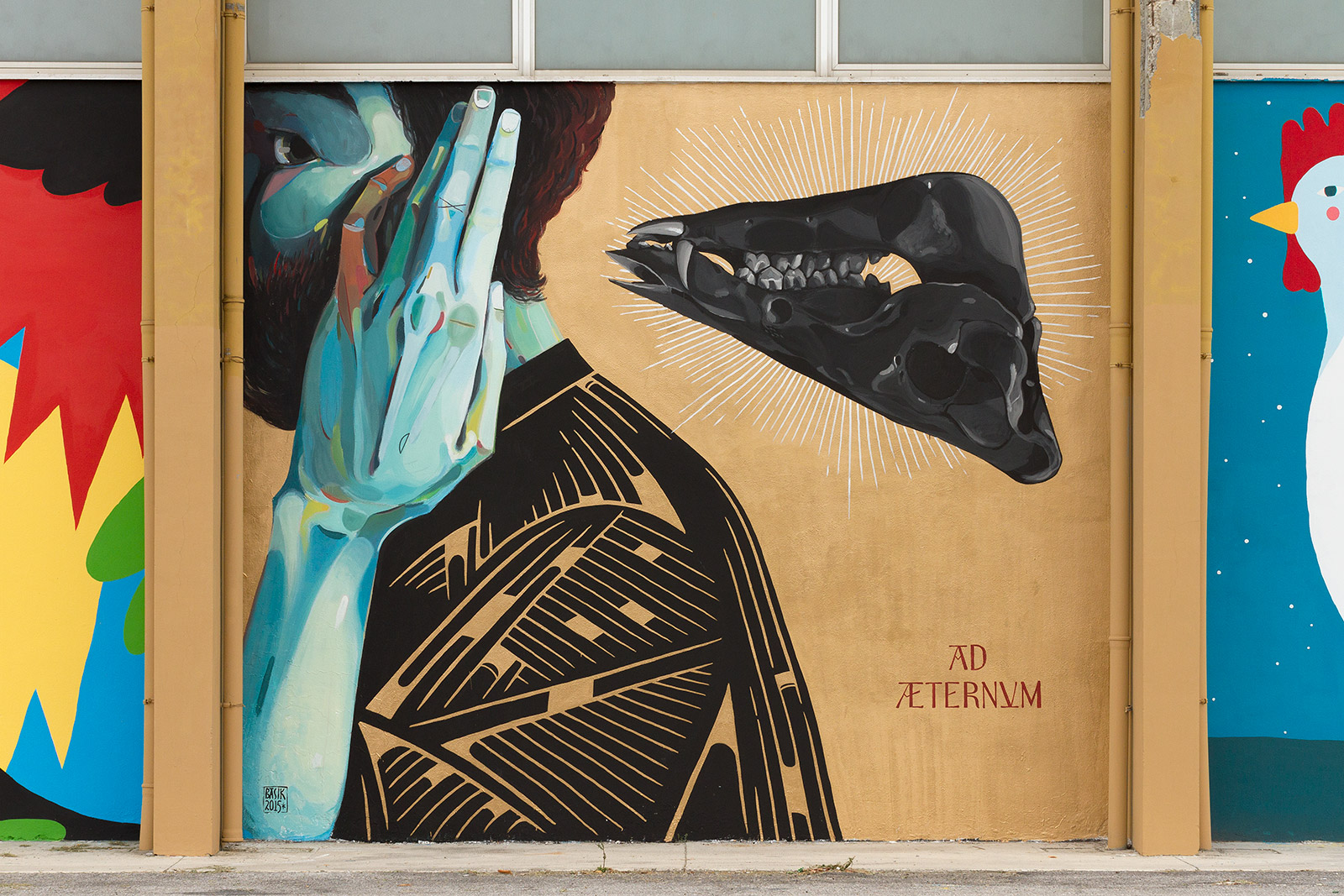
St. Anthony Seduced by The Infinite
Pesaro, Italy 2015
Pesaro, Italy 2015
The figure is here tempted by the promise of eternal life, represented by a reverse pig’s skull (the hog is in fact one of the saint’s classical symbols often depicted close to his figure).
On bottom right the latin words Ad æternum (forever).
On bottom right the latin words Ad æternum (forever).


The Throw
Chiesanuova, San Marino Republic 2025
Chiesanuova, San Marino Republic 2025
Piece made for BuoneNove festival.
Inspired by a story involving St. Marino and St. Leo, who both crossed the Adriatic sea from Dalmatia to Rimini to work as stonemasons for the Roman Empire.
Legend has it that once they respectively moved to the nearby mount Titano and mount Feltro (the actual areas of San Marino and San Leo), they threw each other work tools from one mount to the other.
Inspired by a story involving St. Marino and St. Leo, who both crossed the Adriatic sea from Dalmatia to Rimini to work as stonemasons for the Roman Empire.
Legend has it that once they respectively moved to the nearby mount Titano and mount Feltro (the actual areas of San Marino and San Leo), they threw each other work tools from one mount to the other.

Spectrum Vitae: Successive/Complementary
Falciano, San Marino Republic 2025
Falciano, San Marino Republic 2025
The title of the artwork expresses a synthesis of scientific rigor and inspirational depth. Spectrum Vitae evokes the color wheel, a symbol of continuity, transformation, and interconnection. Each color represents a phase or nuance of human and natural experience where science and art meet. The term spectrum emphasizes the scientific dimension of the project, linked to light and color theory, while vitae universally refers to life itself, constantly evolving and transforming.
Successive/Complementary adds a dynamic interpretive layer by highlighting the natural transition between phases (successive) and the harmonious balance between opposing yet interdependent elements (complementary). These scientific and philosophical concepts are expressed through the color wheel supported between two hands.
The artwork conveys a message of connection and continuity, where every transition is both an ending and a new beginning. The hands symbolize humanity and collaboration, bridging what has been and what will be in a continuous process of growth and discovery.
Ultimately, the viewer is invited to reflect on how science, nature, and creativity intertwine throughout life’s journey, maintaining a balance between progress and complementarity, between what we inherit and what we create together.
Successive/Complementary adds a dynamic interpretive layer by highlighting the natural transition between phases (successive) and the harmonious balance between opposing yet interdependent elements (complementary). These scientific and philosophical concepts are expressed through the color wheel supported between two hands.
The artwork conveys a message of connection and continuity, where every transition is both an ending and a new beginning. The hands symbolize humanity and collaboration, bridging what has been and what will be in a continuous process of growth and discovery.
Ultimately, the viewer is invited to reflect on how science, nature, and creativity intertwine throughout life’s journey, maintaining a balance between progress and complementarity, between what we inherit and what we create together.
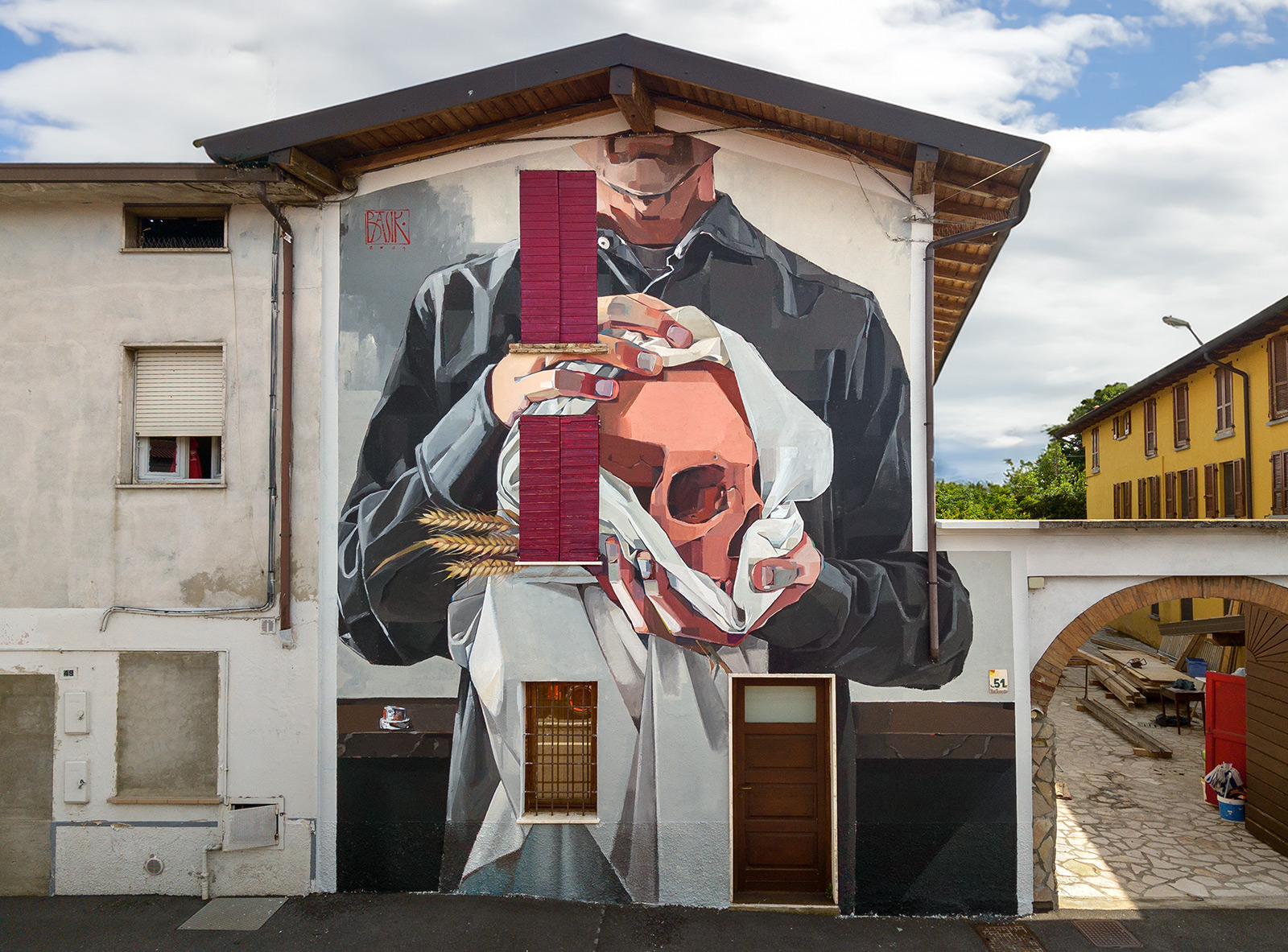
The Unboxing
Covo, Italy 2024
Covo, Italy 2024
Having as its focal point the depiction of the relic of St. Lazarus kept in town of Covo, the work mixes the setting characteristics of a vanitas with a half-length figure in the act of unboxing the remains of the local patron saint.
Completing the composition are three ears of wheat, reminding the town's heraldry, and a fatcap set in the background, symbolizing the author's artistic journey.
Just as the painted subject hands seem to gift the relic of St. Lazarus to the viewers, the artist, acting on a deeper interpretational level, aims to the recreate the same gesture by donating the work to Covo and its citizens.
Completing the composition are three ears of wheat, reminding the town's heraldry, and a fatcap set in the background, symbolizing the author's artistic journey.
Just as the painted subject hands seem to gift the relic of St. Lazarus to the viewers, the artist, acting on a deeper interpretational level, aims to the recreate the same gesture by donating the work to Covo and its citizens.


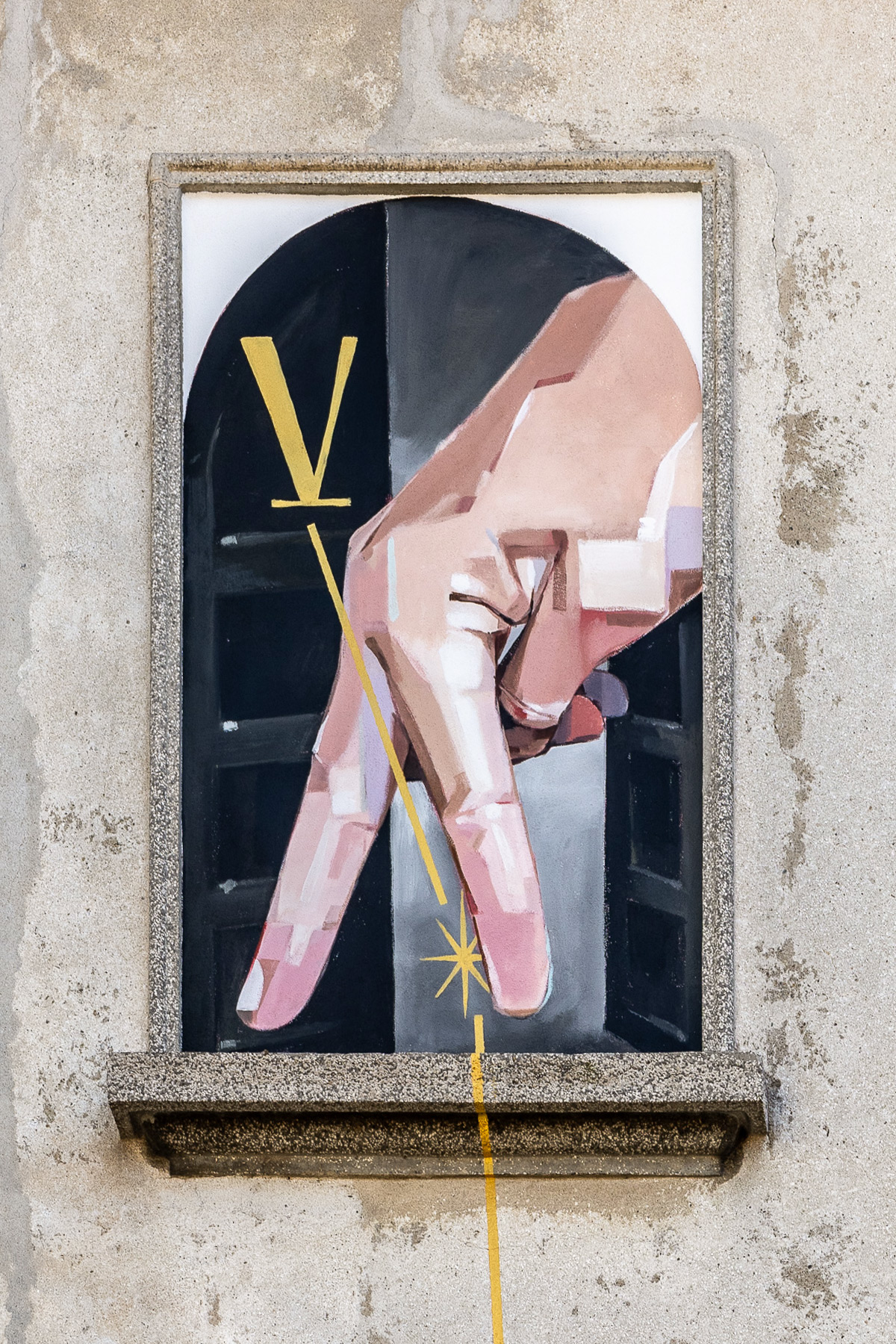
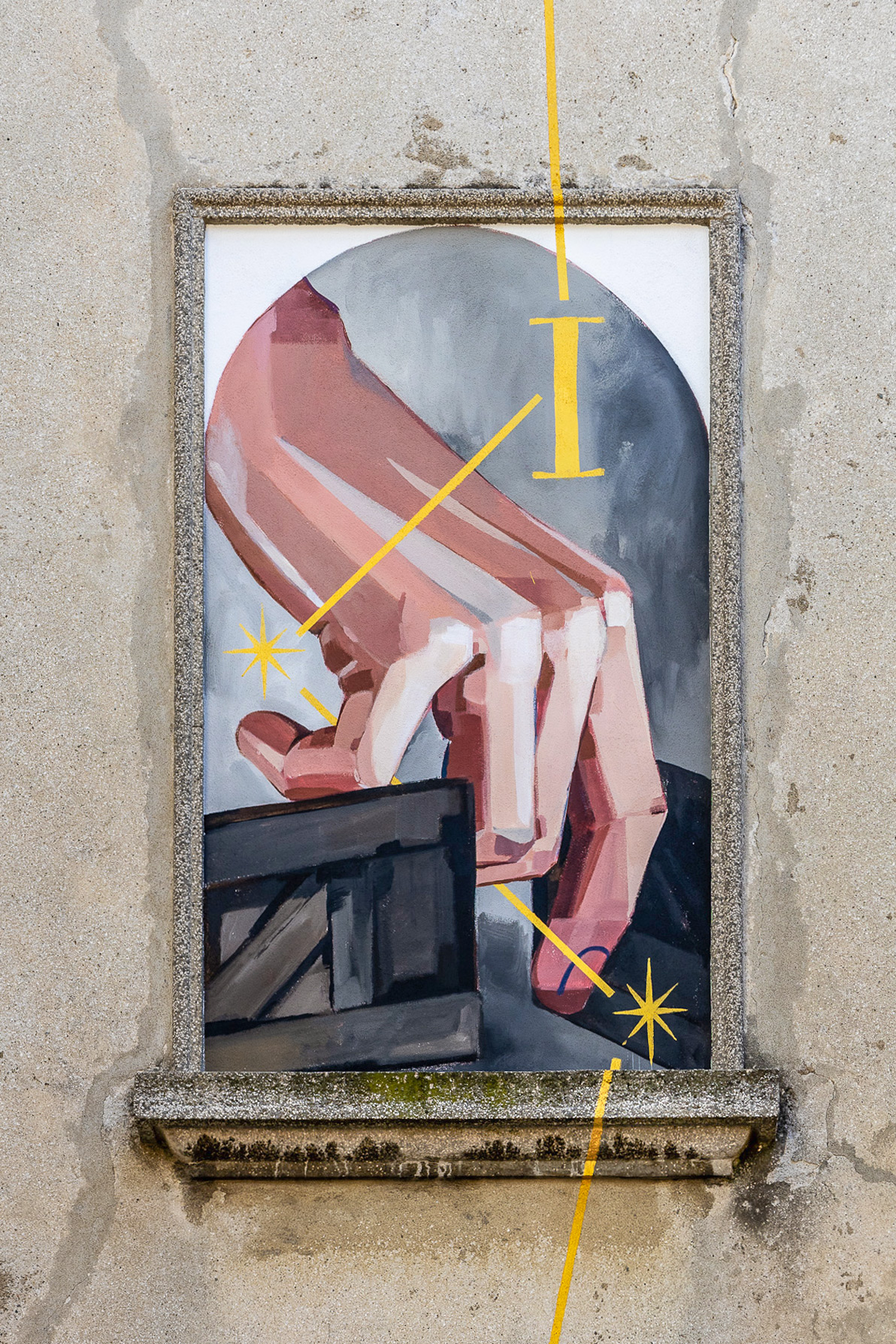
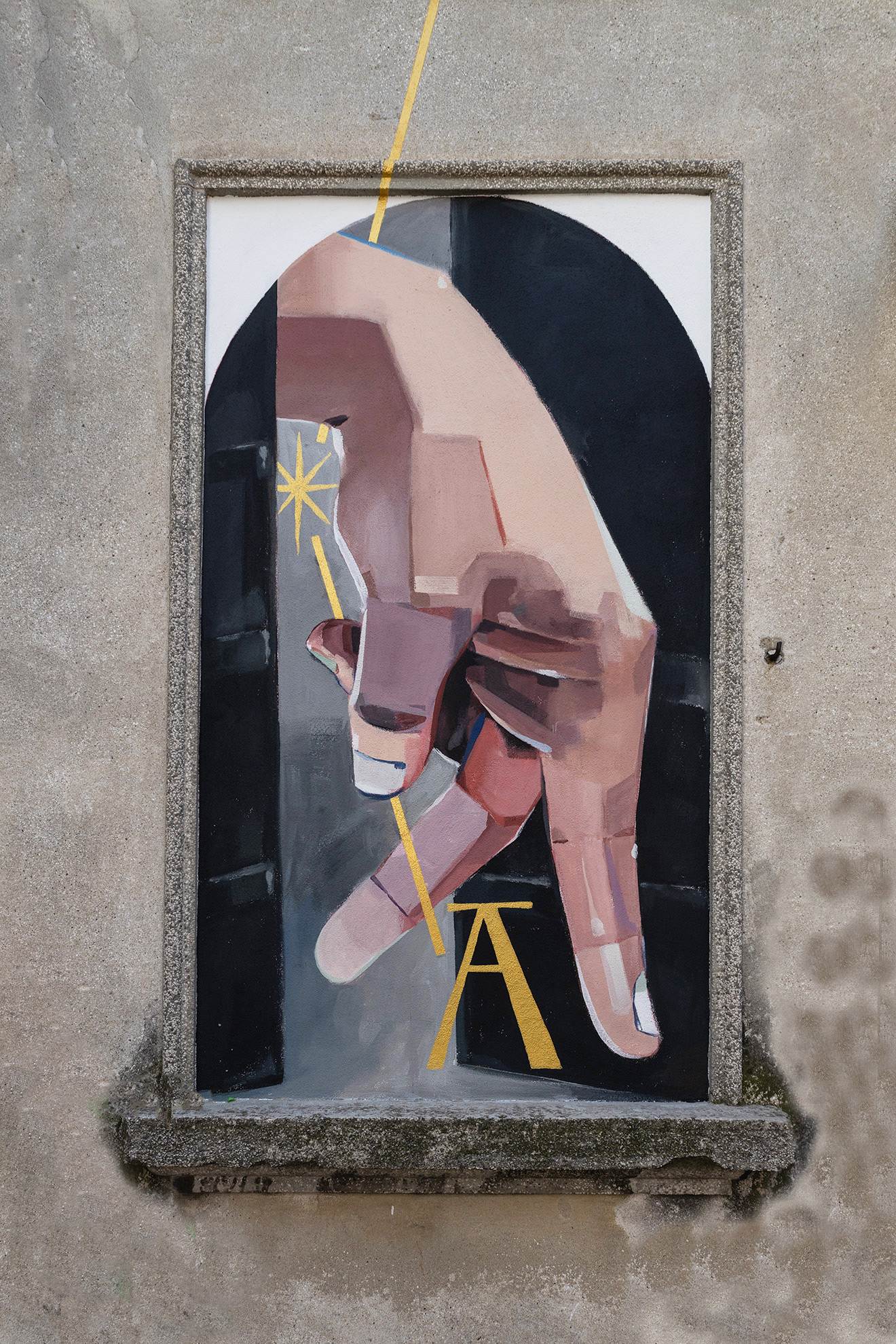
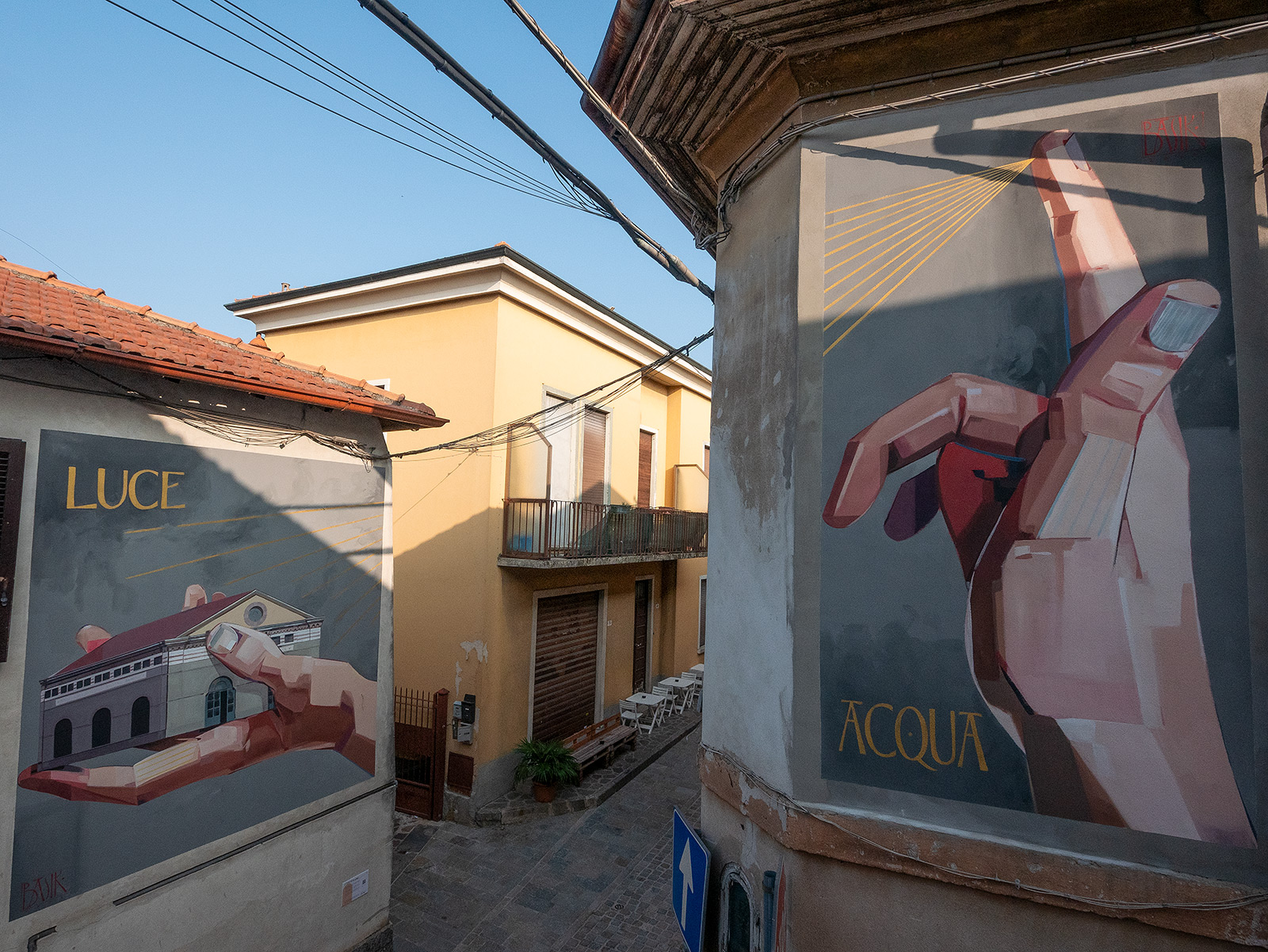
The Dance of St. Michaels
Paderno d’Adda, Italy 2023
Paderno d’Adda, Italy 2023
Widespread work painted along Paderno's main road, inspired by the local heritage.
Curated by Annalisa Ferraro.
Curated by Annalisa Ferraro.
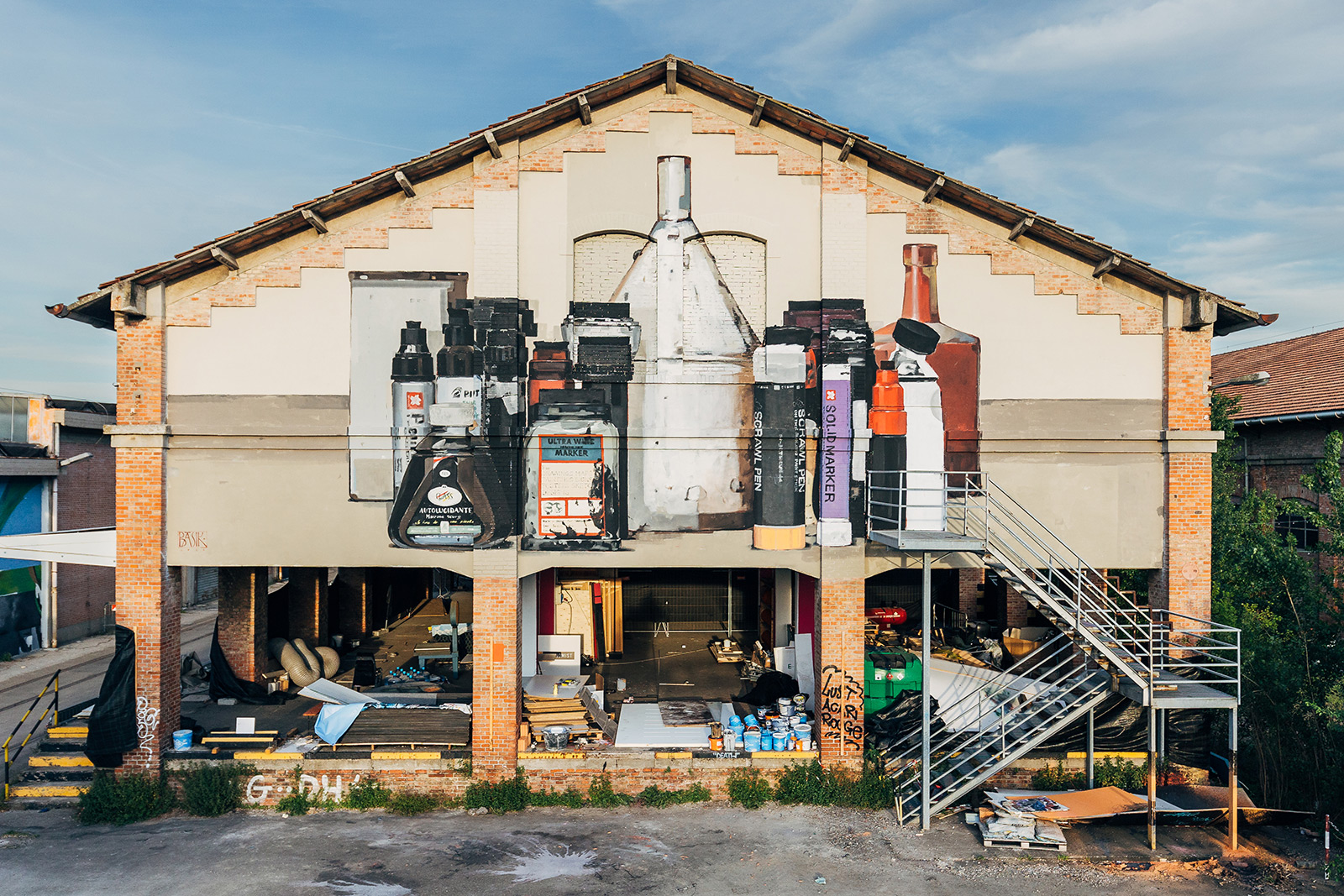
Still Life with Markers
Bologna, Italy 2023
Bologna, Italy 2023
Tribute to the work of Giorgio Morandi for Urbana at Dumbo Space.
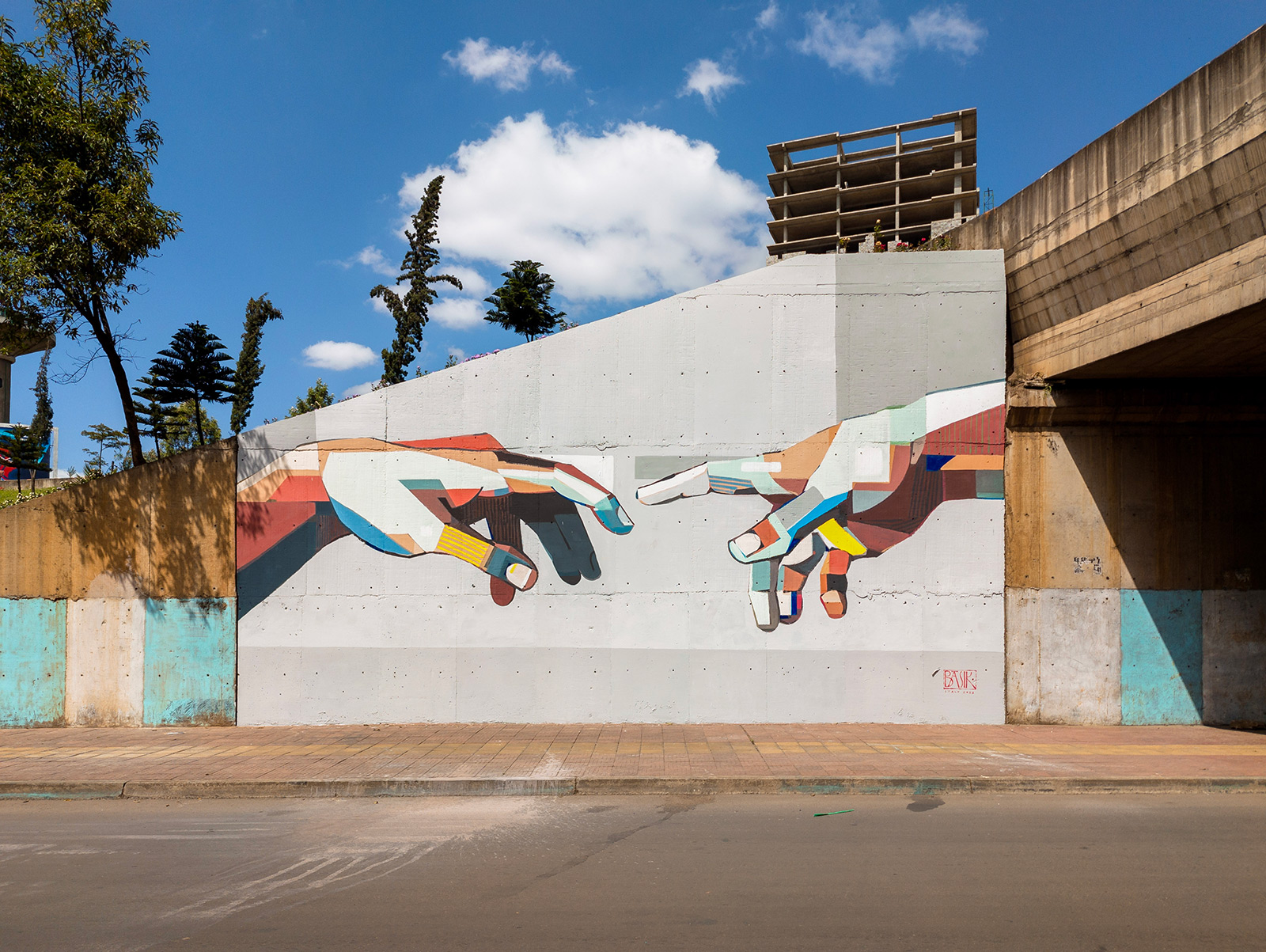
Sixteen Days
Addis Ababa,Ethiopia 2022
Addis Ababa,Ethiopia 2022
Homage to Michelangelo Buonarroti's Creation of Adam, which took sixteen days for its completion.
Mural for Italian Cultural Institute in Addis Ababa, Ethiopia.
Mural for Italian Cultural Institute in Addis Ababa, Ethiopia.
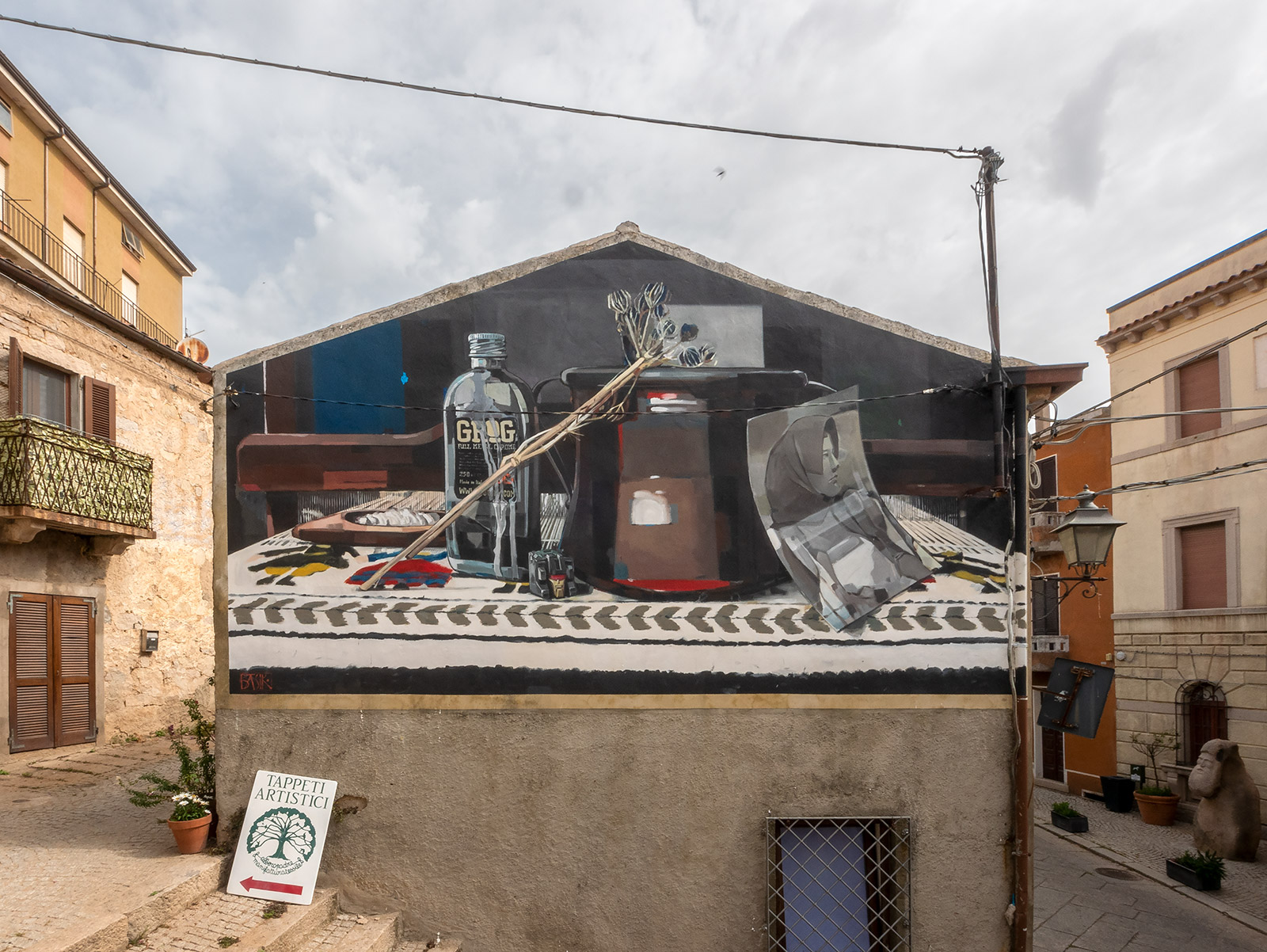
Aggese Still Life
Aggius, Italy 2022
Aggius, Italy 2022
The Aggius area is known for its handmade weaving tradition, as well as the banditry phenomenon, that endured through centuries during Spanish and Savoy rule over the island.
The painting features a carpet in the making, serving both as subject and main environment, and a photo of the female bandit Paola Argiolas. The composition, based on the juxtaposition of tradition and contemporaneity, creates a bond between old and new, a subtle line going from handcraft to banditry, to even marking the urban landscape.
The painting features a carpet in the making, serving both as subject and main environment, and a photo of the female bandit Paola Argiolas. The composition, based on the juxtaposition of tradition and contemporaneity, creates a bond between old and new, a subtle line going from handcraft to banditry, to even marking the urban landscape.

Symbolaria
Bellaria, Italy 2022
Bellaria, Italy 2022
Here the composition binds together two context-related attributes of the town of Bellaria-Igea Marina: on one hand, the sea and the harbor, as well as the jobs and sustaining that such environment have always provided to local people, while on the other hand lies Bellaria's patron, Saint Apollonia, of which tooth and tongs are traditionally defining pictorial traits.
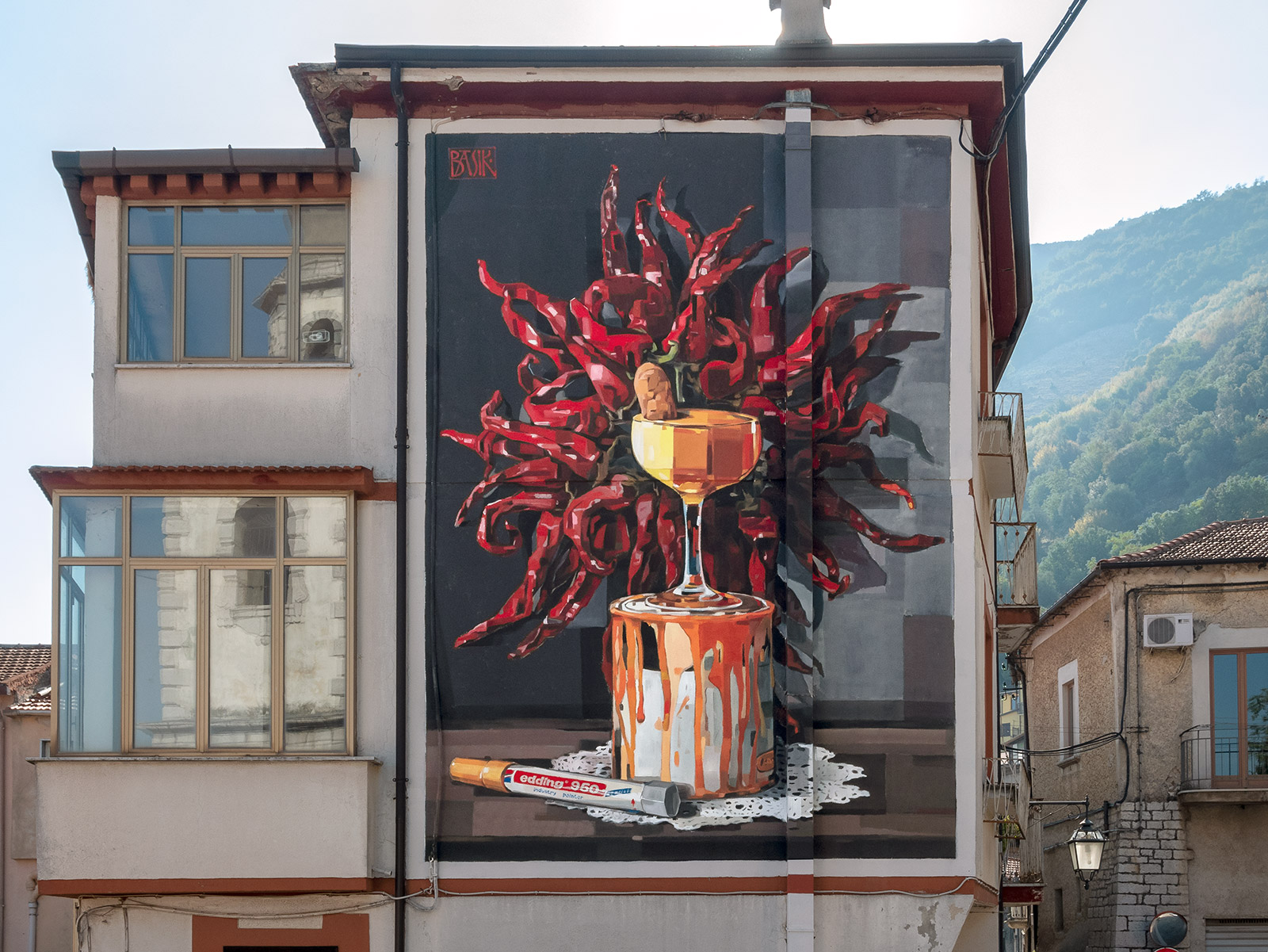
Ostensory representational attempt using context-related elements
Galdo degli Alburni, Italy 2021
Galdo degli Alburni, Italy 2021
The ostensory-like shape of the composition, as well as the central eggnog glass element are both referred to the iconography of St. Pascal Baylon, saint patron of this tiny town located at the foot of Alburni mountains, in southern Italy.
The area is also renowned for ‘peperoni cruschi’ (lit. crunchy peppers) that crown the composition.
Lying at the bottom, a paint tin and a solid marker, reminiscent of the long experiential journey that brought the artist in Galdo.
Thus, context becomes a key element in the making of the mural, of which the single items are nothing but subtle metaphors of a place and its inhabitants, as well as the lives interacting with such environment and its people, indissolubly intertwined and connected one another to create a single pictorial entity.
The area is also renowned for ‘peperoni cruschi’ (lit. crunchy peppers) that crown the composition.
Lying at the bottom, a paint tin and a solid marker, reminiscent of the long experiential journey that brought the artist in Galdo.
Thus, context becomes a key element in the making of the mural, of which the single items are nothing but subtle metaphors of a place and its inhabitants, as well as the lives interacting with such environment and its people, indissolubly intertwined and connected one another to create a single pictorial entity.
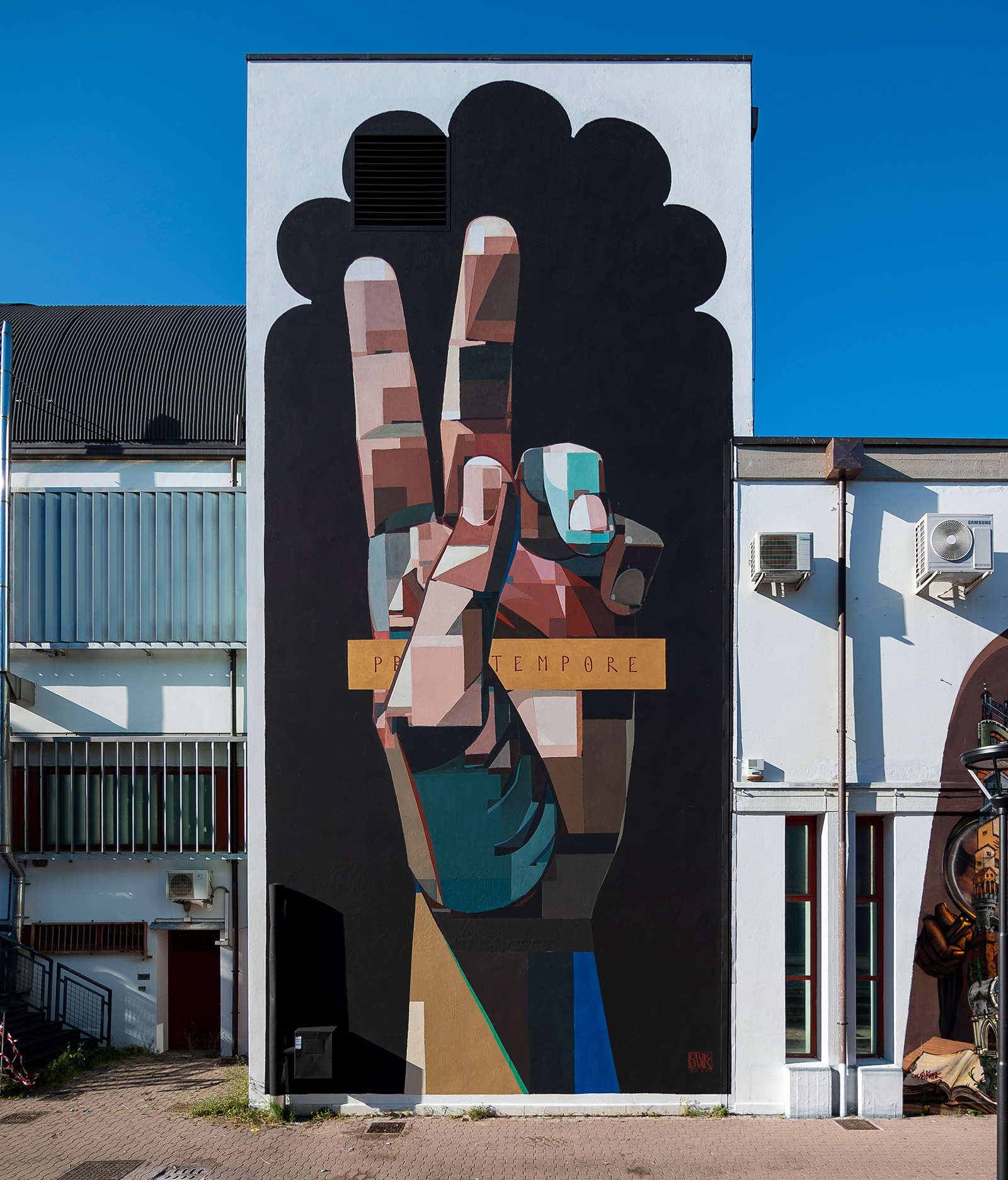
Temporary image of the hand of St. Gregory the Great
Cesena, Italy 2021
Cesena, Italy 2021
This portrayal of St. Gregory's relic, located in the local cathedral's museum, fully embeds the dichotomy within the act of painting something kept in a container to last as a symbol over the centuries by taking its “image” to the most inhospitable environment such as the streets.
Thus, the idea of preservation and its strength symbolically fade away over the inevitability of time and its effect over matter, even the work of art.
The last act of such operation is represented by this published picture, a relic itself, although digital, which will survive immaculate over the physical work.
Thus, the idea of preservation and its strength symbolically fade away over the inevitability of time and its effect over matter, even the work of art.
The last act of such operation is represented by this published picture, a relic itself, although digital, which will survive immaculate over the physical work.
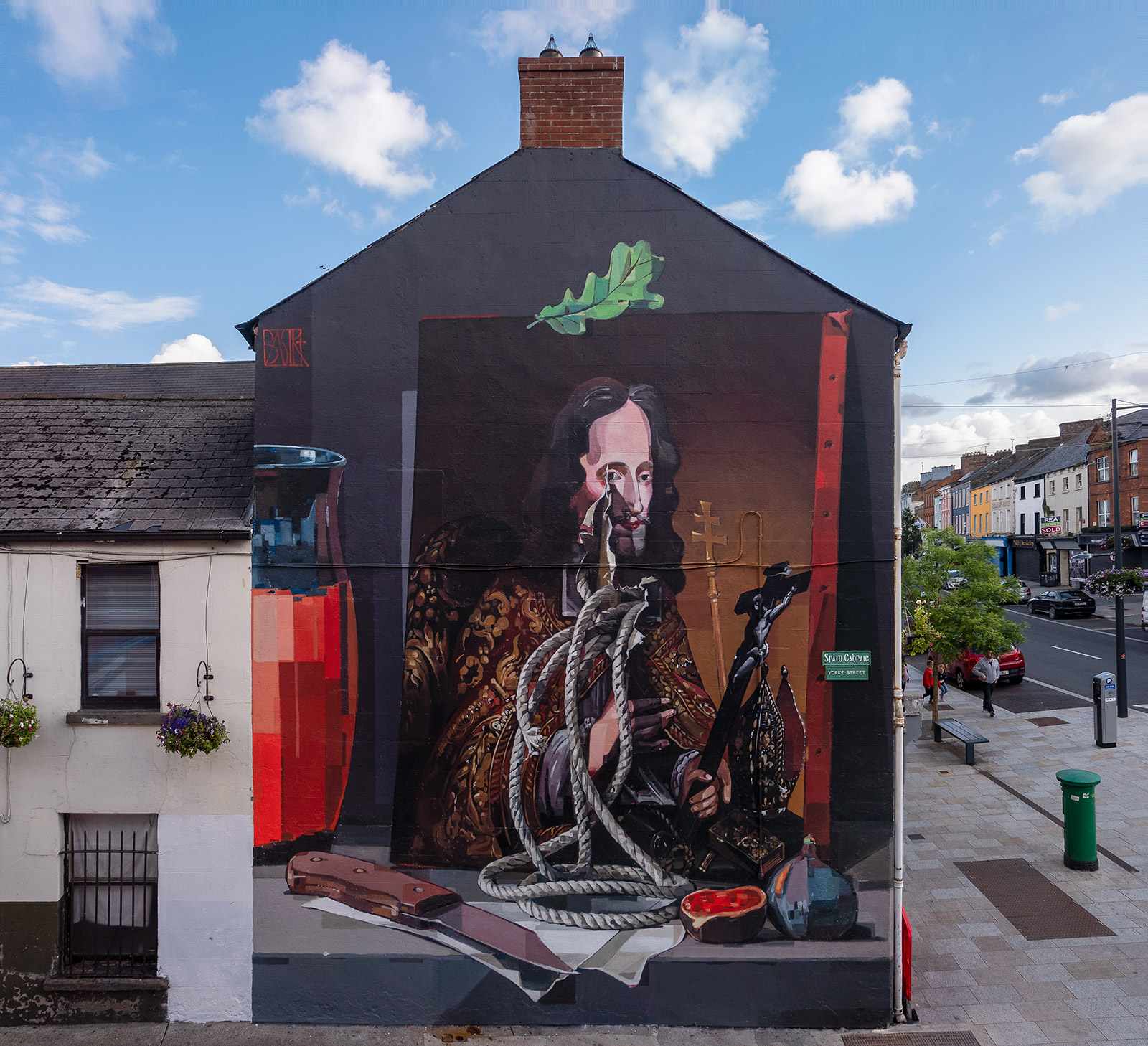
Still life with a torn portrait of Oliver Plunkett
Dundalk, Ireland 2021
Dundalk, Ireland 2021
St. Oliver Plunkett was the last Irish to be canonised and last victim of the "Popish plot". He lived and died during Cromwell's conquest of Ireland and was hanged, drawn, and quartered for treason, falsely accused to conspire with French soldiers to invade English lands and “promoting the Roman faith".
The piece faces the building under which Plunkett was detained before being sent to London to face trial and execution.
Edward Luttrell's 17th Century portrait of Plunkett sets the center stage of the still life composition that tells a story of which context is a fundamental trait, as well as using concepts at the core of the vanitas theme (of which the iconoclast approach over Plunkett's canvas could be considered as a variation) such as transience of life and certainty of death to create a parallel to the similar ephemeral characteristic of urban art.
The piece faces the building under which Plunkett was detained before being sent to London to face trial and execution.
Edward Luttrell's 17th Century portrait of Plunkett sets the center stage of the still life composition that tells a story of which context is a fundamental trait, as well as using concepts at the core of the vanitas theme (of which the iconoclast approach over Plunkett's canvas could be considered as a variation) such as transience of life and certainty of death to create a parallel to the similar ephemeral characteristic of urban art.
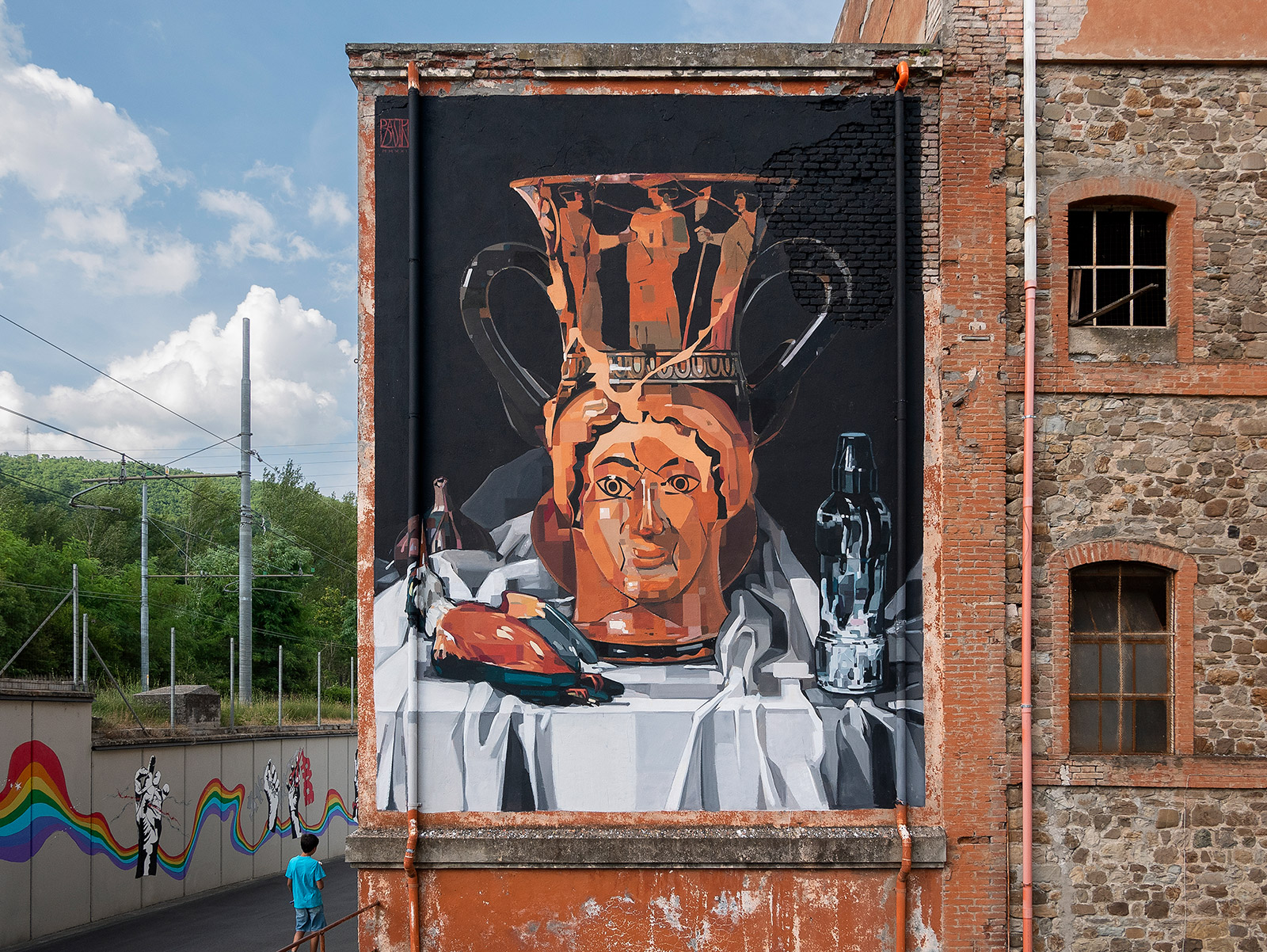
46 - 3
Pioppe di Salvaro, Italy 2021
Pioppe di Salvaro, Italy 2021
Dedicated to the victims and survivors of the "botte della canapiera massacre", Pioppe di Salvaro, 1 october 1944.
An etruscan janiform kantharos, prominent to the composition, acts as a metaphor of the "botte", a water reservoir adjacent to the old hemp mill located in the town of Pioppe di Salvaro (Bologna), where on the 1st october 1944, fortysix civilians were sentenced to death, shot and dumped in by nazi soldiers.
The ancient cup (that can be found in the nearby etrurian museum) stands nonetheless as a symbol of the local community, both from hystorical and contemporary perspectives, of which cracks and patches could be seen as the result of the brutality of war, while a kingfisher's thanatosis is referred to the three civilians who were the only survivors of the massacre.
An etruscan janiform kantharos, prominent to the composition, acts as a metaphor of the "botte", a water reservoir adjacent to the old hemp mill located in the town of Pioppe di Salvaro (Bologna), where on the 1st october 1944, fortysix civilians were sentenced to death, shot and dumped in by nazi soldiers.
The ancient cup (that can be found in the nearby etrurian museum) stands nonetheless as a symbol of the local community, both from hystorical and contemporary perspectives, of which cracks and patches could be seen as the result of the brutality of war, while a kingfisher's thanatosis is referred to the three civilians who were the only survivors of the massacre.

Verginese still life (subscribe to Premium to remove chimney from the picture)
Portomaggiore, Italy 2021
Portomaggiore, Italy 2021
A still life paying homage to the surrounding Verginese area, composed of a central sculpture by Roberto Melli, an early 1900s ferrarese artist, part of the “Scuola Romana”; a hand of saint patron Charles Borromeo; a pomegranate fruit and a typical local delicacy: the salama da sugo.
The building's chimney, intentionally left unpainted, splits the painting in two, impeding the full view of the original picture as it was virtually intended and, as a byproduct of such spatial role, becomes part of the composition itself.
The building's chimney, intentionally left unpainted, splits the painting in two, impeding the full view of the original picture as it was virtually intended and, as a byproduct of such spatial role, becomes part of the composition itself.

The Wrestlers
Firenze, Italy 2020
Firenze, Italy 2020
Collaboration with Giacomo Run.
Curated by Matteo Bidini for Street Levels Gallery.
Curated by Matteo Bidini for Street Levels Gallery.
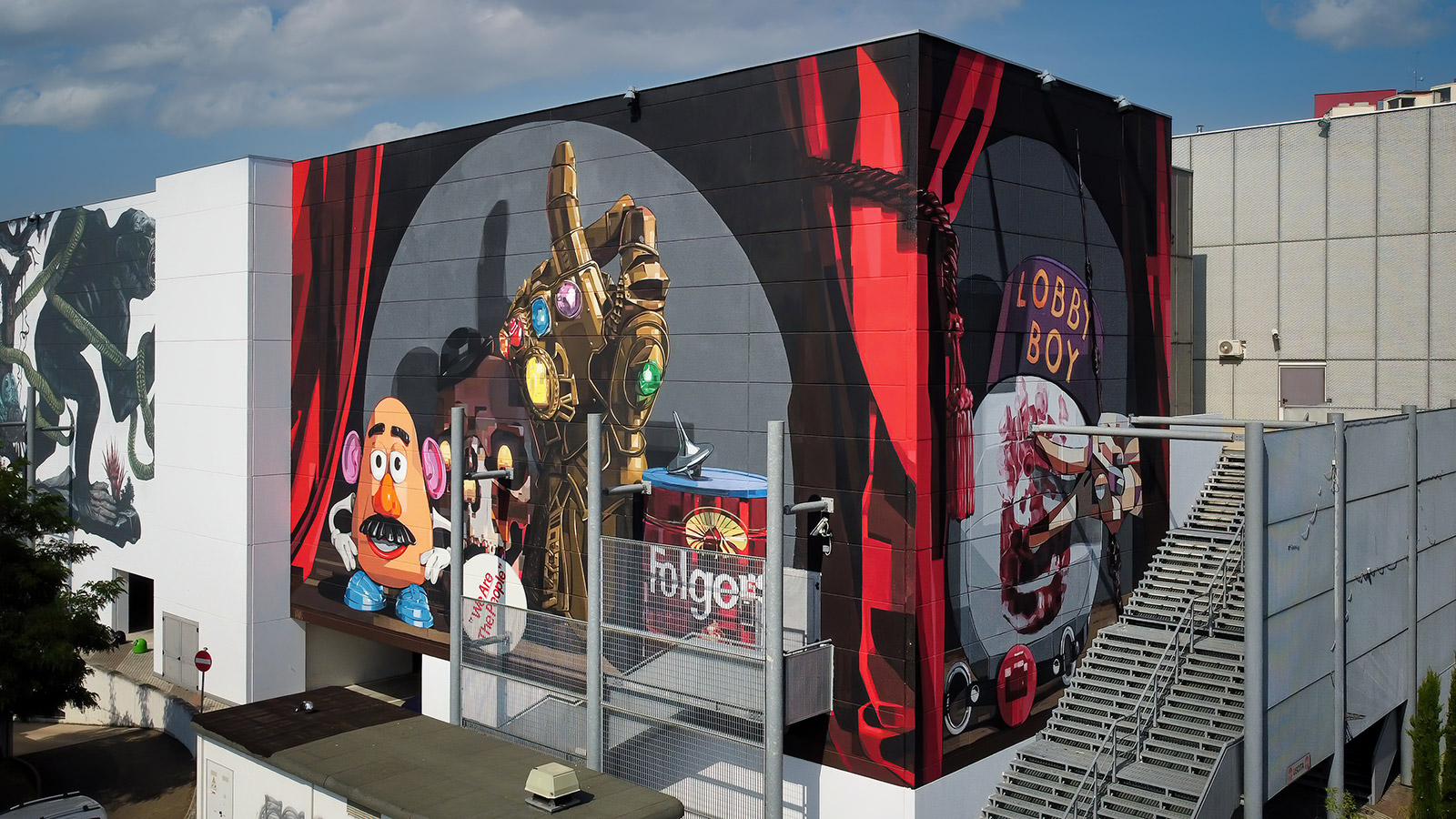
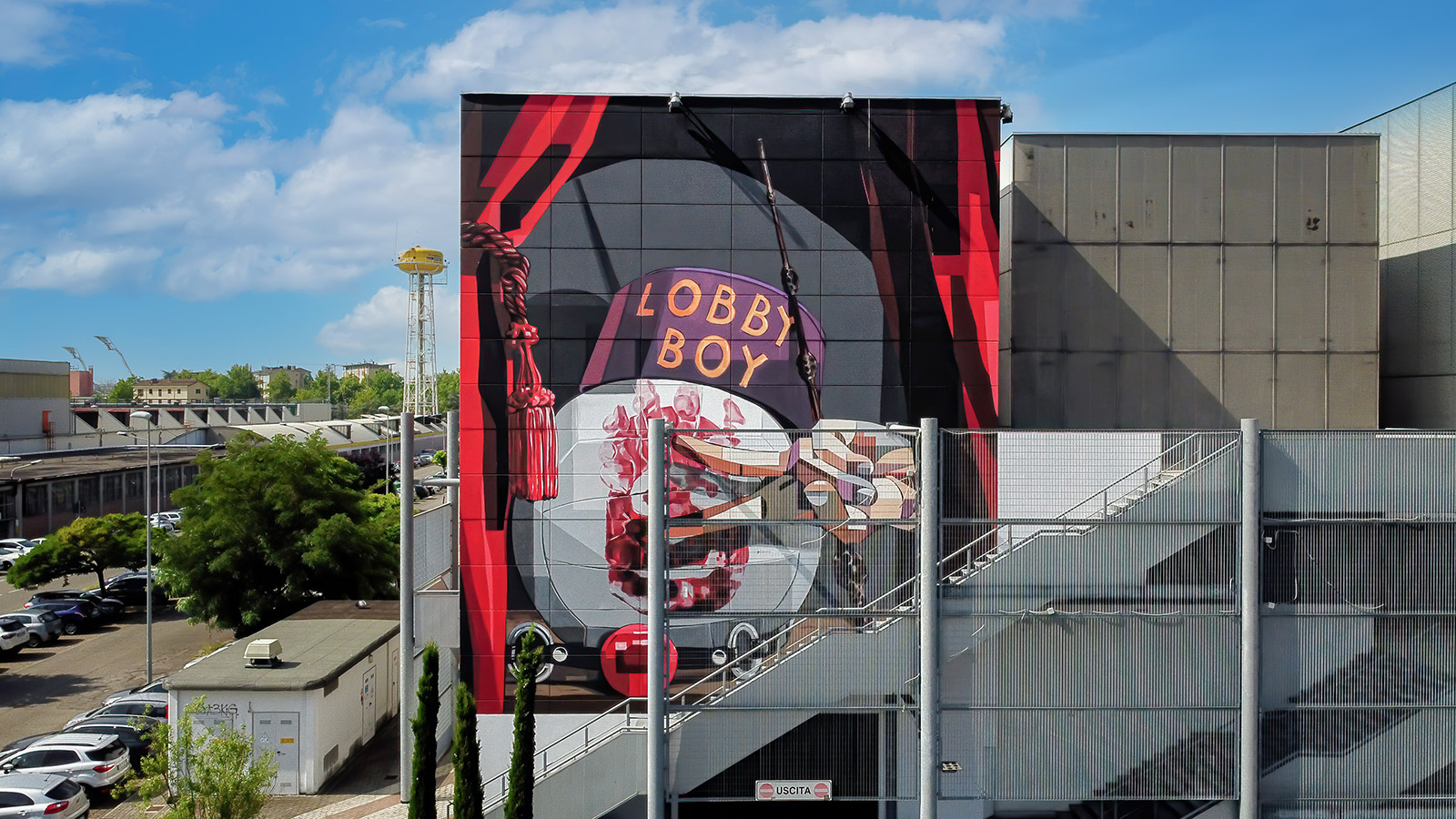
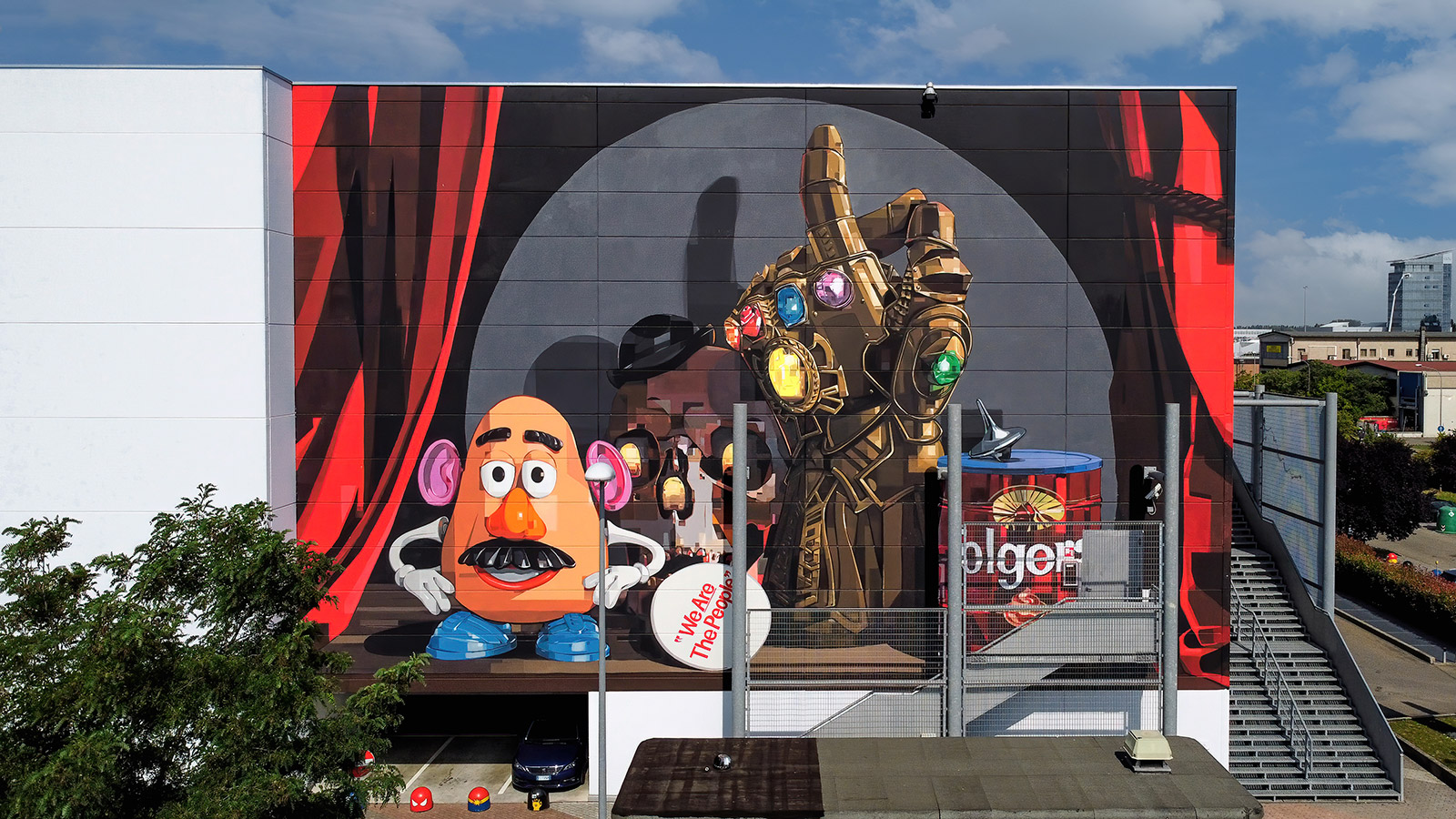
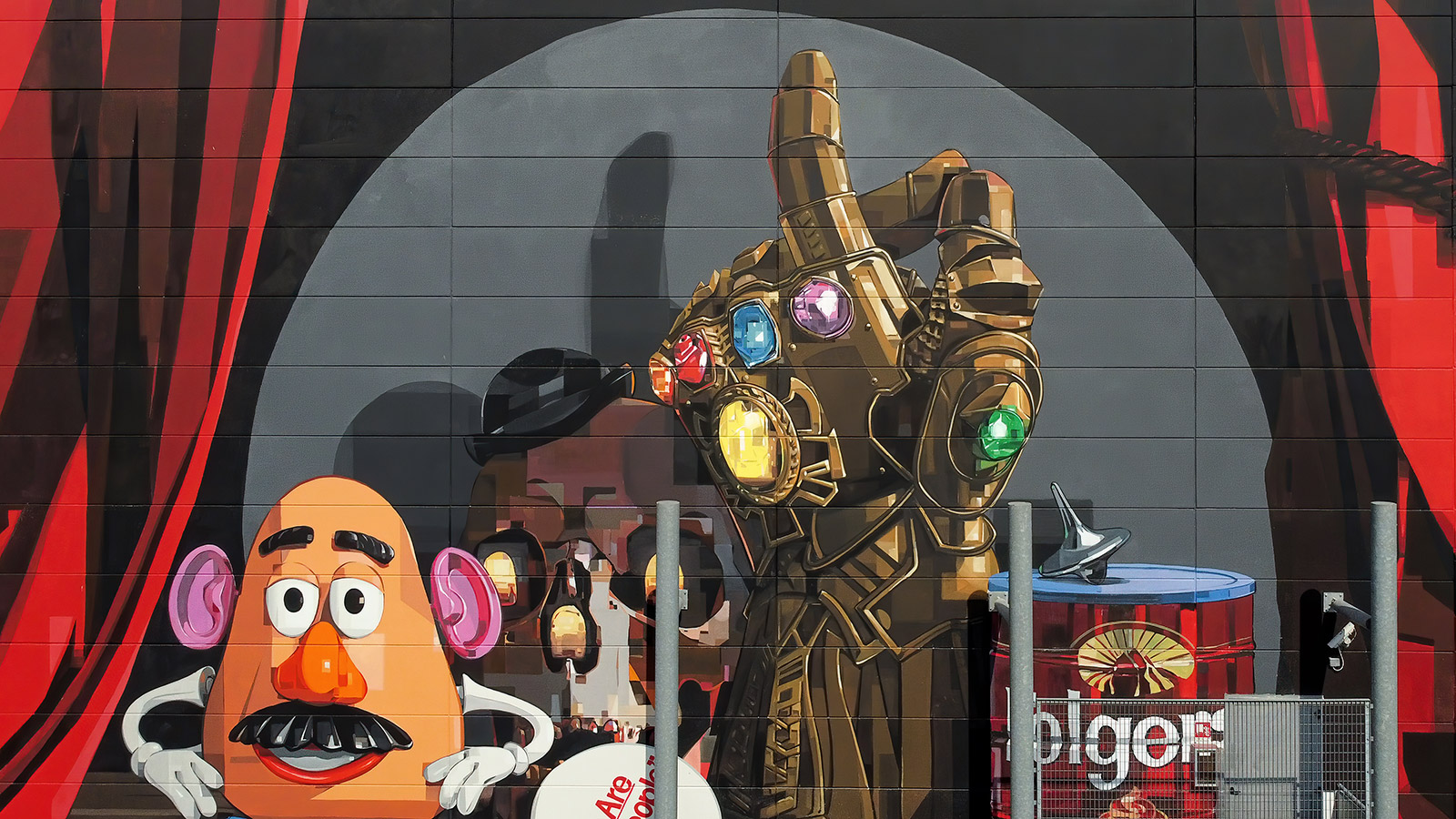
Two Halves Vanitas
Modena, Italy 2020
Modena, Italy 2020
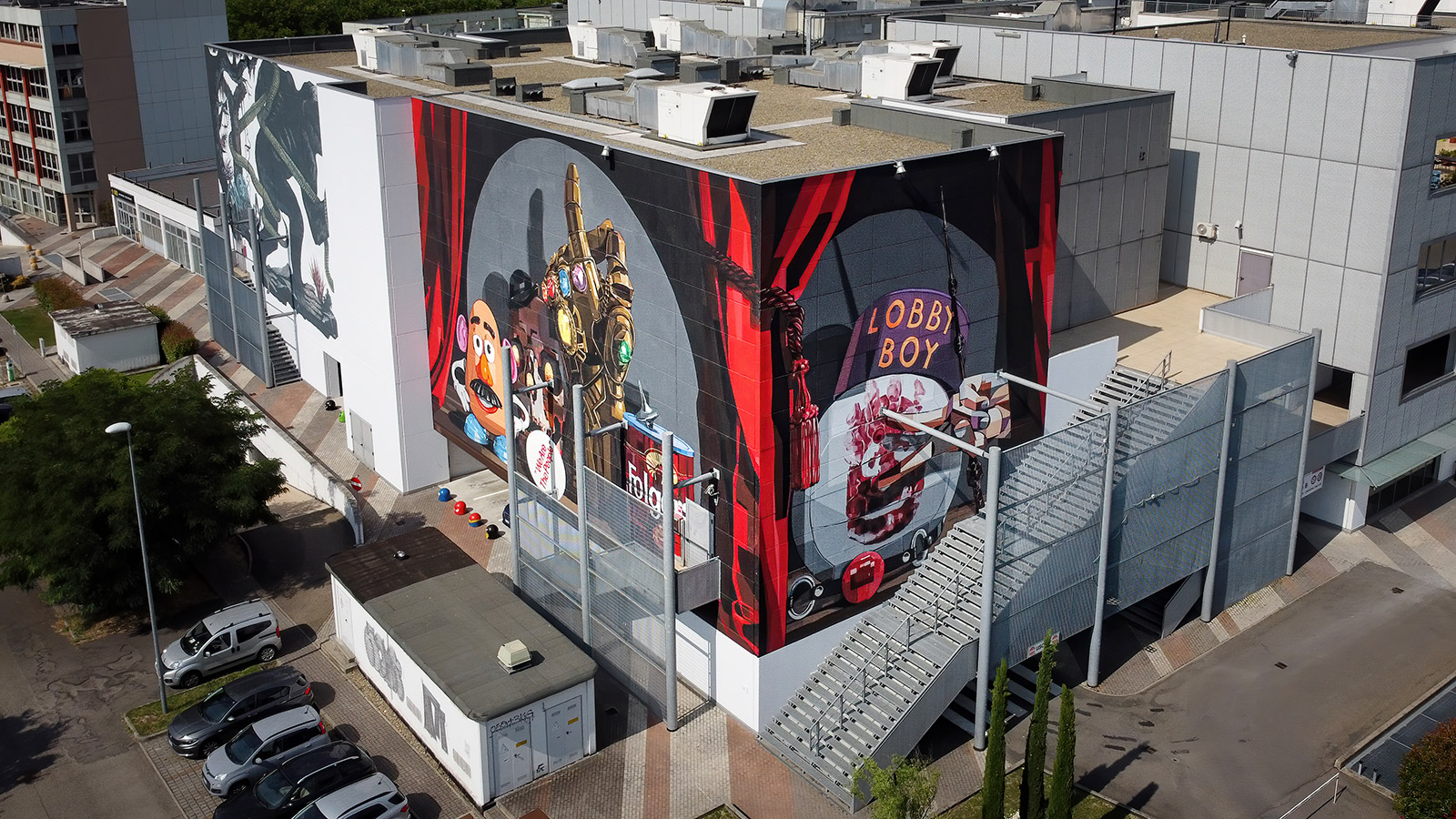
400 sq m commission for Cinema Victoria, Modena.
A blend of iconic movie elements part of contemporary pop culture with a still life approach. Despite the choice of such elements being more challenging in comparison to my standard imagery, the goal has been nonetheless to try to keep coherence to my body of work while paying homage to the pieces of the masters of European 17th Century regardless of the items portrayed.
A blend of iconic movie elements part of contemporary pop culture with a still life approach. Despite the choice of such elements being more challenging in comparison to my standard imagery, the goal has been nonetheless to try to keep coherence to my body of work while paying homage to the pieces of the masters of European 17th Century regardless of the items portrayed.
Unaesthetic Aesthetics
Seattle, USA 2018
Seattle, USA 2018
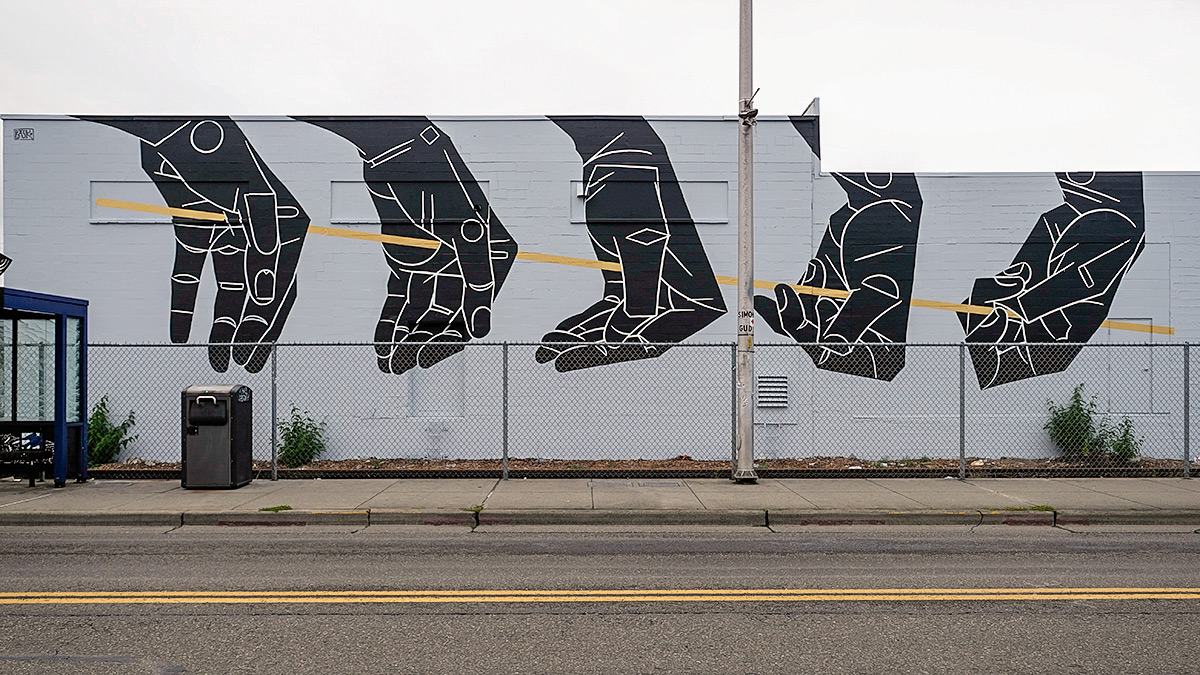
Mural for SODO Track in Seattle. A project by 4 Culture.
Five hands as five frames following the concept of movement. A reference, on a deeper level, to how contemporary society perceives and quickly “consumes” the lives of others and –in case of artists– their work, based on the fruition of pictures that are “framed” on digital platforms (such as social networks).
The progression, from left to right, towards an unnatural and awkward pose challenges the idea of filtered perfection that is often seen and perceived on social media from a user/viewer’s perspective.
A golden line connecting the five black hands by passing through their flesh acts a physical link that further supports the idea of motion, while aiming to be a tribute to the depiction of St. Sebastian in Renaissance art (and onward), in which arrows symbolize the brushes used by the artist himself, while the martyred body metaphorizes a canvas.
Five hands as five frames following the concept of movement. A reference, on a deeper level, to how contemporary society perceives and quickly “consumes” the lives of others and –in case of artists– their work, based on the fruition of pictures that are “framed” on digital platforms (such as social networks).
The progression, from left to right, towards an unnatural and awkward pose challenges the idea of filtered perfection that is often seen and perceived on social media from a user/viewer’s perspective.
A golden line connecting the five black hands by passing through their flesh acts a physical link that further supports the idea of motion, while aiming to be a tribute to the depiction of St. Sebastian in Renaissance art (and onward), in which arrows symbolize the brushes used by the artist himself, while the martyred body metaphorizes a canvas.
Swipe to Unluck
Ibiza, Spain 2018
Ibiza, Spain 2018
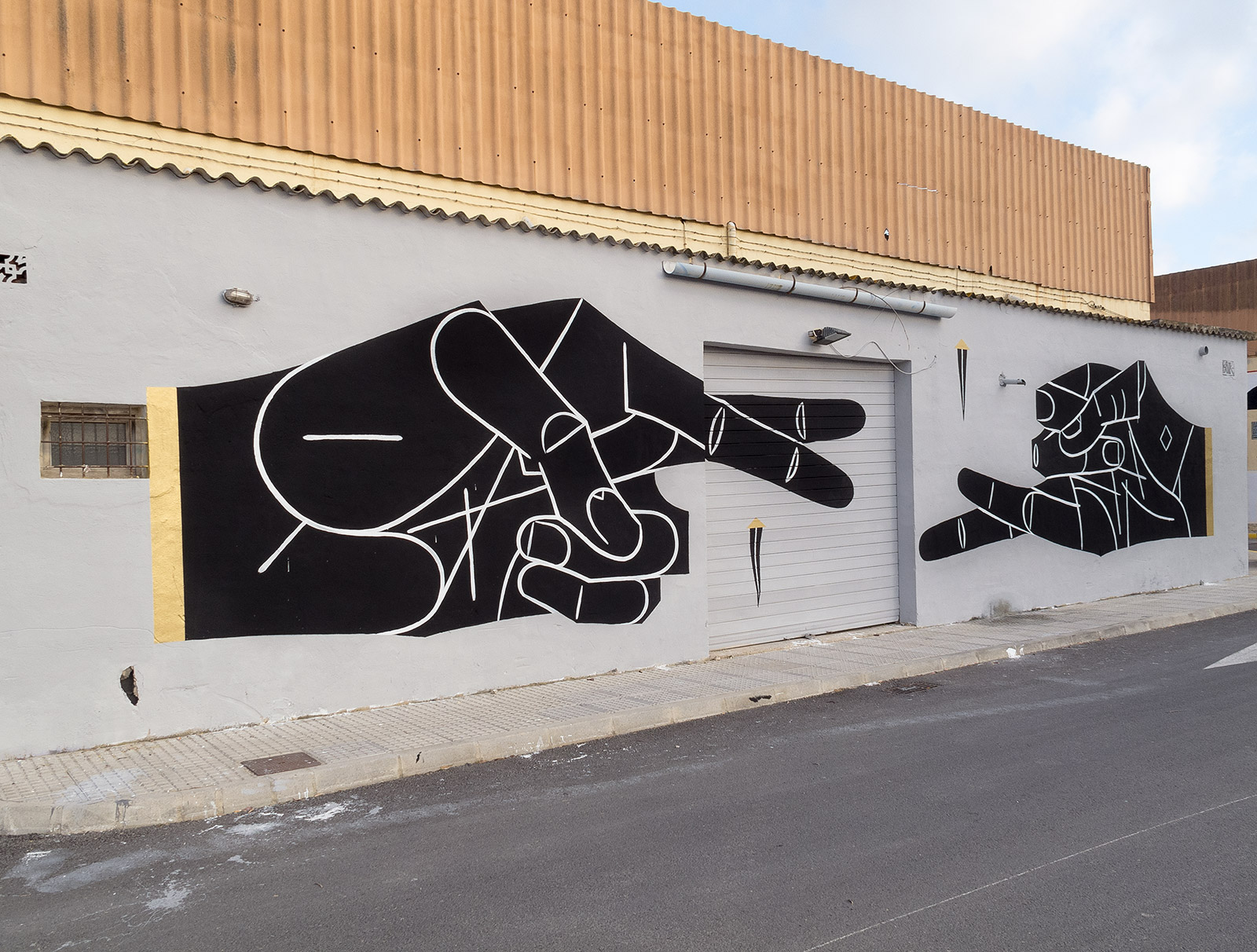
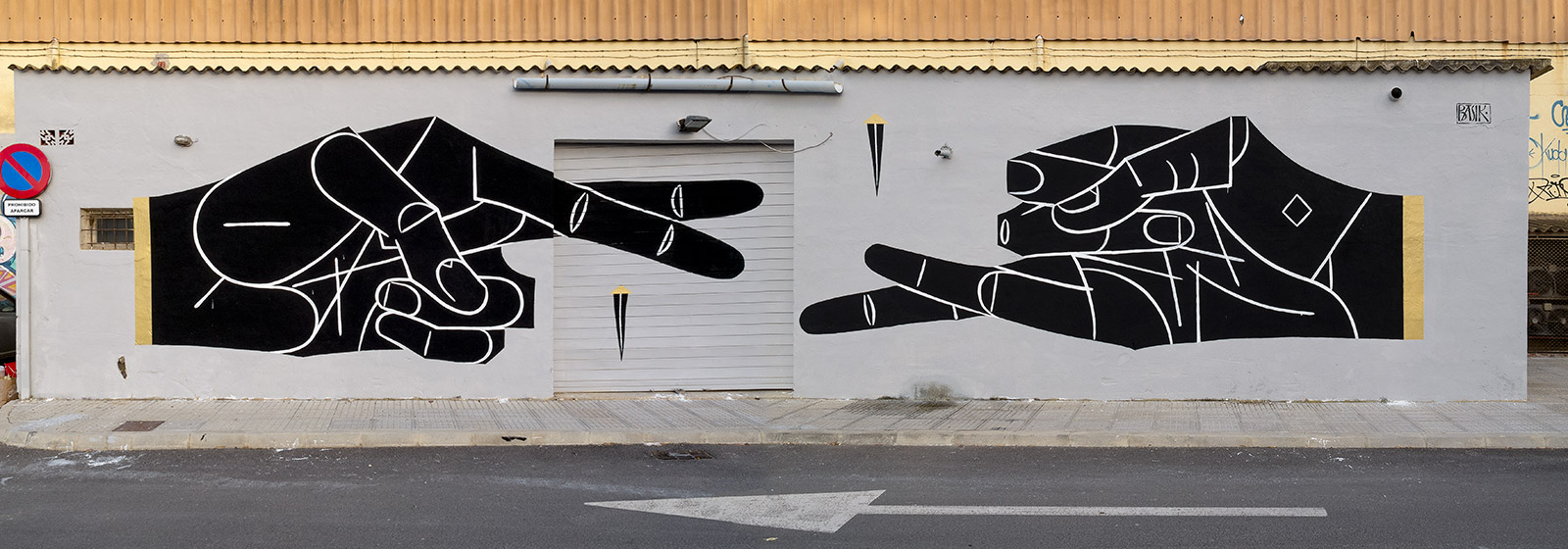
Having its origin in biblical Israel, the crossing fingers gesture has been commonly used since early Christianity as a symbol of Christ’s cross to invoke protection against evil.
While losing its religious value, fingers crossed have lived throughout ages to contemporaneity as a symbol of luck, transcending and adapting to cultural shifts over time.
Can a symbol so strong maintain its value when an attempt to change form is made? Can a concept survive through physical evolution as well as it has survived the loss of religious severity due to progressive metabolization in popular culture?
While losing its religious value, fingers crossed have lived throughout ages to contemporaneity as a symbol of luck, transcending and adapting to cultural shifts over time.
Can a symbol so strong maintain its value when an attempt to change form is made? Can a concept survive through physical evolution as well as it has survived the loss of religious severity due to progressive metabolization in popular culture?
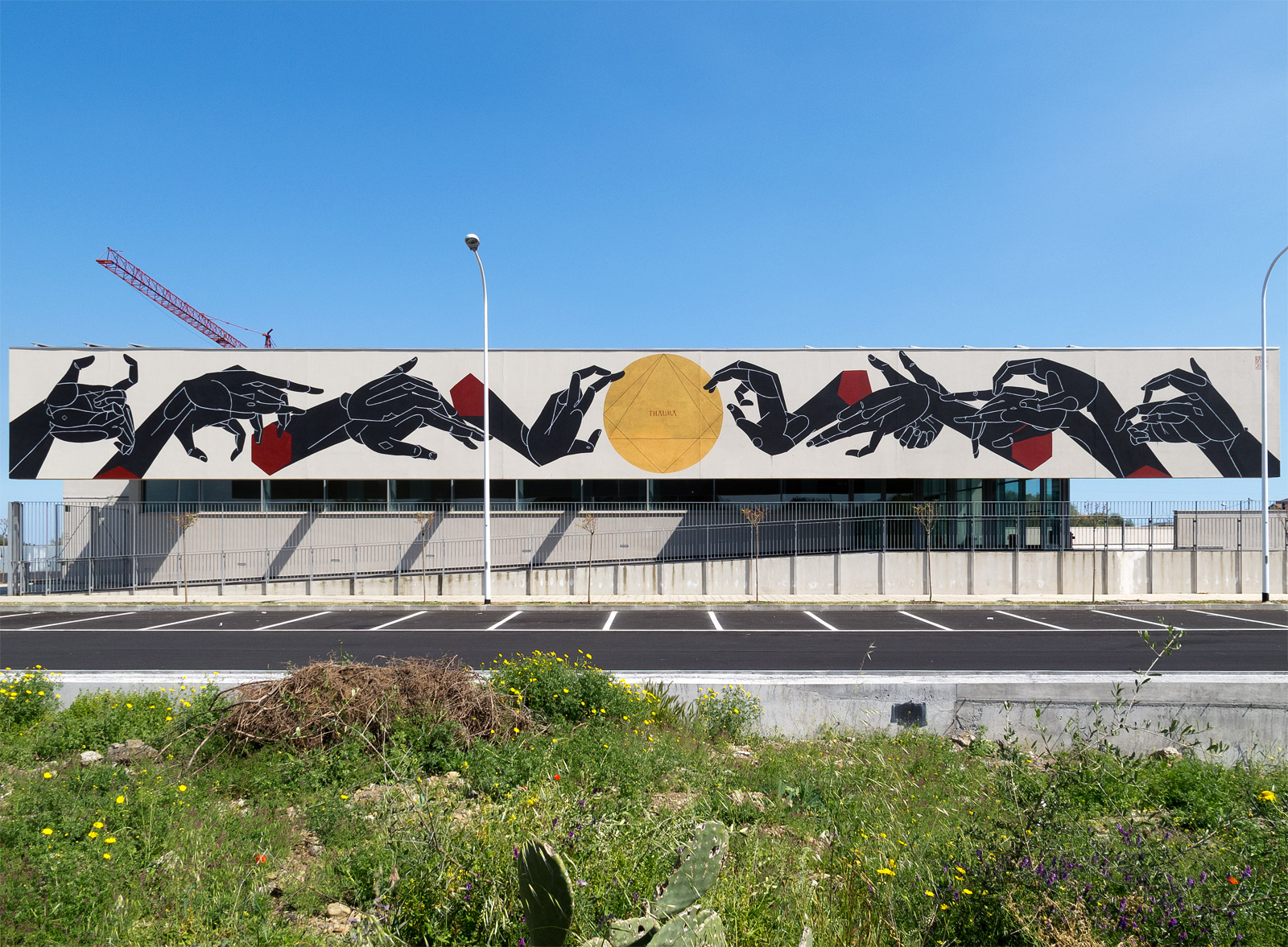
Thauma (The temptation of Saint Anthony)
Misterbianco, Italy 2015
Misterbianco, Italy 2015
Mural for I-Art Residency.
Saint Anthony, commonly venerated for his protection from fire, is Misterbianco’s patron, as the town celebrates the saint every year since its destruction by a severe Etna’s eruption in 1669.
Saint Anthony, commonly venerated for his protection from fire, is Misterbianco’s patron, as the town celebrates the saint every year since its destruction by a severe Etna’s eruption in 1669.
Hands casting animals as chinese shadows play are protracted to poke St. Anthony, which is abstractly represent by a geometrical golden element at the center of the scene.
Thauma is the greek word for wonder, as a celebration of the land surrounding mount Etna (the painting is in fact facing the volcano). Nonetheless the greek letter T or “Tau” is a common symbol defining St. Anthony.
Thauma is the greek word for wonder, as a celebration of the land surrounding mount Etna (the painting is in fact facing the volcano). Nonetheless the greek letter T or “Tau” is a common symbol defining St. Anthony.
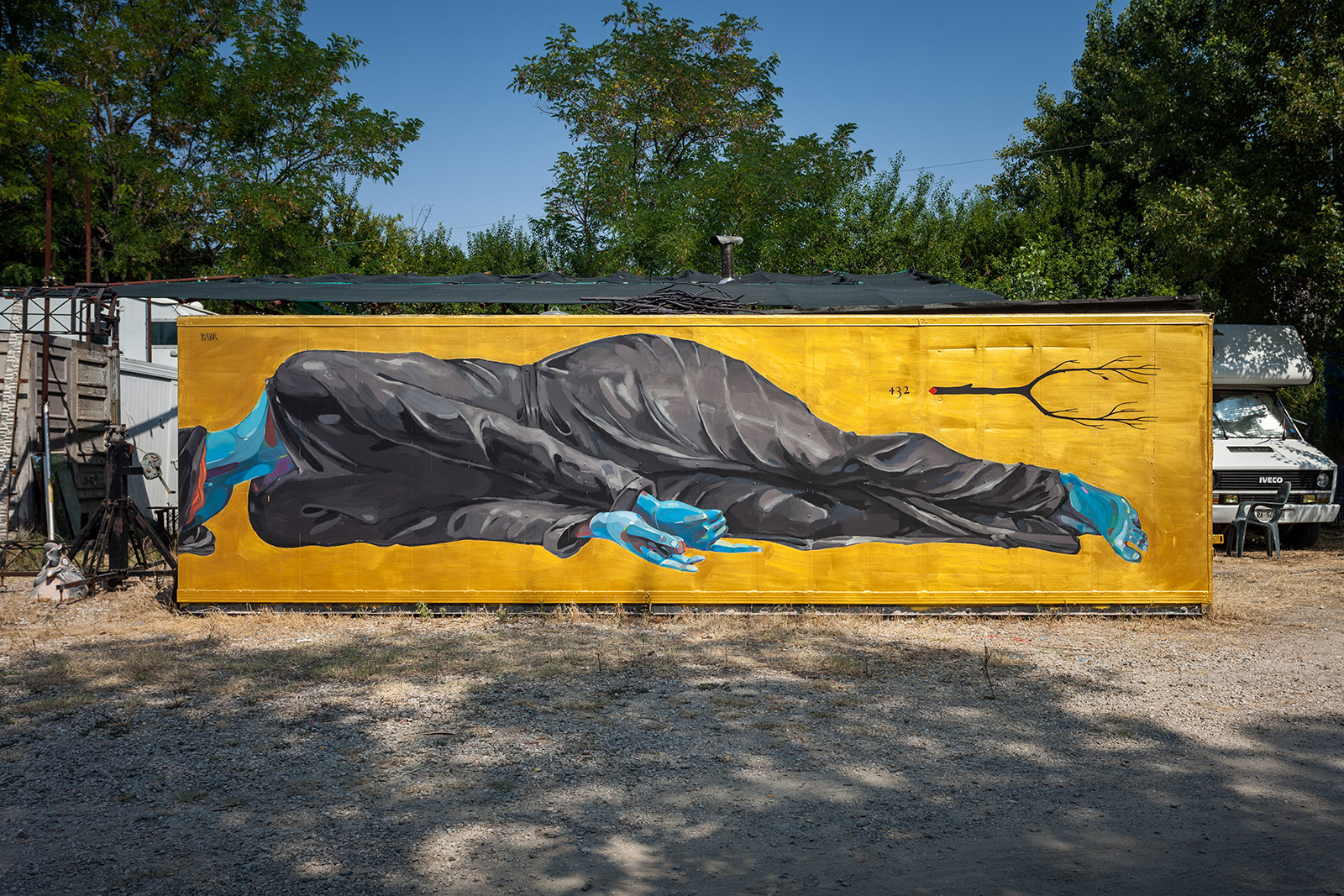
No Title (St. Cecilia)
Santarcangelo di R., Italy 2015
Santarcangelo di R., Italy 2015
Featuring a frontal tribute of Stefano Maderno’s sculpture, the “Martyrdom of Saint Cecilia”, a noble roman woman and early christian martyr which later became titled as protector of musicians; it’s followed by a branch resembling a natural diapason, with the Phylosophical pitch value by its side.
On the side a seven-pointed stars that thinly wants to remind the seven chords of Orpheus’ lyra, which was used by the ‘first of all artists’ to charm every living thing.
On the side a seven-pointed stars that thinly wants to remind the seven chords of Orpheus’ lyra, which was used by the ‘first of all artists’ to charm every living thing.
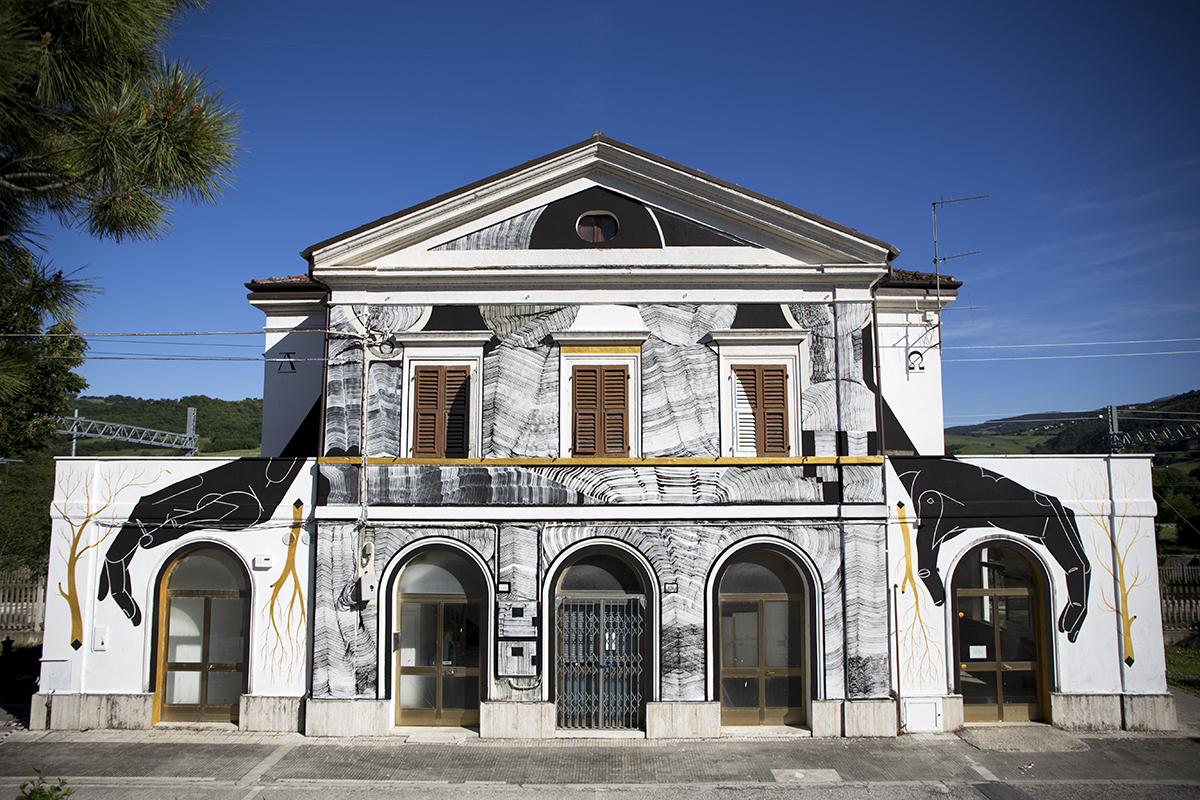


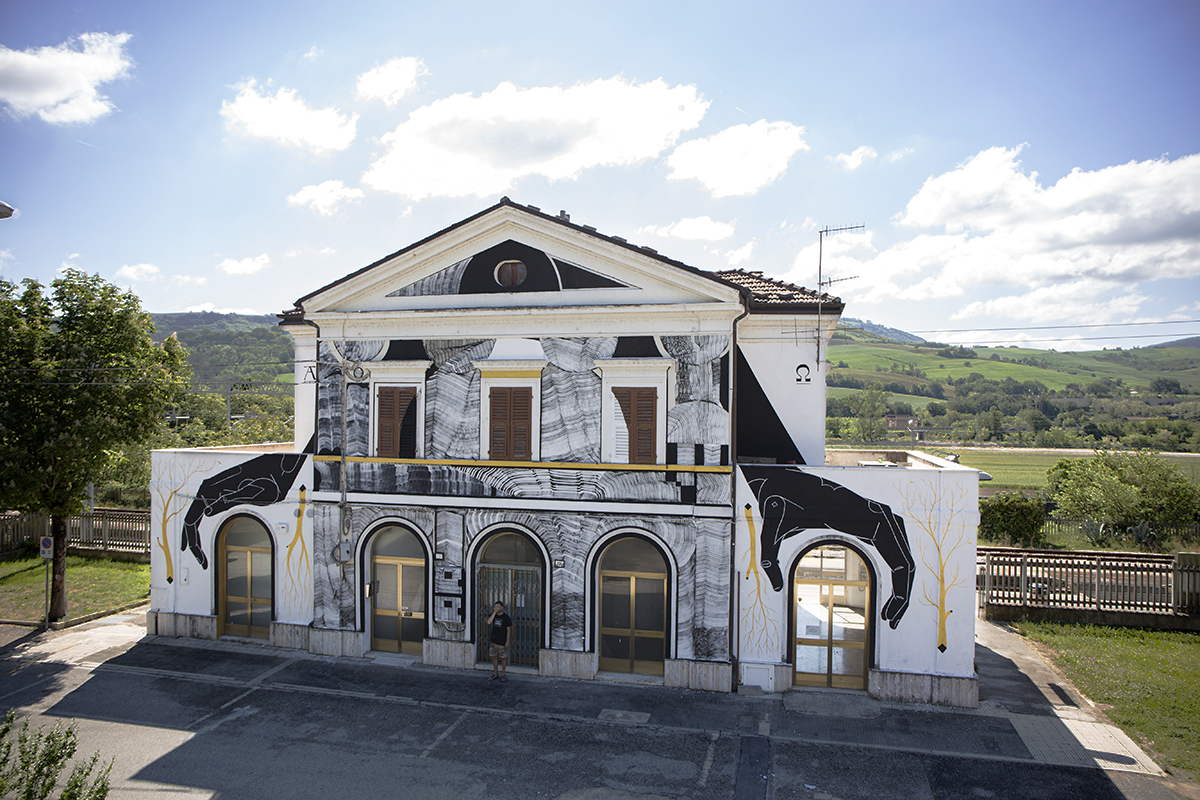

Alpha and Omega
Serra S. Quirico, Italy 2015
Serra S. Quirico, Italy 2015
Collaboration with 2501 for PopUp! festival. Together we painted the train station of Serra San Quirico, surrounded by the beautiful hills of Colli Esini, close to the city of Ancona, Italy.
Omissis
Gdynia, Poland 2014
Gdynia, Poland 2014
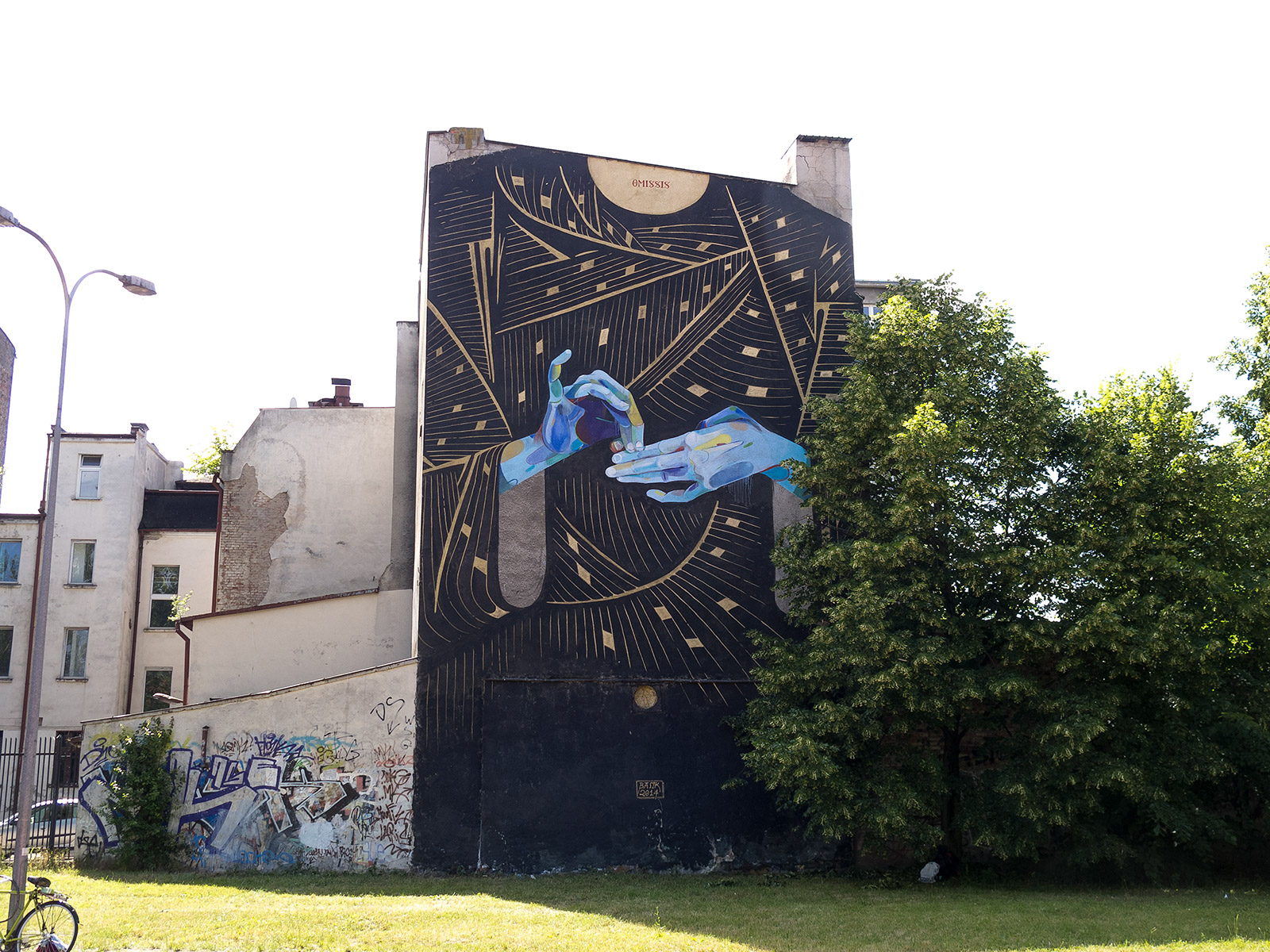
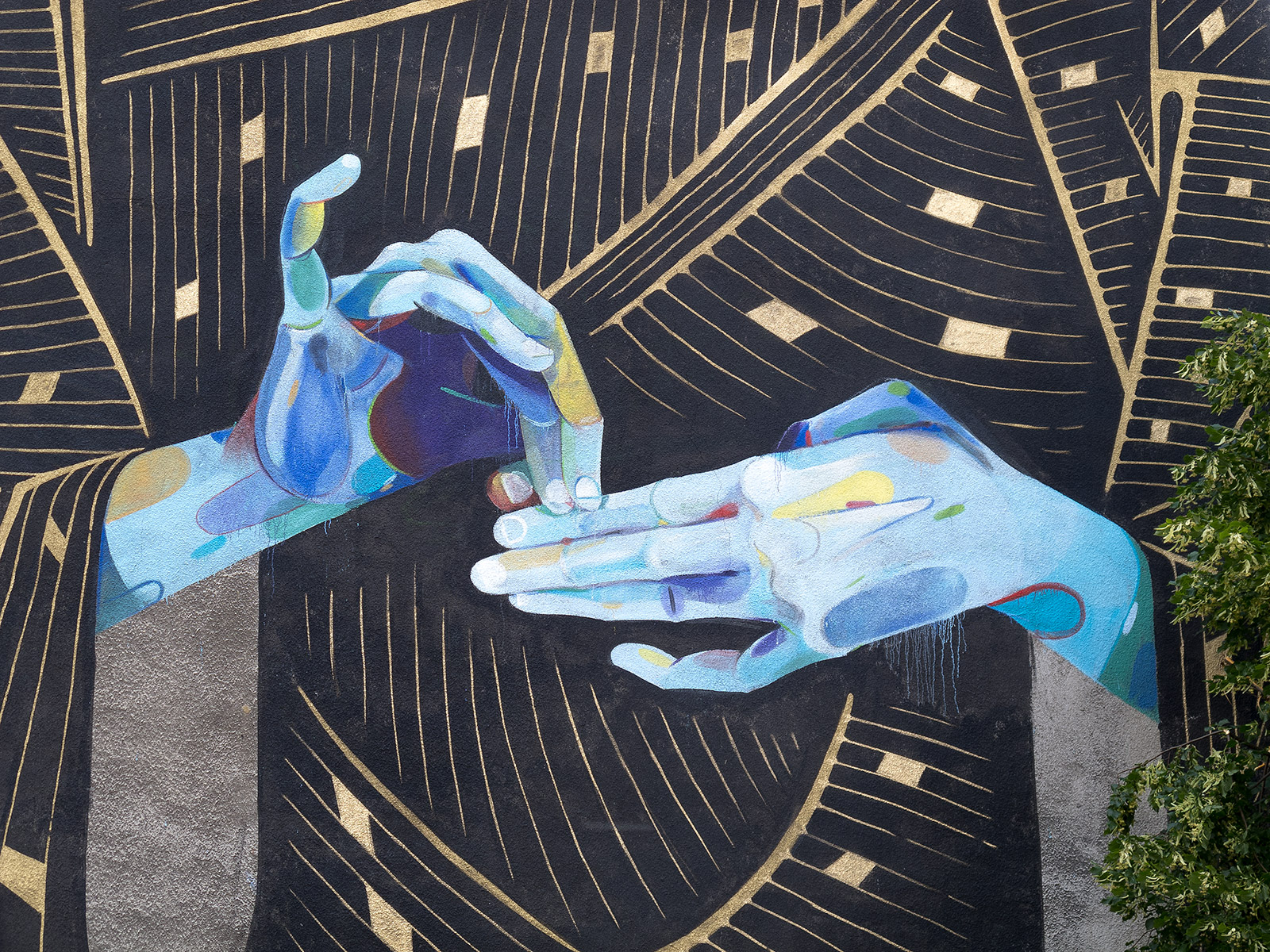
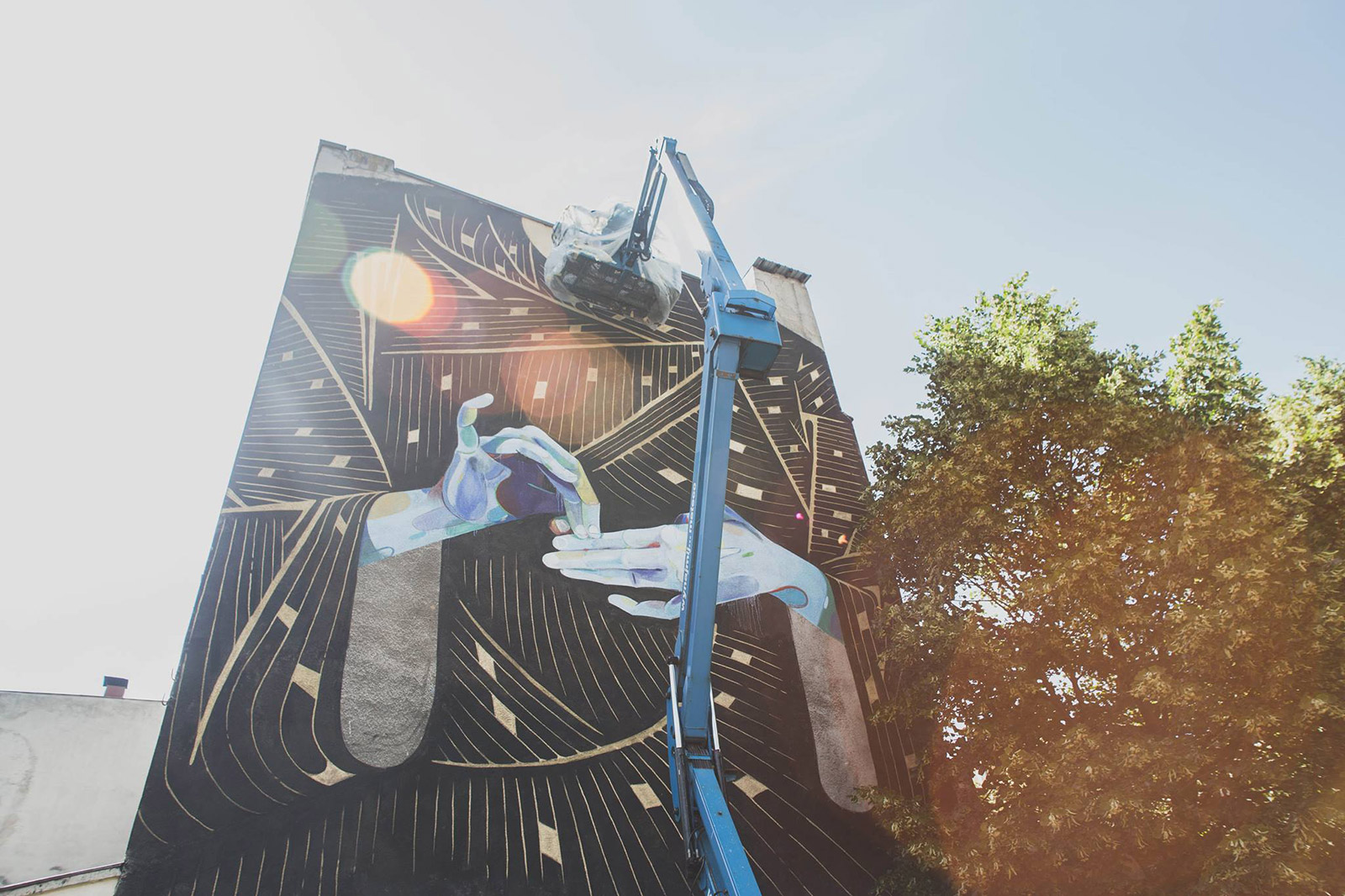
Mural painted for Traffic Design festival.
The subject casts a gesture resembling the thumb pull-off trick, while the black robe with golden highlights is a tribute to the work of italian master Duccio di Buoninsegna. On top lies the latin word Omissis, referring to both the gesture and the distinctive figure’s framing in the façade.
The subject casts a gesture resembling the thumb pull-off trick, while the black robe with golden highlights is a tribute to the work of italian master Duccio di Buoninsegna. On top lies the latin word Omissis, referring to both the gesture and the distinctive figure’s framing in the façade.
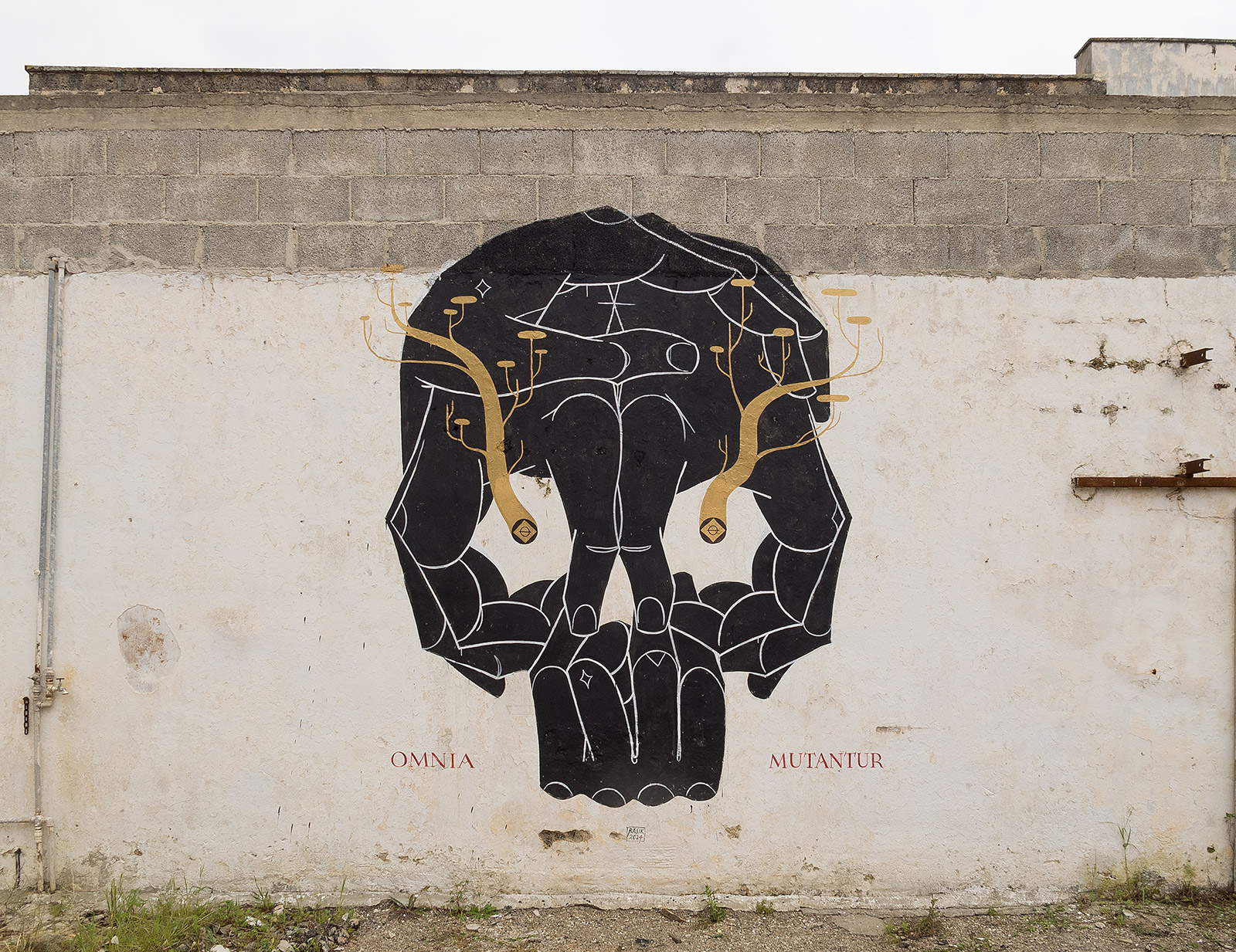
Eraclia / Omnia Mutantur
Racale, Italy 2014
Racale, Italy 2014
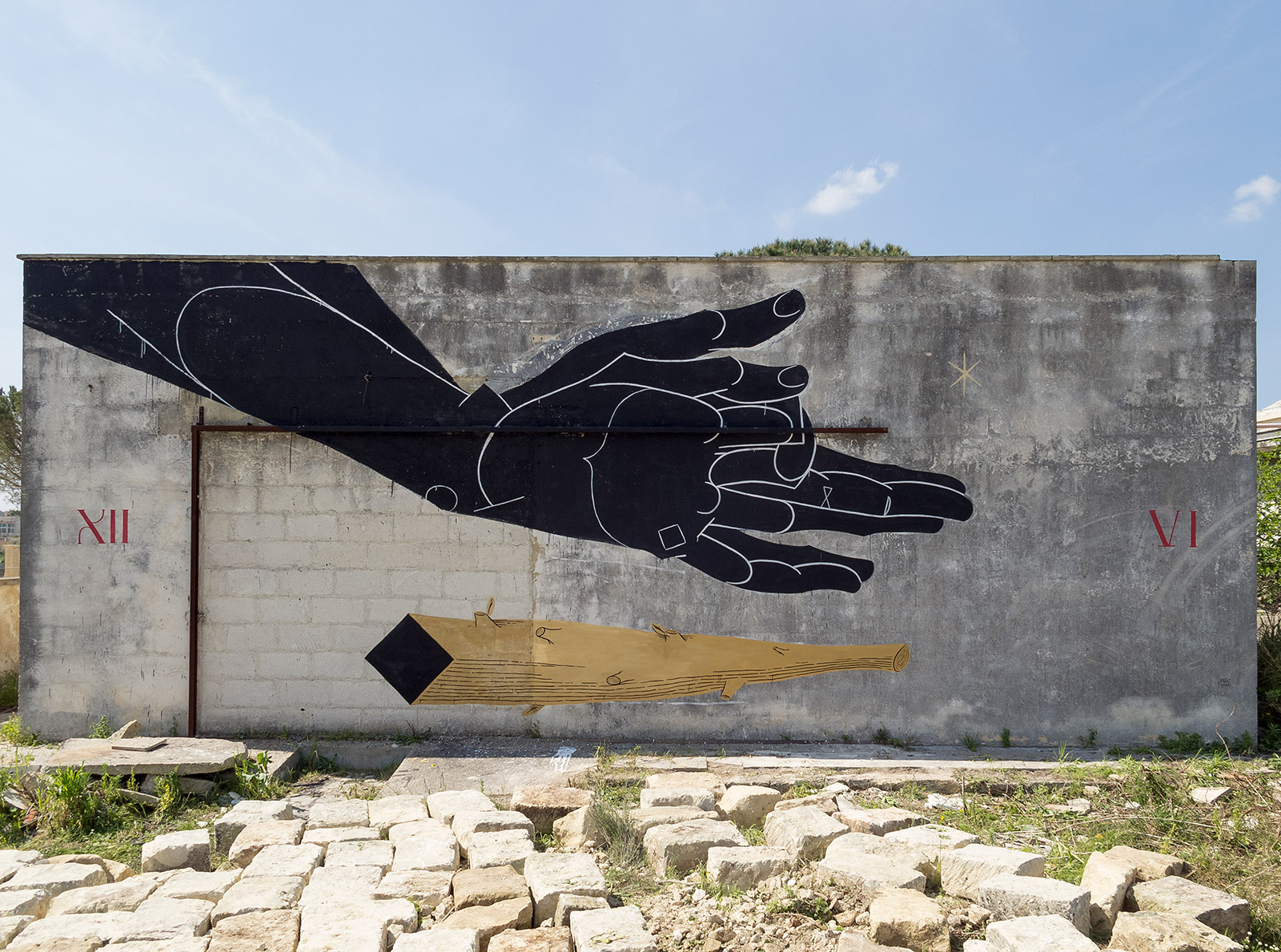
Two black hands casting the shadow of a wolf serve as reminders for the famous Rome’s she-wolf featured in Racale’s seal, probably due to Eraclio, a roman freedman who founded the town.
XII and VI numbers symbolize the twin brothers Romulus and Remus, who, according to Rome’s foundation myth, asked the Gods for a sign to claim the right of foundation of the city. Romulus saw twelve auspicious vultures, while Remus just six.
As a second theory about the genesis of Racale suggests that a Heracles’ worship site was once built in the very same area of the town during greek occupation, the olive club at the bottom of the painting refers to the legend of the divine hero’s slay of the Nemean Lion, in which an eradicated olive tree was used by Heracles as a weapon against the monster. The region surrounding Racale is in fact filled with olive trees.
XII and VI numbers symbolize the twin brothers Romulus and Remus, who, according to Rome’s foundation myth, asked the Gods for a sign to claim the right of foundation of the city. Romulus saw twelve auspicious vultures, while Remus just six.
As a second theory about the genesis of Racale suggests that a Heracles’ worship site was once built in the very same area of the town during greek occupation, the olive club at the bottom of the painting refers to the legend of the divine hero’s slay of the Nemean Lion, in which an eradicated olive tree was used by Heracles as a weapon against the monster. The region surrounding Racale is in fact filled with olive trees.