

The Throw
Chiesanuova, San Marino Republic 2025
Chiesanuova, San Marino Republic 2025
Piece made for BuoneNove festival.
Inspired by a story involving St. Marino and St. Leo, who both crossed the Adriatic sea from Dalmatia to Rimini to work as stonemasons for the Roman Empire.
Legend has it that once they respectively moved to the nearby mount Titano and mount Feltro (the actual areas of San Marino and San Leo), they threw each other work tools from one mount to the other.
Inspired by a story involving St. Marino and St. Leo, who both crossed the Adriatic sea from Dalmatia to Rimini to work as stonemasons for the Roman Empire.
Legend has it that once they respectively moved to the nearby mount Titano and mount Feltro (the actual areas of San Marino and San Leo), they threw each other work tools from one mount to the other.

Spectrum Vitae: Successive/Complementary
Falciano, San Marino Republic 2025
Falciano, San Marino Republic 2025
The title of the artwork expresses a synthesis of scientific rigor and inspirational depth. Spectrum Vitae evokes the color wheel, a symbol of continuity, transformation, and interconnection. Each color represents a phase or nuance of human and natural experience where science and art meet. The term spectrum emphasizes the scientific dimension of the project, linked to light and color theory, while vitae universally refers to life itself, constantly evolving and transforming.
Successive/Complementary adds a dynamic interpretive layer by highlighting the natural transition between phases (successive) and the harmonious balance between opposing yet interdependent elements (complementary). These scientific and philosophical concepts are expressed through the color wheel supported between two hands.
The artwork conveys a message of connection and continuity, where every transition is both an ending and a new beginning. The hands symbolize humanity and collaboration, bridging what has been and what will be in a continuous process of growth and discovery.
Ultimately, the viewer is invited to reflect on how science, nature, and creativity intertwine throughout life’s journey, maintaining a balance between progress and complementarity, between what we inherit and what we create together.
Successive/Complementary adds a dynamic interpretive layer by highlighting the natural transition between phases (successive) and the harmonious balance between opposing yet interdependent elements (complementary). These scientific and philosophical concepts are expressed through the color wheel supported between two hands.
The artwork conveys a message of connection and continuity, where every transition is both an ending and a new beginning. The hands symbolize humanity and collaboration, bridging what has been and what will be in a continuous process of growth and discovery.
Ultimately, the viewer is invited to reflect on how science, nature, and creativity intertwine throughout life’s journey, maintaining a balance between progress and complementarity, between what we inherit and what we create together.
The Unboxing
Covo, Italy 2024
Covo, Italy 2024
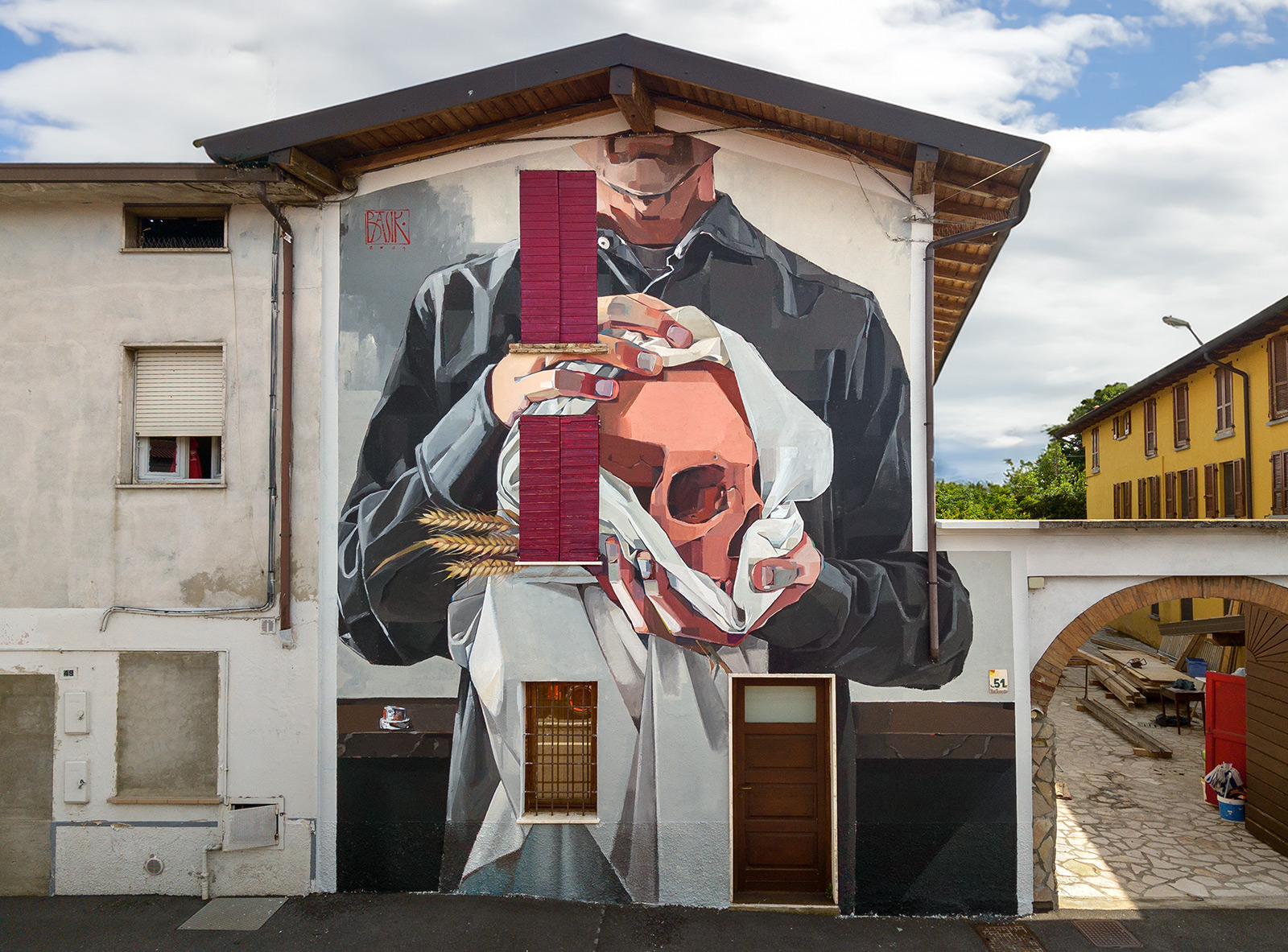
Having as its focal point the depiction of the relic of St. Lazarus kept in town of Covo, the work mixes the setting characteristics of a vanitas with a half-length figure in the act of unboxing the remains of the local patron saint.
Completing the composition are three ears of wheat, reminding the town's heraldry, and a fatcap set in the background, symbolizing the author's artistic journey.
Just as the painted subject hands seem to gift the relic of St. Lazarus to the viewers, the artist, acting on a deeper interpretational level, aims to the recreate the same gesture by donating the work to Covo and its citizens.
Completing the composition are three ears of wheat, reminding the town's heraldry, and a fatcap set in the background, symbolizing the author's artistic journey.
Just as the painted subject hands seem to gift the relic of St. Lazarus to the viewers, the artist, acting on a deeper interpretational level, aims to the recreate the same gesture by donating the work to Covo and its citizens.


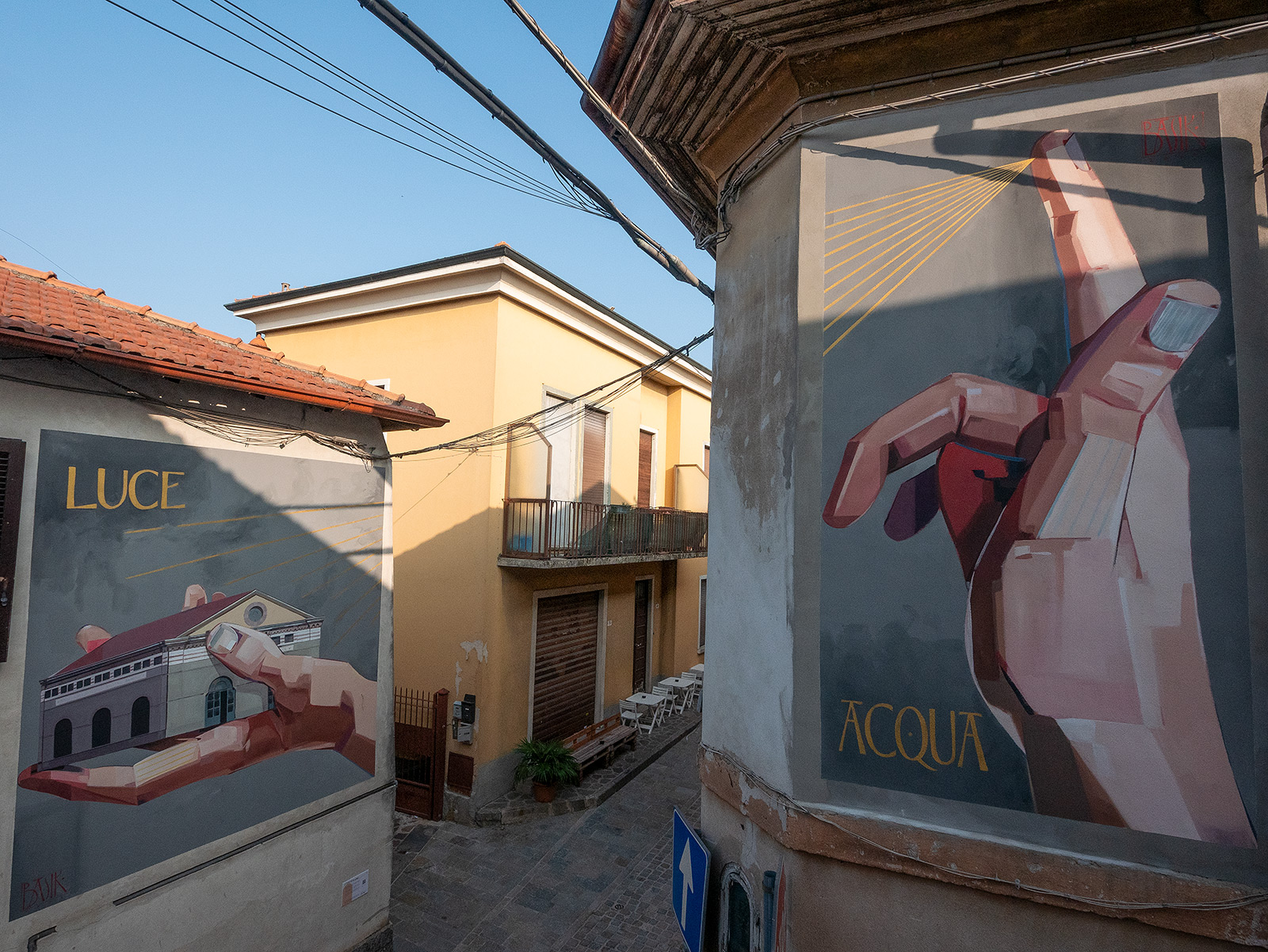
The Dance of St. Michaels
Paderno d’Adda, Italy 2023
Paderno d’Adda, Italy 2023
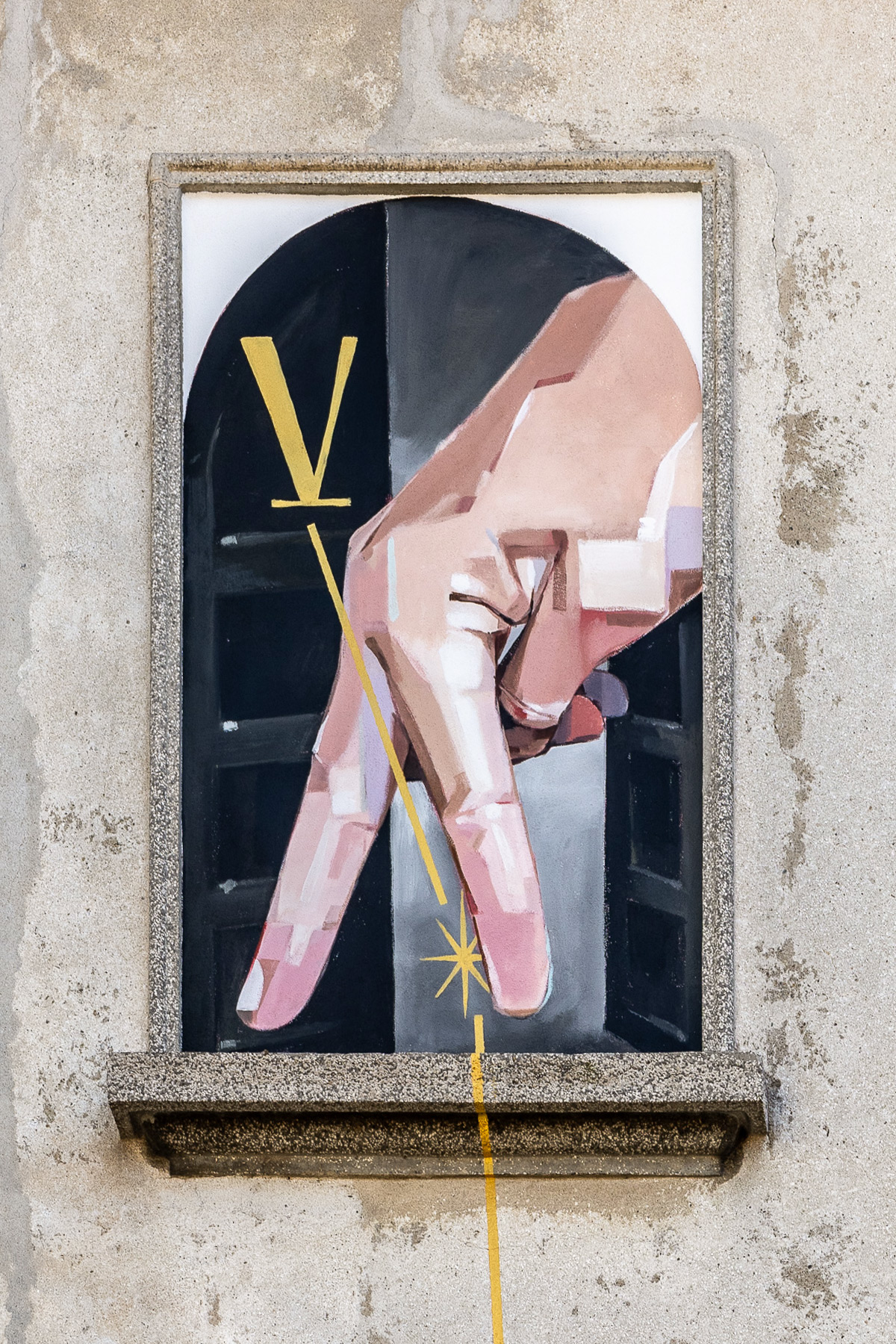
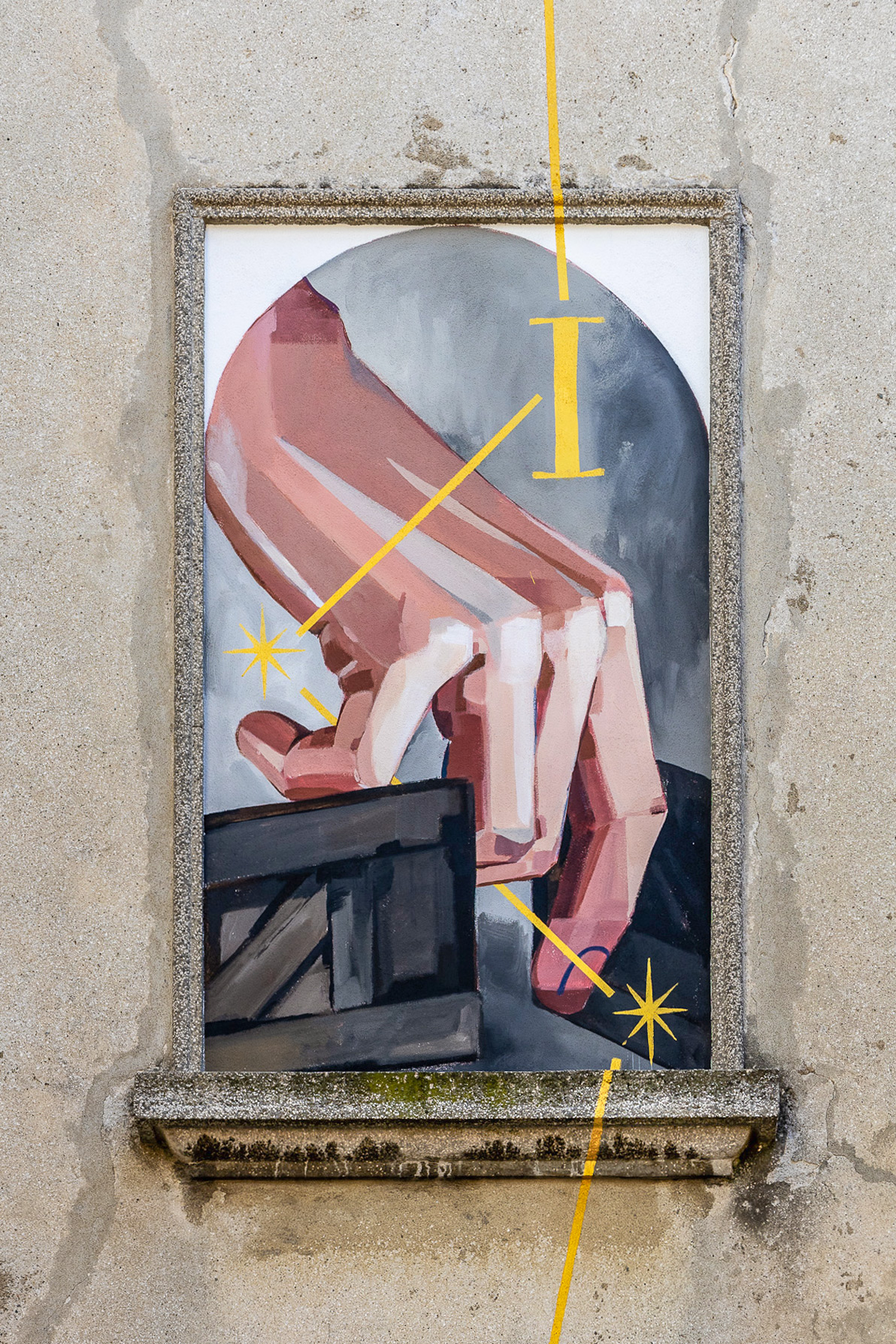
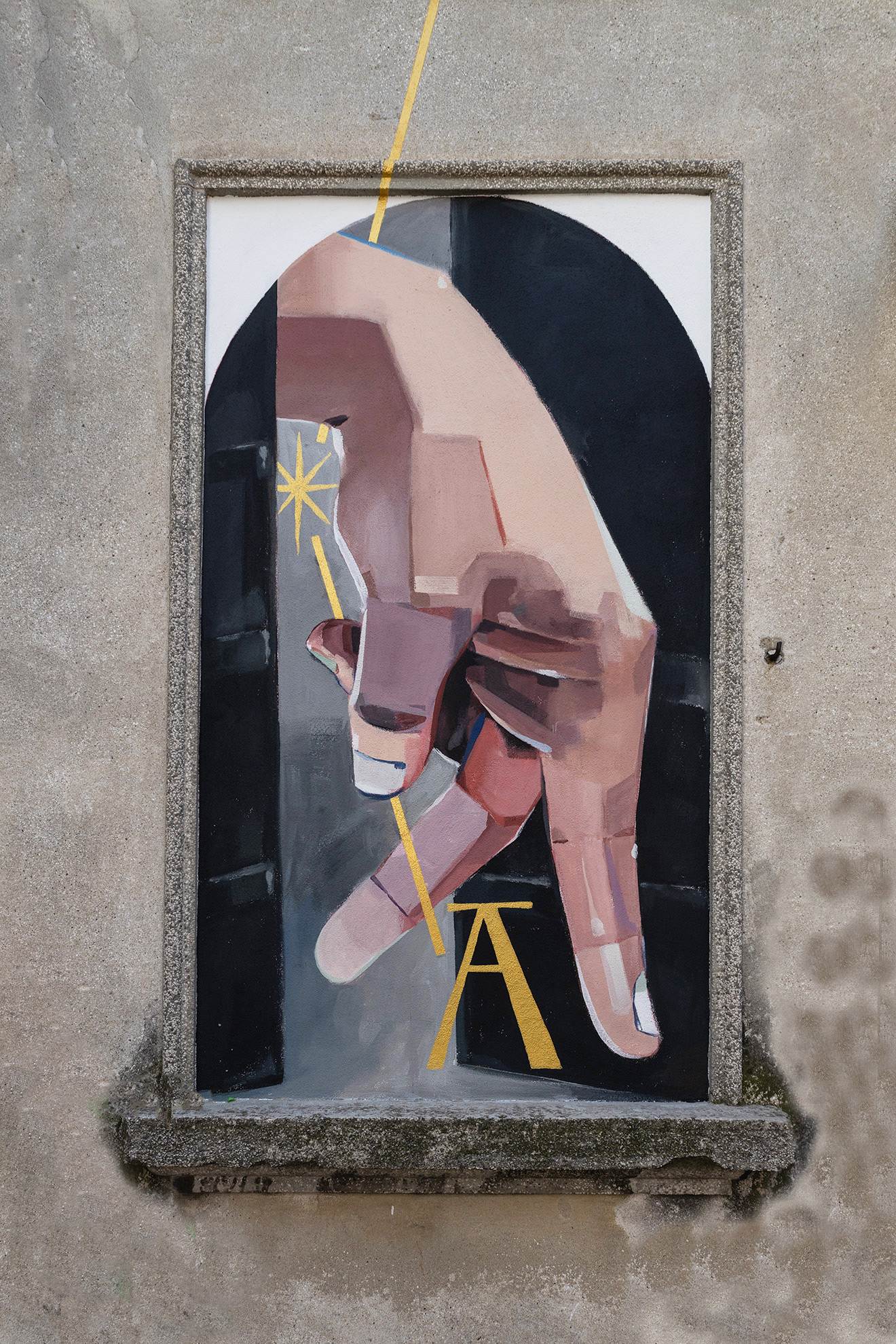
Widespread work painted along Paderno's main road, inspired by the local heritage.
Curated by Annalisa Ferraro.
Curated by Annalisa Ferraro.
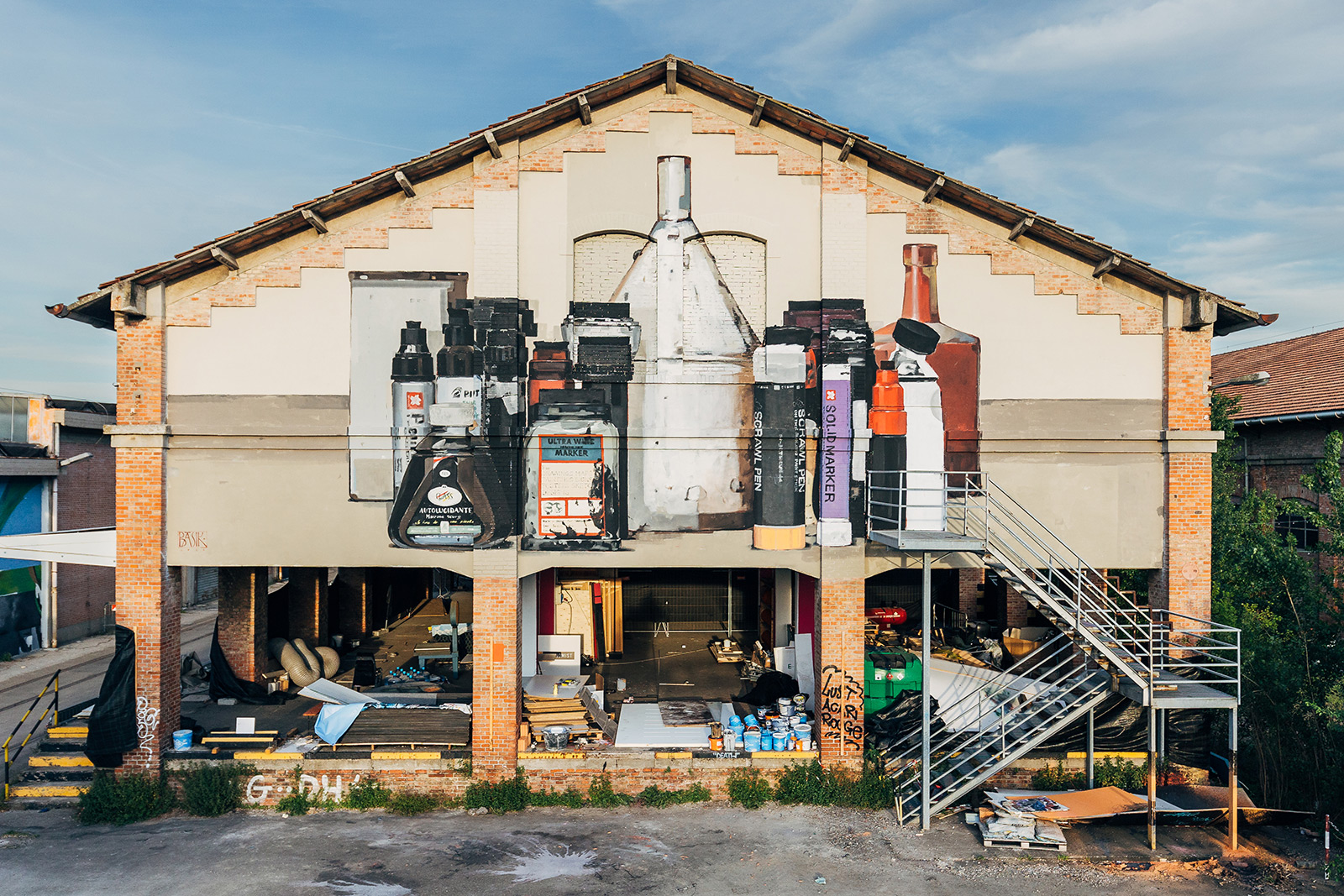
Still Life with Markers
Bologna, Italy 2023
Bologna, Italy 2023
Tribute to the work of Giorgio Morandi for Urbana at Dumbo Space.
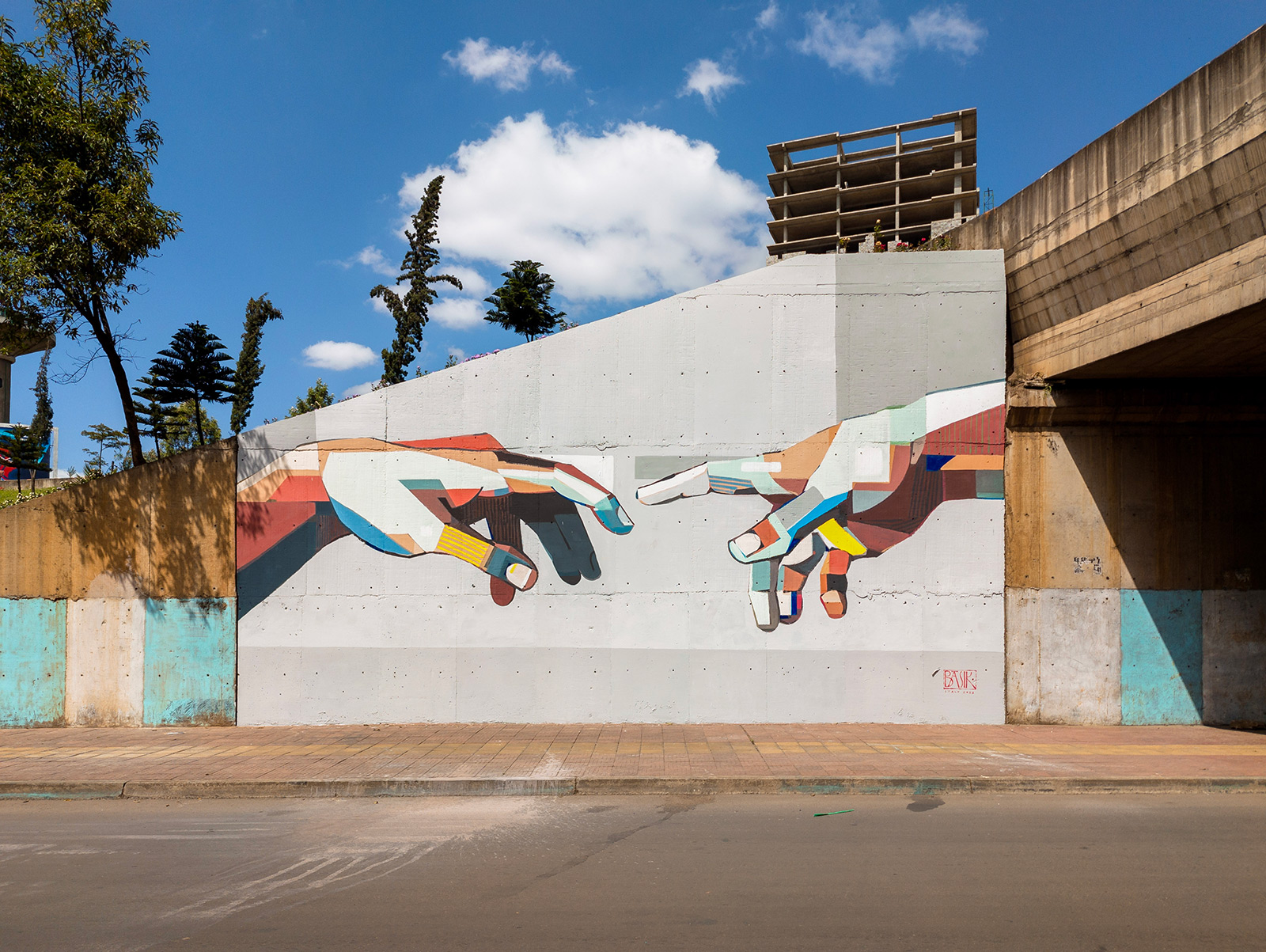
Sixteen Days
Addis Ababa,Ethiopia 2022
Addis Ababa,Ethiopia 2022
Homage to Michelangelo Buonarroti's Creation of Adam, which took sixteen days for its completion.
Mural for Italian Cultural Institute in Addis Ababa, Ethiopia.
Mural for Italian Cultural Institute in Addis Ababa, Ethiopia.
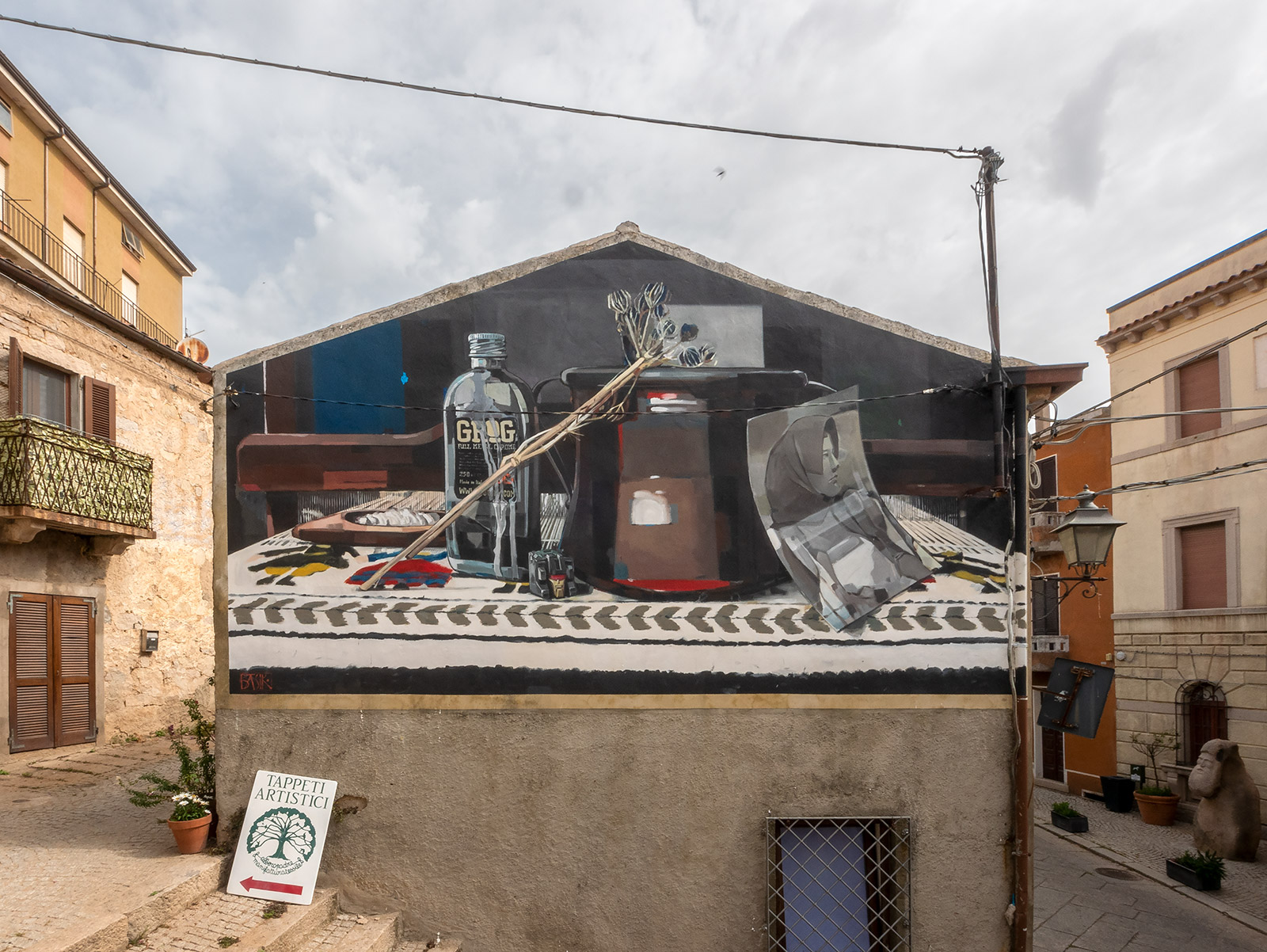
Aggese Still Life
Aggius, Italy 2022
Aggius, Italy 2022
The Aggius area is known for its handmade weaving tradition, as well as the banditry phenomenon, that endured through centuries during Spanish and Savoy rule over the island.
The painting features a carpet in the making, serving both as subject and main environment, and a photo of the female bandit Paola Argiolas. The composition, based on the juxtaposition of tradition and contemporaneity, creates a bond between old and new, a subtle line going from handcraft to banditry, to even marking the urban landscape.
The painting features a carpet in the making, serving both as subject and main environment, and a photo of the female bandit Paola Argiolas. The composition, based on the juxtaposition of tradition and contemporaneity, creates a bond between old and new, a subtle line going from handcraft to banditry, to even marking the urban landscape.

Symbolaria
Bellaria, Italy 2022
Bellaria, Italy 2022
Here the composition binds together two context-related attributes of the town of Bellaria-Igea Marina: on one hand, the sea and the harbor, as well as the jobs and sustaining that such environment have always provided to local people, while on the other hand lies Bellaria's patron, Saint Apollonia, of which tooth and tongs are traditionally defining pictorial traits.
Ostensory representational attempt using context-related elements
Galdo degli Alburni, Italy 2021
Galdo degli Alburni, Italy 2021
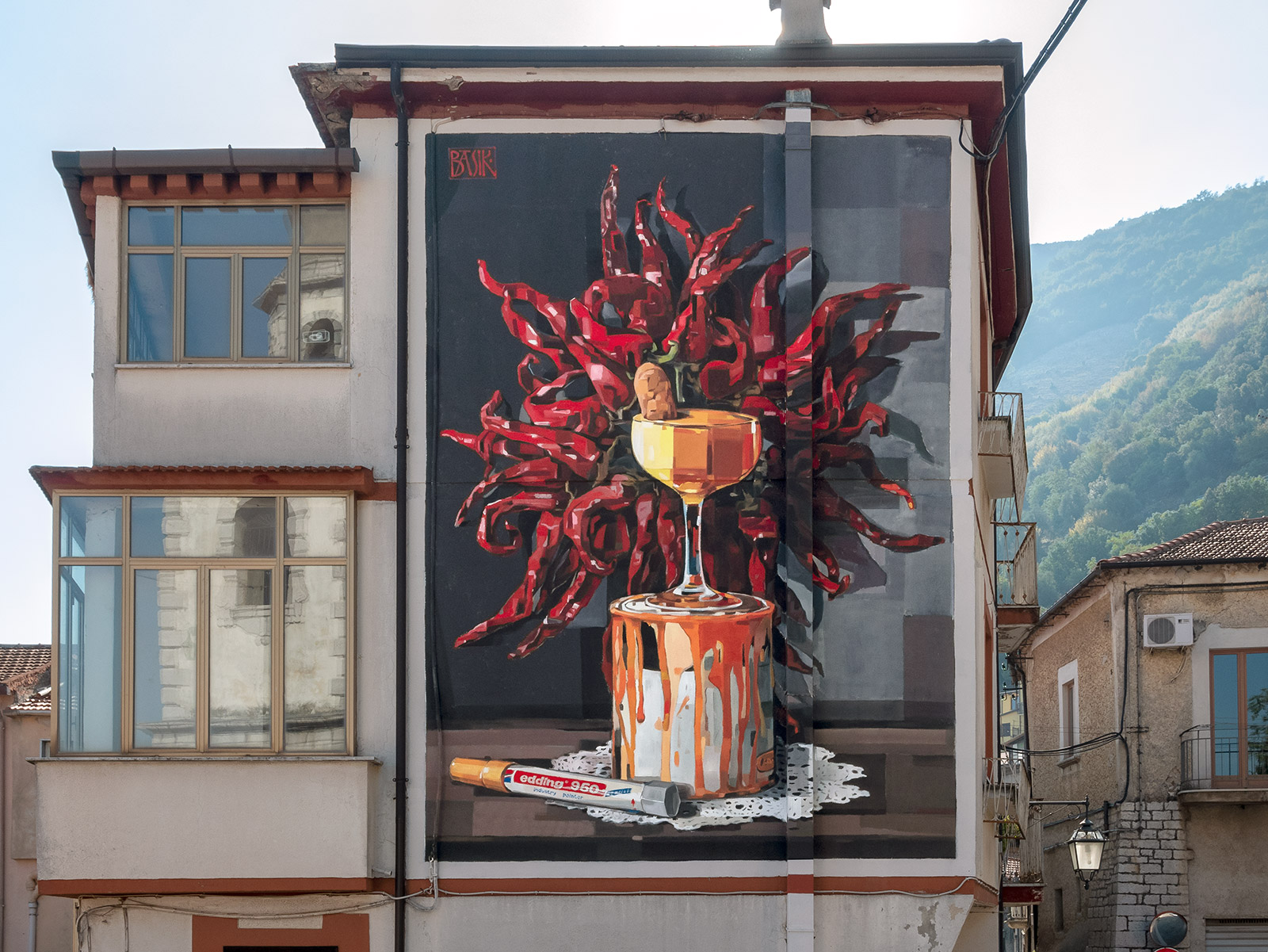
The ostensory-like shape of the composition, as well as the central eggnog glass element are both referred to the iconography of St. Pascal Baylon, saint patron of this tiny town located at the foot of Alburni mountains, in southern Italy.
The area is also renowned for ‘peperoni cruschi’ (lit. crunchy peppers) that crown the composition.
Lying at the bottom, a paint tin and a solid marker, reminiscent of the long experiential journey that brought the artist in Galdo.
Thus, context becomes a key element in the making of the mural, of which the single items are nothing but subtle metaphors of a place and its inhabitants, as well as the lives interacting with such environment and its people, indissolubly intertwined and connected one another to create a single pictorial entity.
The area is also renowned for ‘peperoni cruschi’ (lit. crunchy peppers) that crown the composition.
Lying at the bottom, a paint tin and a solid marker, reminiscent of the long experiential journey that brought the artist in Galdo.
Thus, context becomes a key element in the making of the mural, of which the single items are nothing but subtle metaphors of a place and its inhabitants, as well as the lives interacting with such environment and its people, indissolubly intertwined and connected one another to create a single pictorial entity.
Temporary image of the hand of St. Gregory the Great
Cesena, Italy 2021
Cesena, Italy 2021
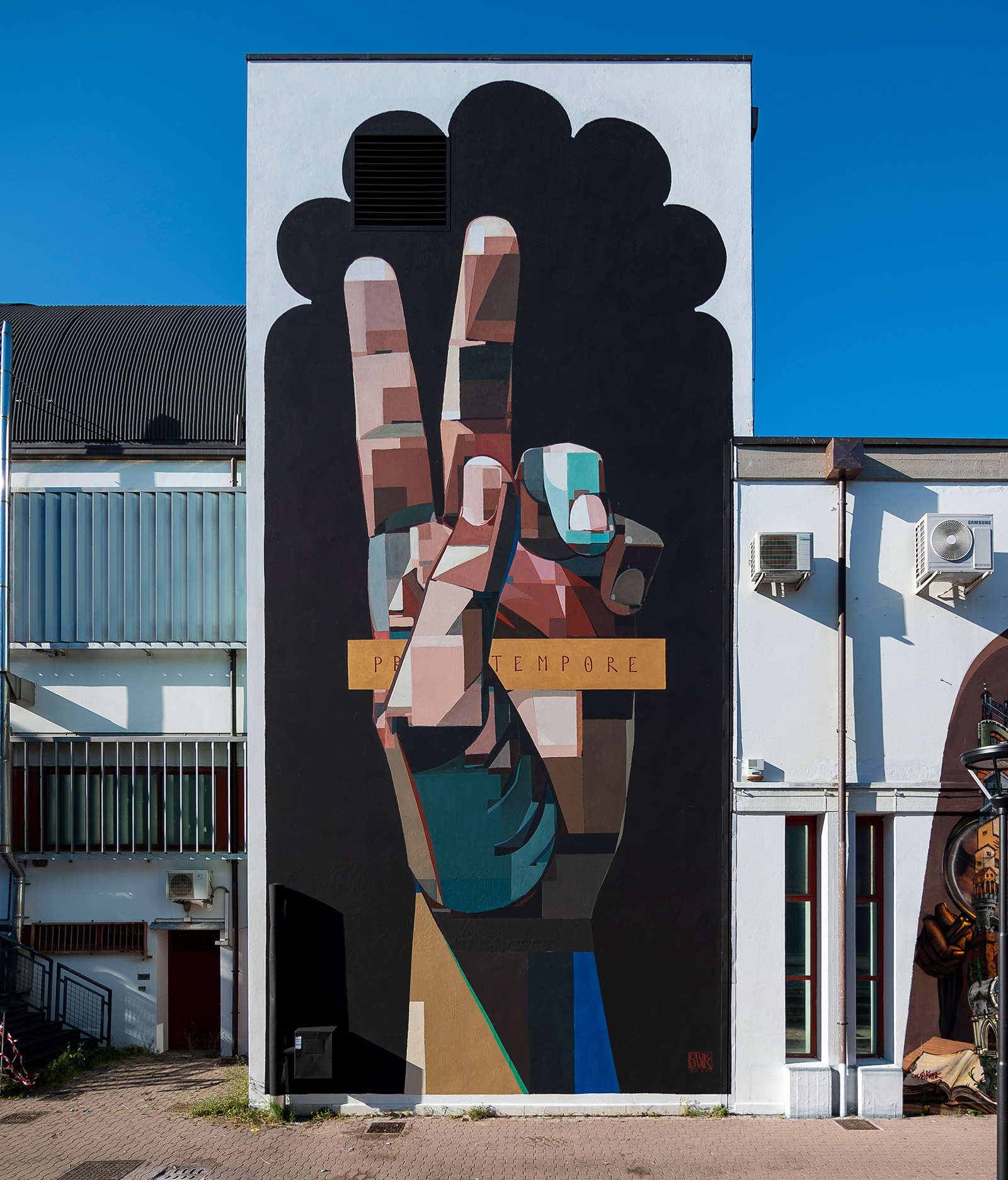
This portrayal of St. Gregory's relic, located in the local cathedral's museum, fully embeds the dichotomy within the act of painting something kept in a container to last as a symbol over the centuries by taking its “image” to the most inhospitable environment such as the streets.
Thus, the idea of preservation and its strength symbolically fade away over the inevitability of time and its effect over matter, even the work of art.
The last act of such operation is represented by this published picture, a relic itself, although digital, which will survive immaculate over the physical work.
Thus, the idea of preservation and its strength symbolically fade away over the inevitability of time and its effect over matter, even the work of art.
The last act of such operation is represented by this published picture, a relic itself, although digital, which will survive immaculate over the physical work.
Still life with a torn portrait of Oliver Plunkett
Dundalk, Ireland 2021
Dundalk, Ireland 2021
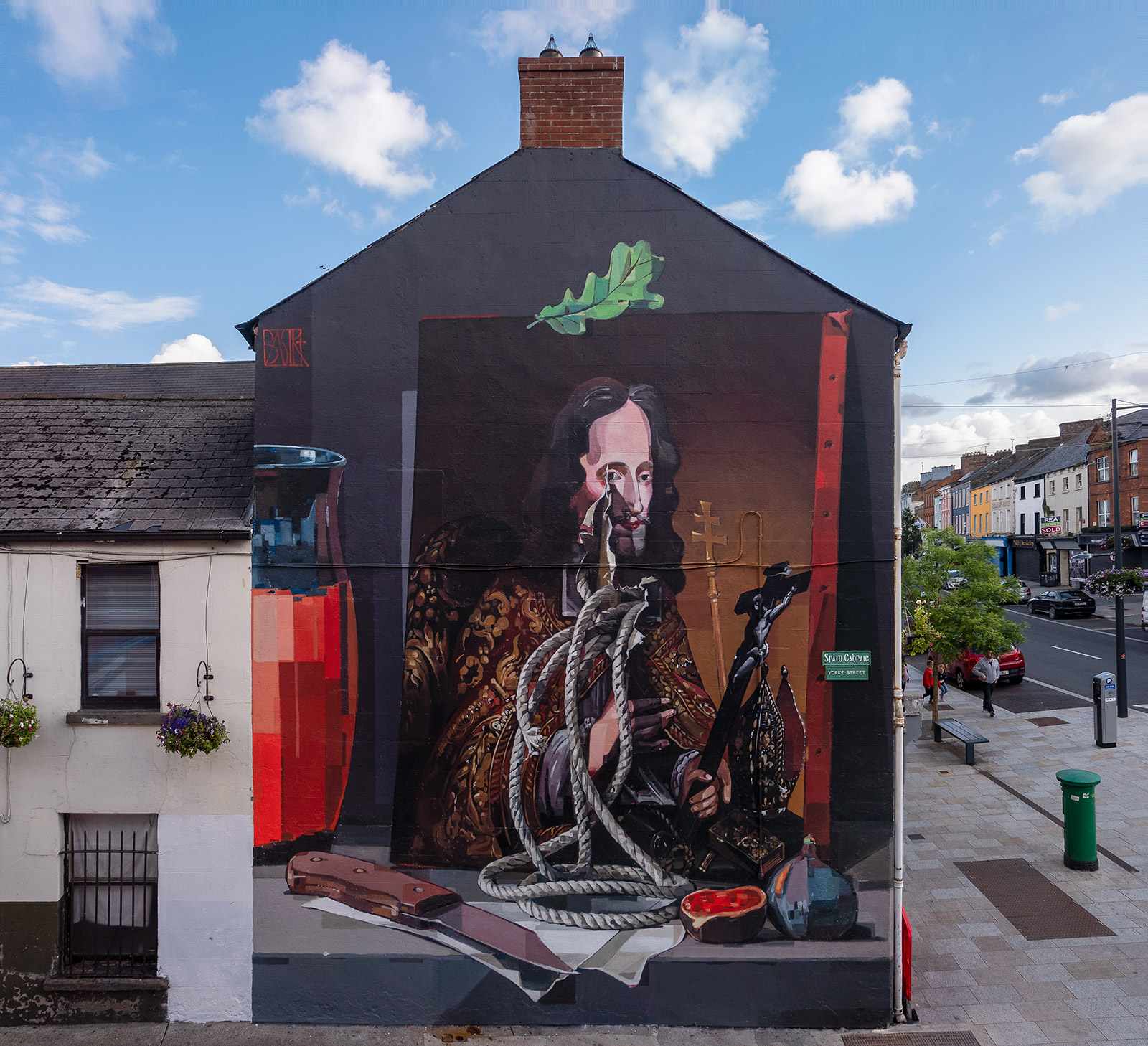
St. Oliver Plunkett was the last Irish to be canonised and last victim of the "Popish plot". He lived and died during Cromwell's conquest of Ireland and was hanged, drawn, and quartered for treason, falsely accused to conspire with French soldiers to invade English lands and “promoting the Roman faith".
The piece faces the building under which Plunkett was detained before being sent to London to face trial and execution.
Edward Luttrell's 17th Century portrait of Plunkett sets the center stage of the still life composition that tells a story of which context is a fundamental trait, as well as using concepts at the core of the vanitas theme (of which the iconoclast approach over Plunkett's canvas could be considered as a variation) such as transience of life and certainty of death to create a parallel to the similar ephemeral characteristic of urban art.
The piece faces the building under which Plunkett was detained before being sent to London to face trial and execution.
Edward Luttrell's 17th Century portrait of Plunkett sets the center stage of the still life composition that tells a story of which context is a fundamental trait, as well as using concepts at the core of the vanitas theme (of which the iconoclast approach over Plunkett's canvas could be considered as a variation) such as transience of life and certainty of death to create a parallel to the similar ephemeral characteristic of urban art.
46 - 3
Pioppe di Salvaro, Italy 2021
Pioppe di Salvaro, Italy 2021
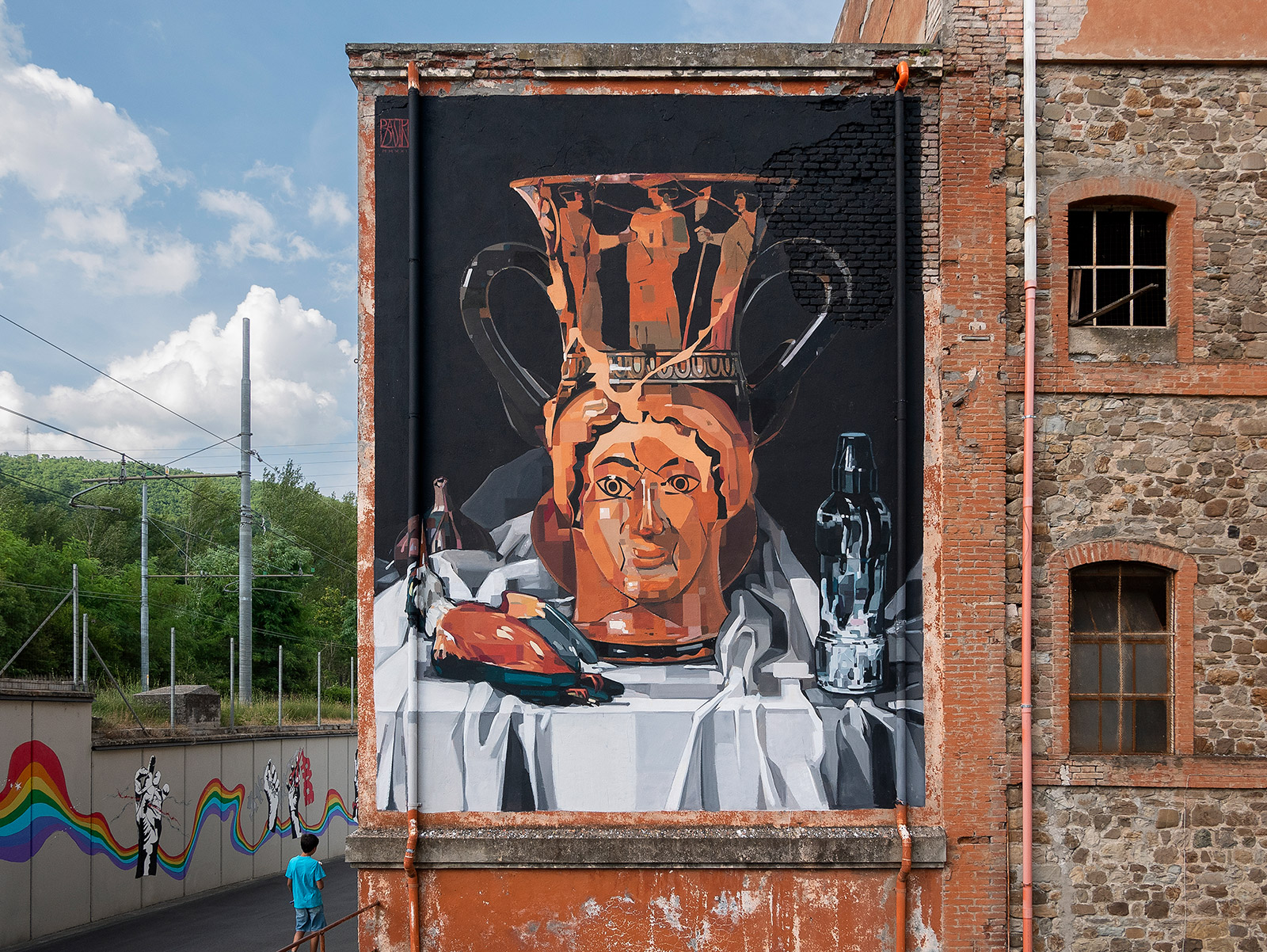
Dedicated to the victims and survivors of the "botte della canapiera massacre", Pioppe di Salvaro, 1 october 1944.
An etruscan janiform kantharos, prominent to the composition, acts as a metaphor of the "botte", a water reservoir adjacent to the old hemp mill located in the town of Pioppe di Salvaro (Bologna), where on the 1st october 1944, fortysix civilians were sentenced to death, shot and dumped in by nazi soldiers.
The ancient cup (that can be found in the nearby etrurian museum) stands nonetheless as a symbol of the local community, both from hystorical and contemporary perspectives, of which cracks and patches could be seen as the result of the brutality of war, while a kingfisher's thanatosis is referred to the three civilians who were the only survivors of the massacre.
An etruscan janiform kantharos, prominent to the composition, acts as a metaphor of the "botte", a water reservoir adjacent to the old hemp mill located in the town of Pioppe di Salvaro (Bologna), where on the 1st october 1944, fortysix civilians were sentenced to death, shot and dumped in by nazi soldiers.
The ancient cup (that can be found in the nearby etrurian museum) stands nonetheless as a symbol of the local community, both from hystorical and contemporary perspectives, of which cracks and patches could be seen as the result of the brutality of war, while a kingfisher's thanatosis is referred to the three civilians who were the only survivors of the massacre.

Verginese still life (subscribe to Premium to remove chimney from the picture)
Portomaggiore, Italy 2021
Portomaggiore, Italy 2021
A still life paying homage to the surrounding Verginese area, composed of a central sculpture by Roberto Melli, an early 1900s ferrarese artist, part of the “Scuola Romana”; a hand of saint patron Charles Borromeo; a pomegranate fruit and a typical local delicacy: the salama da sugo.
The building's chimney, intentionally left unpainted, splits the painting in two, impeding the full view of the original picture as it was virtually intended and, as a byproduct of such spatial role, becomes part of the composition itself.
The building's chimney, intentionally left unpainted, splits the painting in two, impeding the full view of the original picture as it was virtually intended and, as a byproduct of such spatial role, becomes part of the composition itself.